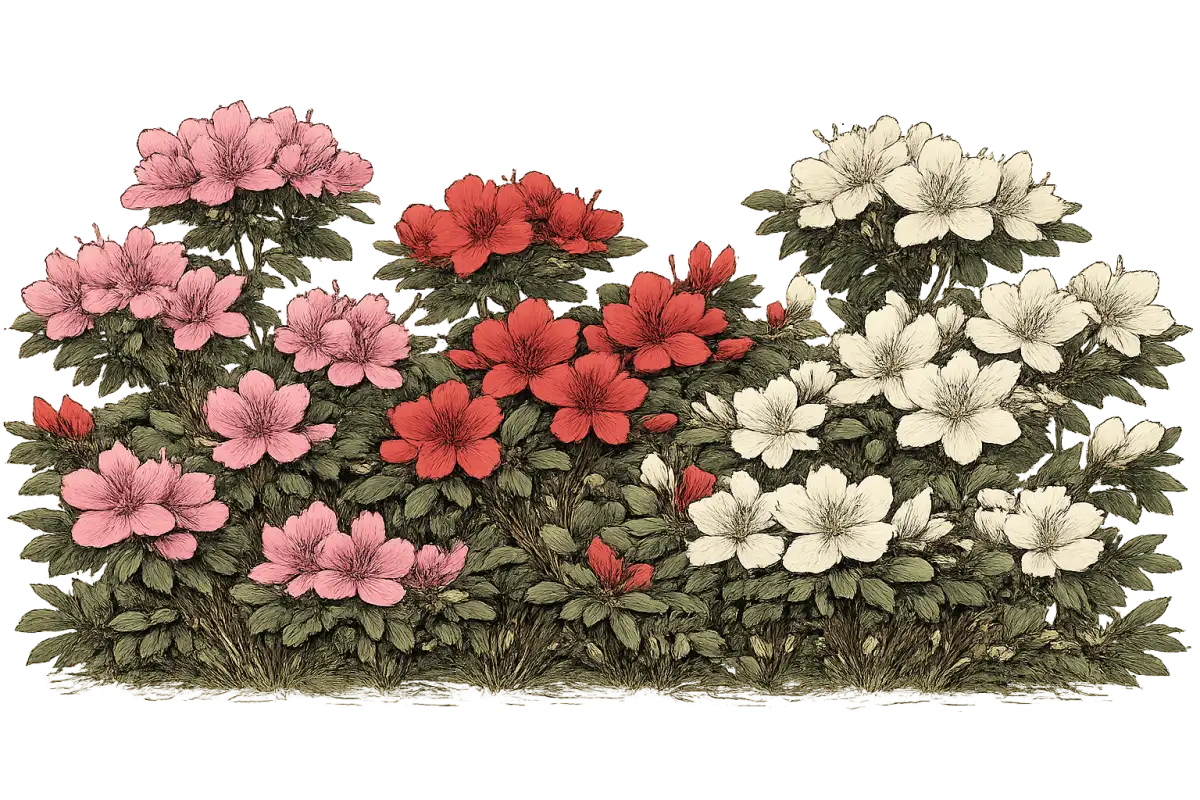
Cold Zones (3–4): Deciduous Natives and Northern Lights Only
In zones 3 and 4, the cold eliminates nearly every evergreen azalea from serious consideration. The exception to that blanket rule is the Northern Lights Series, developed by the University of Minnesota specifically for the northern US and Canada. These are deciduous hybrids of native North American species, and they are among the most cold-tolerant azaleas in existence — rated reliably to zone 3.
Mandarin Lights delivers vivid orange flowers on plants reaching 5–6 feet. Rosy Lights blooms deep rose-pink with notable fragrance at the same size. Golden Lights softens the palette with soft yellow flowers at 4–5 feet, and White Lights offers white blooms with a yellow blotch and pleasant fragrance. One of the practical advantages of these varieties in cold zones is their bloom timing — late spring flowering in May and June, after the worst frost risk has passed at northern latitudes.
Beyond the Northern Lights series, native deciduous species are outstanding cold-zone choices that most gardeners overlook entirely. Rhododendron canadense, the Rhodora, is a purple-pink bloomer rated to zone 3 and thrives where almost nothing else grows. R. prinophyllum, the Roseshell Azalea, blooms pink with an unusual clove fragrance and is hardy to zone 3 as well.
Zone 5: Transitional — Getting the Conditions Right
Zone 5 opens up the Northern Lights varieties reliably, and adventurous gardeners can attempt the hardiest evergreen types in protected microclimates. Girard Hybrids — bred in Ohio specifically for improved cold tolerance — are the most dependable evergreen option here, rated for zones 5–8. 'Stewartstonian', a red compact grower, is listed at zones 4b–8 and has a track record in zone 5 when sited thoughtfully away from prevailing winter winds.
Zone 5 is also where one of the most spectacular native shrubs in North America becomes reliable: R. calendulaceum, the Flame Azalea. Blooming in orange, yellow, and red — often all three on the same plant — it grows 4–8 feet and is rated zones 5–7. If you have not grown it, you are missing something genuinely extraordinary.
Zones 6–7: The Sweet Spot — Widest Selection Available
Zones 6 and 7 are the core of azalea country in America. Evergreen types become fully reliable, deciduous natives continue to excel, and two specific groups deserve attention here because they changed what gardeners could realistically expect from the genus.
Encore Azaleas are the reblooming breakthrough — hybrids of Kurume and Southern Indica types that bloom in spring, rebloom in summer, and flower again in fall. Traditional azaleas give you 2–3 weeks of spring color and then 49 weeks of foliage. Encore Azaleas give you months. They are compact at 3–4 feet tall and 4 feet wide, hardy from zones 6–10, and available in over 30 named varieties. Autumn Empress blooms bright pink. Autumn Embers is red. Autumn Angel is white. Autumn Royalty produces purple flowers that are genuinely striking in fall when most shrubs have gone quiet.
Glenn Dale Hybrids were developed by the USDA specifically to combine large flowers with cold hardiness — a combination that was previously difficult to achieve. Mid-size plants at 4–6 feet, they bloom in late spring and bridge the timing gap between early and late azalea season. Hundreds of named varieties exist.
Kurume Hybrids are the compact workhorses of foundation planting — 2–4 feet tall, covered in masses of small flowers. Hino Crimson delivers bright red in a very compact 2–3 foot frame. Coral Bells blooms soft pink at the same size. Snow provides clean white. These are the plants you see massed in front of older homes across the Mid-Atlantic states, looking precisely as good today as they did twenty years ago when someone planted them right.
For deciduous natives in this zone range, R. calendulaceum and R. arborescens (the Sweet Azalea, white-flowered, fragrant, and reaching 8–15 feet) are both outstanding. R. viscosum, the Swamp Azalea, blooms white in late season and is one of the few azaleas that tolerates wetter soil — a genuinely useful trait for difficult sites.
Zones 7–8: Southern Transition — Where Size Becomes a Factor
Zone 7 and warmer is where Southern Indica Hybrids become fully reliable — and where their size demands respect. These are the large landscape azaleas of the American South: Formosa at 6–10 feet of intense magenta-purple, intensely vigorous and among the most widely planted shrubs in the Southeast. George Lindley Tabor at 6–8 feet with light orchid-pink flowers and a deeper blotch. Mrs. G.G. Gerbing at 6–8 feet of pure white. Fielder's White, very popular for its clean white flowers with a faint pink tinge.
These plants are beautiful. They are also significantly larger than what most homeowners expect when they bring them home from the nursery. A Formosa planted against a house foundation will need aggressive pruning within five years and will be in a constant battle with the structure within ten. Match the variety to the space, not to the flower color you fell in love with at the garden center.
Satsuki and Gumpo Hybrids solve the size problem elegantly: low, spreading plants at 2–3 feet tall with late-season bloom in May and June, excellent for ground cover use and front-of-border positions. Gumpo White and Gumpo Pink are the standards of this group — reliable, well-behaved, and widely proven in zones 6–9.
Robin Hill Hybrids are less well-known but deserve more attention in zones 7–9. Late-blooming with large flowers and mid-size plants, they fill a gap in the azalea calendar when other types have finished.
Zones 8–9: Gulf Coast and Deep South
The heat and humidity of the Gulf Coast favor the largest-growing evergreen types. Winter cold is rarely a limiting factor here; summer heat tolerance becomes the primary concern, and Southern Indica is built for exactly these conditions.
Formosa is among the most widely planted shrubs in coastal Georgia, South Carolina, Alabama, Mississippi, Louisiana, and East Texas — for good reason. It handles the heat, the humidity, and the occasional hard freeze that reaches these zones. Kurume types provide a compact alternative where Southern Indica's eventual scale is a problem.
Encore Azaleas reach their full potential in this zone range. Along the Gulf Coast in zones 8b–9, they can produce flowers for 6–8 months of the year — their longest season anywhere in the country. In the rest of the country, an azalea is a spring event. In zone 9, an Encore Azalea is a landscape feature for most of the year.
Zone 10: Narrow Options
Zone 10 — South Florida, Hawaii, and similar truly tropical climates — pushes most azalea varieties past their limits. The absence of adequate winter chilling hours is the core problem. Options narrow to the most heat-tolerant Southern Indica cultivars and certain tropical species. Container growing with controlled soil conditions is often more reliable than in-ground planting in true zone 10. This is the one zone where I would recommend consulting a local nursery specialist before committing to any specific variety.
Quick Reference: Best Bets by Zone
| Zone Group | Top Evergreen Picks | Top Deciduous Picks | Notes |
|---|
| 3–4 | None reliable | Northern Lights series, Rhodora | UMN-bred extreme cold hardiness |
| 5 | Girard Hybrids, Stewartstonian | Northern Lights, Flame Azalea | Protected sites only for evergreens |
| 6–7 | Encore, Glenn Dale, Kurume | Flame Azalea, Sweet Azalea | Widest selection; core azalea country |
| 7–8 | Encore, Southern Indica, Gumpo | Native species | Watch mature size of Southern Indica |
| 8–9 | Southern Indica, Kurume, Encore | Native species | Encore provides up to 8 months of bloom |
| 10 | Heat-tolerant Southern Indica | Few options | Containers often more reliable |
Choosing the Right Site: Light, Drainage, and Neighbors
Site selection determines more about long-term azalea success than any other single factor. You can correct soil chemistry over time. You can adjust watering practices. You cannot easily move a five-year-old azalea that has been in the wrong spot.
Light: The Partial Shade Principle
The rule is simple and worth repeating: morning sun with afternoon shade. East-facing sites are nearly ideal. The plant gets enough light to bloom well and build energy reserves, but avoids the intense heat of afternoon sun that causes leaf scorch and dramatically increases lace bug susceptibility.
The lace bug connection is not a minor detail. Azaleas growing in full sun can have ten times the lace bug population of the same variety growing in appropriate partial shade. Lace bugs are the most significant insect pest of azaleas in the United States, and full-sun planting is the primary reason they become a serious problem. Many gardeners spend years spraying for lace bugs in a planting that would have far fewer lace bugs if it had been sited differently from the start.
Too much shade creates the opposite set of problems: fewer flowers, leggy and open growth habit, and increased disease pressure from poor air circulation. Full shade under a dense conifer is as problematic as full afternoon sun.
Evergreen azaleas — Kurume, Southern Indica, Glenn Dale, Encore — need more shade than deciduous types. Deciduous natives like Flame Azalea tolerate considerably more sun and are better choices for brighter sites. In zones 7 and warmer, even deciduous types benefit from some afternoon shade.
Drainage: The Non-Negotiable
Phytophthora root rot is the most lethal azalea disease, and it is caused entirely by wet, poorly drained soil. A plant in a chronically wet spot will eventually collapse regardless of how well every other care practice is followed. The symptoms look exactly like drought stress — the plant wilts, the gardener waters more, the additional water accelerates the root rot, and the plant dies faster.
If your site holds water after rain, either choose a different location or build raised beds. Raised beds constructed 12–18 inches high with an acid planting mix completely circumvent native soil drainage problems. They also allow precise pH control from day one — which makes them the professional's choice when native soil conditions are difficult.
What Grows Nearby
The best azalea companions share the same acid soil requirement: rhododendrons as the tall background layer, camellias for winter and early spring bloom, mountain laurel for its native evergreen presence, pieris for early-season interest, and blueberries for the edible benefit of identical pH needs. Under high-canopy deciduous trees — oaks, in particular — azaleas find both the dappled shade they prefer and a long-term source of acidifying leaf litter as those oak leaves decompose over the root zone year after year.
Avoid planting beneath shallow-rooted trees like maples. The root competition for water and nutrients in the same soil zone puts azaleas at a consistent disadvantage.
Planting: The Details That Determine Whether You Succeed
The how of planting matters enormously with azaleas, and the most critical detail is one that runs against instinct.
Plant at or slightly above grade. The top of the root ball should be at or just above the surrounding soil surface. Planting even 2–3 inches too deep restricts oxygen to the shallow, fibrous root system and slowly strangles the plant. The decline from excessive planting depth is gradual — it looks like disease or drought, it develops over 1–2 years, and by the time it is obvious something is wrong, the cause is long past and hard to diagnose.
The instinct is to plant deep for stability. Resist it. Mulch provides the stability and moisture retention. Depth is not needed and is harmful.
When to plant: Spring or fall. Avoid summer planting — the heat stresses new transplants and makes establishing adequate moisture genuinely difficult.
Step-by-step:
1. Dig the hole twice as wide as the root ball but no deeper than the root ball itself. Width is what matters for azaleas, not depth.
2. Set the root ball at or just above surrounding soil level. When in doubt, err high.
3. Backfill with a mix of native soil amended with composted pine bark and sphagnum peat moss. Do not use pure peat alone — it repels water badly when it dries out.
4. Firm gently around roots to eliminate air pockets; do not stomp.
5. Water deeply to settle the soil.
6. Apply 2–3 inches of acidic mulch — pine bark or pine needles — across the entire root zone.
7. Keep mulch 2–3 inches away from the main stem to prevent crown rot.
Foundation planting note: If you are planting azaleas as a foundation planting — and azaleas are one of the classic American foundation plants — account for mature size before you plant. Many Southern Indica types will reach 6–10 feet. If that scale is wrong for your house, choose a different series. Gumpo and Kurume types stay compact. Encore Azaleas at 3–4 feet fit foundation situations where larger types would eventually take over. The variety decision and the site decision are inseparable.
Watering: Consistency Over Quantity
Azalea roots are shallow and fibrous — a dense mat concentrated in the top 12 inches of soil, often much shallower. This architecture means the roots can access surface moisture quickly but also exhaust available moisture quickly in summer heat. Consistent moisture is what azaleas need. Not wet. Not dry. Consistent.
The target: 1 inch of water per week during the growing season, from rainfall, irrigation, or both. A simple rain gauge or tuna can placed in the garden tells you exactly how much rain fell and when you need to supplement.
Deep and infrequent beats shallow and frequent. A slow, deep soak that penetrates 10–12 inches encourages roots to grow deeper and access a larger reservoir. Shallow daily sprinkling concentrates roots in the top inch or two and makes the plant progressively more vulnerable to drought — the opposite of what you want. Drip irrigation or soaker hoses at the root zone are more efficient than overhead sprinklers and keep foliage dry, which reduces disease pressure from petal blight and powdery mildew.
Zone-specific realities: In zones 8–9, summer heat can push demand to 1.5–2 inches per week during heat waves. Learn to read the early warning signs — azaleas roll their leaves inward when drought-stressed. Respond before the plant wilts; consistent moisture prevents far more problems than any recovery watering. In zones 4–5, winter watering may be needed for evergreen types during dry periods before the ground freezes, to prevent root desiccation when frozen soil cuts off water uptake while leaves continue to transpire.
The overwatering trap is real. The symptoms of Phytophthora root rot are indistinguishable from drought stress — the plant wilts, looks depleted, and drops leaves. The diagnostic clue is finding wet soil around a wilting plant. If the soil is wet and the plant is wilting, the problem is not drought. Stop watering. Assess drainage. Root rot progresses rapidly once established and has no effective cure. The plant in a chronically wet spot is already on borrowed time regardless of what else you do.
Mulch is the most impactful single thing you can do for azalea water management. A 2–3 inch layer of organic mulch reduces soil moisture evaporation by 50–70% in summer, moderates extreme soil temperature swings that stress shallow roots, suppresses weeds competing for moisture, and — with pine bark or pine needles — provides mild ongoing acidification as it breaks down. It is not optional. It is the tool that makes the shallow root zone manageable.
 Where to Plant