Cold Zones (3-4): New Wood or Nothing
In zones 3 and 4, winter is the boss, and the boss is unforgiving. Bigleaf hydrangeas planted here will live, grow, and never bloom — their buds are killed annually before they can open. The only rational strategy is to plant species that bloom on new wood, so winter bud kill is irrelevant.
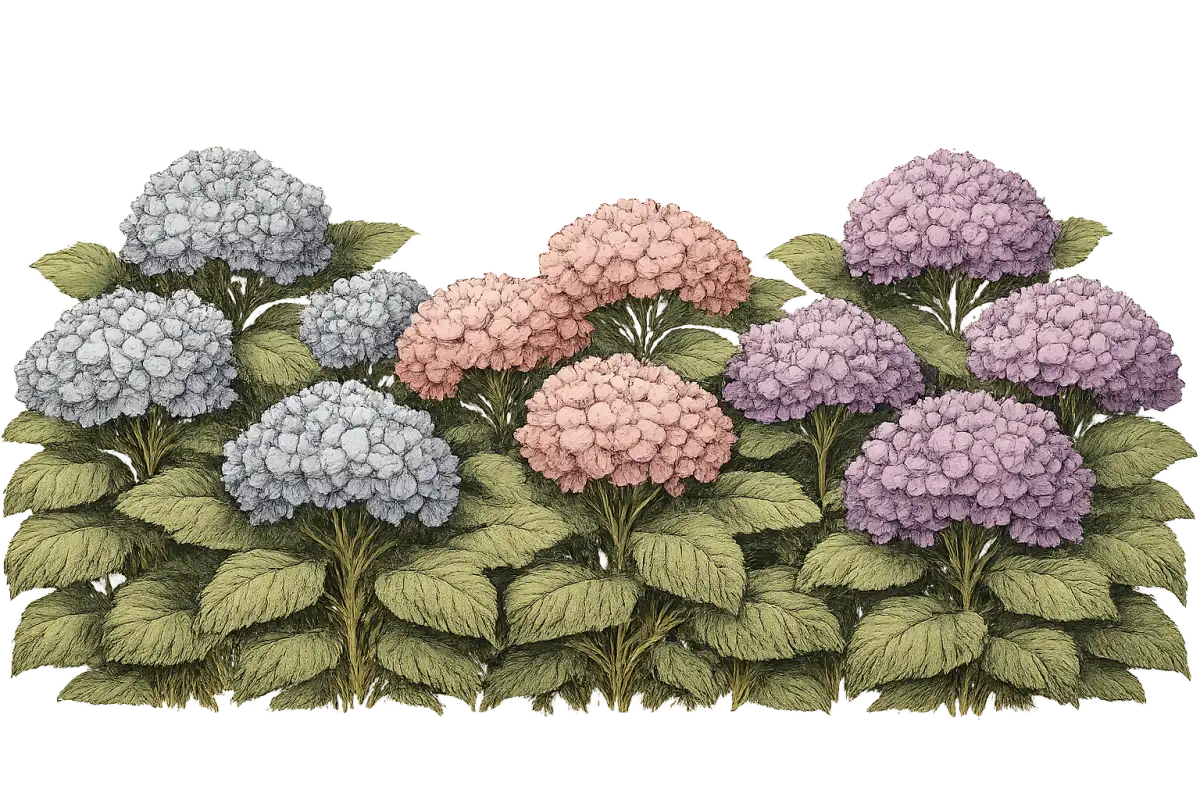
Panicle hydrangeas are your primary option, and fortunately it is an outstanding one. Limelight is the most famous panicle hydrangea in the world — massive lime-green to dusty-pink flower clusters on a 6-8 foot shrub, winner of the Gold Medal award. If you want something more manageable for smaller spaces, Little Lime is a dwarf version that tops out at 3-5 feet with the same beautiful color progression to burgundy-pink in fall. Quick Fire is the earliest blooming panicle, opening white flowers in early summer when other panicles are still preparing — it deepens to deep rose by August. For dramatic fall color, Fire Light produces the strongest red of any panicle variety, transitioning from white through deep red as nights cool.
For something truly compact, Bobo stays at just 3 feet and covers itself so completely in blooms that you can barely see the foliage. Pinky Winky offers a two-toned bicolor effect — older lower florets turn deep pink while the tip of the same cluster remains white — creating a dynamic display through summer and fall.
Smooth hydrangeas give you a different look entirely. Annabelle — the classic white globe — has been a garden standard for decades. Incrediball solved Annabelle's one weakness (flopping under the weight of enormous heads) with stronger stems. For pink lovers, Invincibelle Spirit delivers the Annabelle form in warm pink. And for small spaces, Invincibelle Wee White stays at a remarkable 1-2.5 feet, making it suitable for containers and front-of-border plantings even in zone 3 gardens.
Transition Zones (5-6): Where Variety Selection Becomes Consequential
Zone 5 and 6 are where hydrangea decisions get genuinely interesting — and where the most gardening heartbreak occurs. Every hydrangea type is technically possible here. But "technically possible" and "reliably blooming" are different things, and the gap between them is what trips people up.
Panicle and smooth hydrangeas remain bulletproof. Plant them freely without a second thought. For panicles, Limelight Prime blooms earlier than original Limelight with notably stronger stems, and Zinfin Doll produces what Proven Winners describes as the most vibrant colors of any panicle variety. Strawberry Sundae has the unusual quality of displaying three colors simultaneously on the same plant as different portions of the flower clusters age at different rates.
Bigleaf hydrangeas in zones 5-6 are a different story. UConn Extension is direct about it: bigleaf is "hardy to zone 6, but depending on winter weather and planting location they may not bloom" reliably in zone 5. The flower buds, which formed on last summer's stems, are extremely vulnerable to the combination of cold temperatures, desiccating winter winds, and late spring frosts. A bigleaf in zone 5 can go years between blooming seasons if planted without protection and without the right variety.
The game-changer was the introduction of reblooming bigleaf cultivars. Before the Endless Summer series reached the market in the early 2000s, northern gardeners wanting the blue-or-pink color-changing bigleaf experience essentially had two choices: grow it and accept frequent non-blooming years, or do not grow it at all. Reblooming varieties produce flowers on both old wood (early season) and new wood (approximately six weeks later), so even when winter kills the old-wood buds, the plant still flowers on the current season's growth. This opened bigleaf hydrangea gardening to millions of northern gardeners who had previously given up on it.
For zones 5-6, the reblooming strategy is your primary playbook for bigleaf hydrangeas. Endless Summer The Original is still the most widely planted rebloomer and the one with the longest performance record. BloomStruck offers more vivid color — intense violet-blue or deep rose-pink — with distinctive reddish-purple stems and notably strong flower support. Summer Crush is the most compact of the Endless Summer line (18-36 inches wide), making it appropriate for smaller gardens and container growing. Twist-n-Shout is the lacecap entry in the collection, with a more delicate, open flower structure that pollinators prefer over the sterile mophead forms.
Even with reblooming varieties in zones 5-6, winter protection of the old-wood buds is worthwhile — it gives you more total flowers. Without protection you get the new-wood flush; with protection you get both flushes. The difference between a plant with one round of blooms and one with two is substantial in a garden.
Oakleaf hydrangeas are possible in zone 5 but need sheltered placement. UConn notes "likely flower bud injury" at zone 5's limit. Site them on south-facing exposures protected from prevailing winds. Ruby Slippers (compact at 3-4 feet, white flowers aging to ruby red, excellent mahogany fall color) and Snow Queen are the best choices for zone 5 planting.
Standard Zones (6-7): The Full Range Opens Up
Zones 6 and 7 are where hydrangea diversity really opens up. All six types thrive here with proper siting, and the gardener's job shifts from "which types can survive" to "which types serve this spot best."
Bigleaf hydrangeas bloom reliably in zone 6 with reasonable winter protection, and in zone 7 without any protection at all. The full catalog of bigleaf varieties becomes available: the deep blue Nikko Blue (a reliable classic), Penny Mac (a proven rebloomer), and the unusual Ayesha with its cupped petals that resemble lilac florets. For lacecap lovers, Blue Wave delivers rich blue with a delicate flat-top structure. Glowing Embers produces 8-inch heads in reddish pink to crimson.
Oakleaf hydrangeas hit their stride in zones 6-7. If you have never grown one, consider this your encouragement to start. The large species forms — Alice reaches 10-12 feet with massive flower heads — are structural anchors for large borders. Snow Queen is more restrained at 6-8 feet with notably upright flower panicles and outstanding fall color. Ruby Slippers at 3-4 feet suits smaller gardens without sacrificing the four-season appeal.
Climbing hydrangea establishes well in zones 6-7. Give it a north- or east-facing wall, something rough enough for aerial roots to grip, and two or three years of patience. Once established, it is self-sufficient and spectacular.
Warm Zones (8-9): Shade Becomes Your Primary Tool
In zones 8 and 9, every hydrangea type can technically grow. The challenge is heat, not cold. Afternoon sun in these zones does things to bigleaf and smooth hydrangeas that gardeners from cooler climates find shocking — wilted, scorched, brown-edged leaves by 3:00 in the afternoon, and flower heads that bleach out and look spent within a week of opening.
The fix is afternoon shade, and it is not optional in these zones for most hydrangea types. Morning sun — ideally east-facing exposure — is fine and necessary for good bloom. Afternoon shade is imperative for bigleaf, smooth, and mountain types. Panicle hydrangeas tolerate more sun than the others but still perform better with some afternoon protection in zones 8-9.
Oakleaf hydrangeas are the heat champions of the genus in this zone range. They are native to the Southeast, from North Carolina south to Florida, which means they evolved in the very conditions that stress the other types. They tolerate more sun, handle more drought once established, and still deliver spectacular fall color even in warm climates. Snow Queen, Alice, Ruby Slippers, Snowflake (a double-flowering form with layered florets), and Munchkin (a compact 3-footer with dark pink blooms) are the top choices for southern gardens.
Water demand increases substantially in zones 8-9. Plan for 1-2 inches of water per week minimum, which means supplemental irrigation is nearly always required in summer. Mulch heavily — 3-4 inches — to retain moisture and moderate soil temperature around shallow root systems.
One panicle-specific note for the warmest parts of this zone range: the white-to-pink color development that makes panicle hydrangeas so appealing may be reduced when nighttime temperatures consistently stay above 70°F. The color shift is temperature-driven. Warm nights mean less dramatic fall color on panicle varieties.
Quick Reference: Top Picks by Zone Group
| Zone Group | Top 3 Varieties | Type | Why |
|---|
| 3-4 | Limelight, Quick Fire, Incrediball | Panicle / Smooth | New-wood bloomers; bulletproof cold hardiness |
| 5-6 | BloomStruck, Limelight Prime, Snow Queen | Reblooming Bigleaf / Panicle / Oakleaf | Rebloomer insurance + reliable performers |
| 6-7 | Nikko Blue, Twist-n-Shout, Ruby Slippers | Bigleaf / Bigleaf / Oakleaf | Full variety opens; four-season interest |
| 7-8 | Snow Queen, Fire Light, BloomStruck | Oakleaf / Panicle / Bigleaf | Heat-tolerant leads; afternoon shade required |
| 8-9 | Alice, Limelight, Endless Summer The Original | Oakleaf / Panicle / Bigleaf | Native heat champion + reliable performers |
Planting: The Decisions That Are Hardest to Undo
I have moved enough shrubs for clients — at considerable expense — to have strong feelings about planting mistakes. Most of them come down to two things: wrong sun exposure and insufficient attention to mature size. Both are correctable before you dig the hole. Neither is easy to fix three years later.
Site by type, not by aesthetics alone. Panicle hydrangeas want full sun in zones 3-6 and tolerate part shade; they are the only type that actively prefers a sunny southern exposure in northern gardens. Bigleaf and mountain types want morning sun with afternoon shade — at minimum 4 hours of sun daily for good bloom, but shielded from the harshest afternoon angle. In zones 7 and warmer, afternoon shade for bigleaf is not a preference but a requirement. Climbing hydrangeas go on north- and east-facing walls where most other shrubs will not bloom at all.
As Proven Winners puts it: "Most people think of hydrangeas as shade plants, but they look and flower best with at least 4 hours of morning sun." UConn Extension recommends 6-8 hours of sun daily for maximum bloom. The key is which hours.
Plant in spring after last frost, or in early fall with at least 6 weeks before first frost. Avoid summer planting — the heat stress on a newly disturbed root system is brutal and unnecessary.
Soil preparation matters more than most gardeners realize. The ideal is loam — good water retention with good drainage. Proven Winners is blunt: hydrangeas "will not tolerate wet feet — ever." If your soil is heavy clay, incorporate gypsum (5-15 pounds per 100 square feet) to break it up, and work in compost. One important caution from Proven Winners for panicle hydrangeas in clay soil: do not heavily amend only the planting hole itself. Heavily amended soil surrounded by dense clay acts like a bathtub — water fills the amended zone and cannot escape, and roots rot. Either amend broadly across the bed or plant slightly high.
If your soil is sandy, incorporate peat moss and compost for moisture retention — sandy soil gives you nothing to hold water near shallow roots.
Dig the hole 2-3 times wider than the root ball, but no deeper. This is important. The top of the root ball should sit at or very slightly above grade (1 inch above is fine, to allow for settling). The crown — the base of the stems where they meet the roots — must be level with the ground. Too high and the roots dry out; too deep and the crown rots and the plant may fail to bloom.
Loosen any circling roots before planting. Use native soil for backfill — do not create a heavily amended pocket surrounded by native soil. Water thoroughly immediately after planting and do not fertilize at planting time, which can burn new, undeveloped roots.
Mulch immediately. Apply 2-3 inches of shredded bark, keeping it a few inches back from the stems. In cold zones 5-6, increase to 4-6 inches for winter protection of shallow root zones. Mulch is not optional — it moderates soil temperature, retains moisture, and suppresses weeds that compete aggressively with shallow-rooted shrubs.
Space for mature size, not for how the plant looks in the ground today. Bigleaf hydrangeas want 3-6 feet between plants. Panicle and oakleaf types need 6-8 feet. Planting closer might look more finished in year one, but you will be thinning, transplanting, or simply managing the resulting competition within three to five years. The rule of thumb: space plants to barely touch at full maturity, leaving enough gap for air circulation.
Watering: More Consistent Than You Think, More Specific Than You Know
The genus name Hydrangea comes from the Greek for "water vessel," and the plants take the name seriously. Consistent moisture is non-negotiable for all six types, though there are meaningful differences in demand.
The standard target is 1 inch of water per week under normal conditions, increasing to 2 inches per week during hot, dry weather — a figure that comes directly from UConn Extension. Deliver that water in deep sessions two or three times per week rather than light daily sprinkling. Deep watering encourages roots to grow downward; surface sprinkling keeps roots shallow and makes the plant more vulnerable to both drought and temperature swings.
Drip irrigation or soaker hoses are the right tool. They deliver water directly to the root zone, keep foliage dry (reducing disease risk from leaf spot and powdery mildew), and prevent the kind of inconsistent surface moisture that stresses these plants. Overhead sprinklers are the alternative that creates the most problems — wet foliage sitting overnight is an invitation to fungal disease.
Newly planted hydrangeas need water every 2-3 days for the first one to two years while they establish. Once established, adjust for rainfall and pull back during cool, wet periods. Overwatering is genuinely more dangerous than underwatering, because it causes root rot — and root rot produces wilting that looks exactly like drought stress. A gardener who sees wilting and adds more water to a soggy root zone is accelerating the plant's death.
Here is the diagnostic that saves plants: check the soil before you water a wilting hydrangea. Wet soil plus wilting means root damage, not drought. Dry soil plus wilting means the plant needs water. These look identical above ground but require opposite responses.
Afternoon wilt on bigleaf hydrangeas is normal and not a crisis. The large, thin leaves transpire water faster than roots can replace it when temperatures exceed 85°F. If the plant droops by mid-afternoon but recovers by the following morning, your watering is correct. Do not add more water. UConn Extension warns, though, that continuous wilting — the kind that persists into evening and the next morning — stresses plants and reduces the following year's flower buds. Adequate and consistent watering is not just about keeping the plant alive. It protects next season's blooms.
Pruning: The Right Action at the Wrong Time Ruins Everything
Pruning is where more good intentions go wrong than anywhere else in hydrangea care. The rules are completely different depending on the type you have, and applying the wrong rule is worse than not pruning at all.
For bigleaf, mountain, oakleaf, and climbing hydrangeas (old-wood bloomers), there are only two acceptable pruning windows. The primary window is immediately after flowering in summer — July and August — before the plant sets next season's buds. The secondary window is early spring, but only for removing clearly dead wood, and only after waiting until buds visibly swell (typically April) so you can distinguish dead stems from dormant live ones.
The spring dead-wood assessment deserves more attention than most guides give it. Scrape the bark lightly on each stem. Green interior means alive. Brown interior means dead. Make cuts a quarter-inch above the first set of live buds on each stem. Remove entirely dead stems flush to the ground. And when in doubt, leave it — erring toward less removal on old-wood bloomers is always the right instinct.
The pruning calendar is straightforward: from September through March, old-wood bloomers should not be touched. Not in fall, not in winter, not in early spring. This is where the classic mistake happens. A well-meaning gardener or a landscaper who does not differentiate between plant types cuts the bigleaf back in October to "tidy it up" or in March because it "looks dead." Every stem cut in those months is a season's worth of flowers removed.
For panicle and smooth hydrangeas (new-wood bloomers), the window is the opposite: late winter to early spring, before new growth emerges. February or March in most zones. These types can be cut hard — panicle hydrangeas respond well to being cut back to a framework of 4-6 main stems at 12-18 inches above ground. Smooth hydrangeas can be cut as low as 6 inches. An important caveat from the pruning guides: do not cut smooth hydrangeas all the way to the ground — leave at least 18-24 inches of existing stem structure. Stems that regrow from close-to-ground cuts are long, thin, and inevitably flop under the weight of those enormous flower heads. Incrediball is meaningfully more stem-sturdy than the original Annabelle, which matters if you like cutting back hard.
For reblooming bigleaf varieties, the rule is: do as little as possible. Deadhead spent flowers during the season to encourage continued new-wood blooming. Remove clearly dead wood in spring. Do not prune after August — that removes buds already forming for next spring's old-wood flush. Aggressive pruning of rebloomers eliminates the early-season old-wood flowers entirely and leaves you with only the later new-wood bloom.
One piece of guidance from Proven Winners is worth quoting directly: hydrangeas generally do not need pruning if they are properly sited. If you chose a variety whose mature size fits the location, you only need to remove spent flowers and dead wood. Choosing compact varieties eliminates most pruning needs. The desire to prune heavily often traces back to a plant that was too large for its location — a problem solved more effectively at the nursery than with the shears.
Feeding Without Overdoing It: Why Less Nitrogen Is More Flowers
The most common fertilization mistake with hydrangeas has nothing to do with forgetting to fertilize. It is fertilizing too much — specifically, with too much nitrogen — and ending up with a plant that is impressively leafy, structurally lush, and almost flowerless.
Nitrogen drives vegetative growth: leaves, stems, new shoots. Phosphorus drives reproductive growth: flowers and roots. Hydrangeas fed heavily with high-nitrogen fertilizers — especially gardeners who allow lawn fertilizer runoff to reach their shrubs — tend to produce dense, dark green canopies with dramatically reduced bloom. If your hydrangea grows vigorously and looks healthy but flowers sparsely, excess nitrogen is the most likely explanation.
Use a slow-release, balanced fertilizer — a rose fertilizer at 15-10-10 or 10-5-5, or a balanced 10-10-10, or the 5-10-10 slow-release formulation recommended by UConn Extension. Higher phosphorus (the middle number) supports flower production. Apply around the drip line — the outer edge of the canopy — not against the trunk, and water thoroughly before and after.
The schedule that works across most situations: one application in early spring when leaves emerge, one in early May to support flower development, and a final application in late June or early July. Reblooming varieties that produce multiple flushes of new-wood flowers can be fed monthly from early spring through late July to fuel that sustained production.
The non-negotiable cutoff is August 15. No fertilizer after mid-August, full stop. Late feeding stimulates new, tender growth that cannot harden off before winter arrives, leaving it vulnerable to cold damage. For old-wood bloomers, it also risks interfering with the bud-setting process that determines next year's blooms.
Oakleaf hydrangeas are notably light feeders. They often perform beautifully with nothing more than an annual compost application. Panicle hydrangeas are similarly forgiving but Proven Winners specifically advises limiting fertilizer to early spring only — excessive nitrogen creates the weak, floppy stems that plagued earlier panicle varieties.
Do not fertilize newly planted hydrangeas. Wait until you see established new growth before feeding. Fertilizer on fresh, undeveloped roots causes burn.
The Color Change Question (And the Myths That Will Waste Your Time)
Turning hydrangeas blue or pink is probably the most discussed topic in hydrangea gardening, and it is also one of the most misunderstood. Let me untangle it before you spend money on amendments that will not work.
Only two species change color based on soil chemistry: bigleaf (H. macrophylla) and mountain (H. serrata). Panicle hydrangeas age from white to pink to red and burgundy — that is genetics and temperature, not pH, and no amount of aluminum sulfate will change it. Smooth hydrangeas go from white to green. Oakleaf goes from white to pink to burgundy. Climbing hydrangeas stay white. If you are trying to turn a panicle or smooth hydrangea blue, you are applying amendments to no effect.
Within the color-changing species, the mechanism is indirect. Soil pH controls the availability of aluminum ions in the soil. When soil is acidic (pH 5.0-5.5), aluminum is soluble and available for the plant to absorb. Once inside the flowers, aluminum ions bind to the anthocyanin pigments — causing the pigment molecules to stack more closely together in a way that reflects blue light. At higher pH (6.5 and above), aluminum is locked in the soil and unavailable to the plant. Without it, the same anthocyanins produce pink.
To shift toward blue: lower soil pH and supply aluminum. Dissolve 1 tablespoon of aluminum sulfate per gallon of water and drench the soil around the plant monthly in March, April, and May. For in-ground plants, you can also broadcast 1 pound (about 2 cups) of aluminum sulfate around the base. Alternatively, broadcast a half-cup of wettable sulfur per 10 square feet in fall and water it in — sulfur lowers pH gradually over winter, making aluminum available by spring.
To shift toward pink: raise pH to block aluminum. Dissolve 1 tablespoon of lime per gallon of water and drench monthly, March through May. Or broadcast 1 cup of dolomitic lime per 10 square feet in fall.
Proven Winners notes that shifting from pink to blue is easier than the reverse. Aluminum sulfate delivers both aluminum ions and acidity in a single product. Going the other direction — from blue to pink — requires raising pH and depleting existing aluminum already in the soil, which takes longer.
Color changes happen gradually. Expect 1-3 full seasons for a complete shift. Amendments affect next season's blooms, not the flowers already open. And the soil naturally drifts back toward its native pH, which means annual maintenance applications are required — this is not a one-time fix.
A few myths worth dismissing quickly: pennies or iron nails do not change flower color (copper and iron are not aluminum). Used coffee grounds have a nearly neutral pH — the acidity went into your coffee, not the grounds. Eggshells dissolve too slowly to meaningfully affect soil pH.
If precise color control is your goal, consider container growing. Container hydrangeas are dramatically easier to color-manage because you control the entire soil volume. There is no surrounding native soil pulling pH back to baseline. Amendments work faster and more completely. Use reduced rates in containers — one-quarter ounce (about half a tablespoon) of aluminum sulfate per gallon of water.
Winter Protection: The Work That Decides Whether Bigleaf Blooms
If you are growing bigleaf or mountain hydrangeas in zones 5 or 6, winter protection is not optional. It is the work that determines whether you get flowers next summer. I have seen gardeners in zone 6 grow Endless Summer for years, get flowers intermittently, and assume the plant was unreliable — when the missing piece was simply protecting those old-wood buds through the winter to add the early-season bloom flush to what new wood was already providing.
What kills buds is a combination of extreme cold (sustained temperatures below -10°F to -15°F), desiccating winter winds that dry out tender bud tissue even at moderate temperatures, late spring frosts that hit after buds have begun to swell during warm spells, and freeze-thaw cycles that damage buds progressively through repeated temperature swings. UMD Extension identifies the late spring frost scenario as particularly common and frustrating — gardeners see promising swelling buds and then a cold snap destroys them.
The most effective protection method is a burlap cage with leaf fill. Drive three or four wooden stakes in a ring around the plant, wrap burlap around the stakes and secure it to form a cage, then fill the cage loosely with dry leaves, straw, or wood chips up to the height of the plant. Leave the top loosely open for airflow to prevent moisture buildup. This method insulates the entire plant — not just the root zone — and is the approach most likely to preserve the old-wood flower buds through harsh winters.
UConn Extension recommends an equivalent approach using wire mesh: surround the plant with a cylindrical chicken-wire enclosure and fill loosely with leaves or mulch. Simpler, still very effective.
Timing matters in both directions. Apply protection after the ground has frozen — too early and you trap moisture and warmth, promoting rot rather than preventing cold damage. Remove protection in spring only after all frost danger has completely passed. The common mistake is removing protection during the first warm spell of March or April, only to have late frost kill the buds that have just begun to swell. UConn offers a practical benchmark: when crocuses flower, it is safe to begin uncovering.
Do not remove stems that look dead through the protective covering in early spring. Wait until new growth appears to assess what actually survived the winter. What appears dead in March may be alive in May.
For reblooming varieties in zones 5-6, winter protection is still worthwhile even though the plants will bloom on new wood regardless. With protection you get both the early old-wood flush and the later new-wood flush. Without protection you get only the later flush. The protected plant will outperform the unprotected one measurably through the season.
Pests and Diseases: Troubleshooting
Most hydrangea problems are diagnosable before you reach for any spray or amendment. The symptoms are fairly consistent, and the causes are usually one of a small handful of things.
No blooms on an otherwise healthy plant is almost always either wrong pruning timing or winter bud kill — the two old-wood-bloomer problems that this guide has returned to repeatedly. Did anyone prune the plant in fall, winter, or early spring? That is cause one. Is it a bigleaf or mountain hydrangea in zone 5 or 6 without winter protection? That is cause two. A third possibility is insufficient light — hydrangeas need at least 4 hours of sun daily. Below that, flowering diminishes or stops. A fourth is excess nitrogen, which produces beautiful foliage at the expense of flowers.
Yellowing leaves with green veins (interveinal chlorosis) on bigleaf hydrangeas almost always signals soil pH that is too high — above 7.0 — which locks up iron and makes it unavailable to the plant. Test the soil pH before adding any amendment. If pH is elevated, lower it with sulfur or aluminum sulfate. General yellowing starting on lower, older leaves suggests overwatering or nitrogen deficiency.
Brown, papery patches on leaves, especially on the afternoon-sun side of the plant, is sunburn. In zones 7 and warmer, afternoon sun on bigleaf hydrangeas causes this reliably. The fix is more shade, not more water. Crispy brown leaf margins often indicate fertilizer or salt burn — water deeply to flush accumulated salts and pull back on feeding rates.
Floppy, weak stems most commonly affect panicle hydrangeas and Annabelle smooth hydrangeas. The causes are insufficient sun (less than 4 hours), excessive nitrogen fertilizer, or pruning that creates very long, thin new growth. For smooth hydrangeas, this is why leaving stems at 18-24 inches rather than cutting to the ground matters — existing stem structure supports the new growth. Choosing Limelight Prime or Incrediball over more prone varieties also helps considerably.
Persistent wilting despite moist soil is a root rot warning. Stop watering immediately, check drainage, and let the root zone dry before reassessing. If the problem has progressed, the plant may need to be dug up, rotten roots trimmed, and replanted into properly draining soil.
 Where to Plant