Cold Zones (3-4): A Longer-Lived Garden Than You Think
If you garden in the upper Midwest, northern Great Plains, or northern New England, you may have been told that your options are limited. With hostas, the opposite is true. The cold hardiness of these plants is genuinely remarkable — they need no winter protection in zones 3 or 4, and snow cover acts as natural insulation for dormant crowns.
The real constraint in cold zones is time, not cold. A shorter growing season means giant varieties take longer to reach full size. Empress Wu — the largest hosta in common cultivation, capable of reaching four feet tall and six feet across — may take five to seven years to develop its full presence in zone 3. Be patient. It will get there.
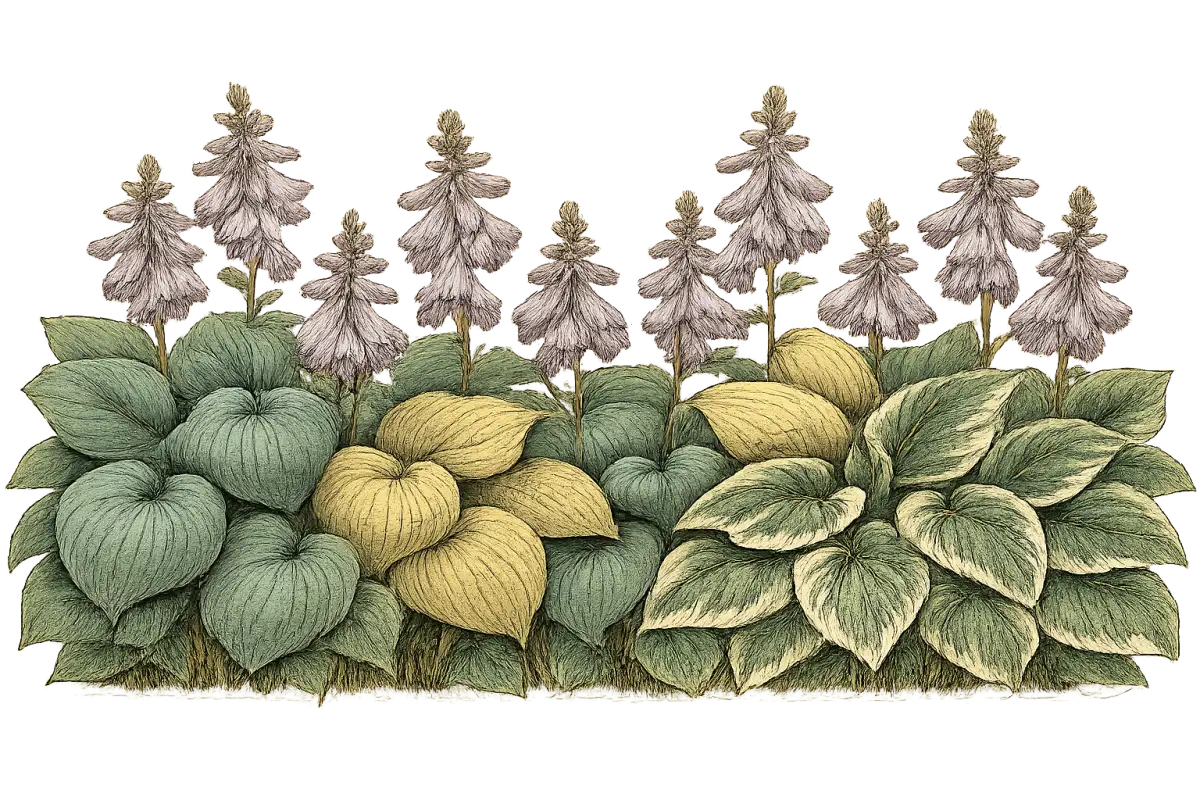
For immediate impact, Halcyon is the backbone plant for northern shade gardens. Its medium-sized blue leaves have heavy substance and exceptional slug resistance, and it performs as reliably as any hosta you can grow. Pair it with Blue Mouse Ears at path edges — the tiny, almost perfectly round leaves of this miniature variety are intensely thick and waxy, giving it remarkable slug resistance while providing a delicate scale contrast against Halcyon's broader form.
For gold color, Sum and Substance is indispensable. Its enormous chartreuse-gold leaves brighten dark corners and tolerate morning sun, making it useful in spots where most other hostas would struggle. It is also one of the most slug-resistant large hostas available.
For classic variegation, Patriot and Francee are the reliable workhorses — dark green leaves with crisp white edges that read beautifully against woodland plantings.
In cold zones, morning sun exposure is far more forgiving than in southern regions. You have real latitude to experiment with placements that would scorch plants in zone 7.
Middle Zones (5-6): The Sweet Spot for Hosta Growing
Zone 5 and 6 represent the ideal hosta climate: growing seasons long enough for giants to develop fully, summers cool enough for blue varieties to hold their color, and winters cold enough to provide the dormancy period these plants actually need.
If you are in the Great Lakes region, central New England, the Mid-Atlantic, or similar latitudes, you have access to essentially the full catalog.
Build the garden in layers. At path edges and along the front of beds, plant miniatures and small varieties: Blue Mouse Ears for thick blue texture, Pandora's Box for tiny white-centered contrast in containers or fairy garden settings, June for its extraordinary blue-gold variegation that shifts in color depending on light and season. June is one of the most visually sophisticated hostas available and consistently ranks as among the most popular varieties worldwide — not because it is easy (though it is), but because its coloring is genuinely beautiful.
In the middle layer: Halcyon for blue, Gold Standard for gold (give it morning sun to develop color), Fire and Ice for striking white-center variegation, Patriot for classic edging.
For the back of borders and specimen placements: Sagae, with its vase-shaped form and blue-green leaves edged in cream, makes one of the finest large hostas for formal gardens. Great Expectations offers thick, slug-resistant substance with a creamy center. And Empress Wu as a focal point specimen is simply unmatched — nothing in the shade garden creates the same sense of drama and scale.
In zone 6, begin thinking about afternoon sun protection for blue varieties. The season runs warm enough that even a few hours of afternoon exposure can fade the waxy coating on Blue Angel or Elegans over a summer or two.
Transitional Zone (7): Where Careful Placement Becomes Essential
Zone 7 — Virginia, the Carolinas Piedmont, Tennessee, northern Georgia — is where hosta growing requires deliberate attention. Hostas are completely viable here and many gardeners grow stunning collections. But the approach must shift.
Afternoon shade is not optional in zone 7; it is the baseline requirement for every variety you plant. Morning sun only. The soil must stay consistently moist, which means mulching at three to four inches and watering two to three times per week during summer heat. Blue varieties should be reserved for the shadiest spots available — they can still be grown beautifully here, but only with more shade than you would think necessary.
The varieties that genuinely excel in zone 7 are the ones bred for substance and vigor. Sum and Substance is the gold standard for southern shade gardens — its thick leaves resist heat, it tolerates morning sun, and its sheer size makes it a commanding presence. Guacamole is another strong performer: heat-tolerant, fragrant (a significant bonus), and vigorous enough to establish quickly. Royal Standard handles warmth better than almost any other hosta and rewards zone 7 growers with tall, sweetly fragrant white flowers when given enough light to trigger blooming.
Avoid most thin-leaved varieties in zone 7. The delicate foliage of some decorative hostas simply cannot withstand sustained summer heat without burning. And miniature varieties, while charming, dry out too quickly in southern summers to be reliably maintained without constant attention.
Warm Zones (8-9): A Challenge Worth Taking
Zone 8 and 9 represent the outer edge of hosta viability, and it would be dishonest to suggest otherwise. In zone 9, hostas are a challenge plant. Expect some leaf burn by August. Expect them to look less lush than they would in zone 5. Treat the best-looking specimens as a success rather than the baseline.
That said, gardeners in coastal Carolinas, the Gulf Coast, and east Texas do grow hostas successfully — by being selective about variety and surgical about placement.
Site selection in these zones is everything. North-facing beds, courtyard gardens that never receive direct afternoon sun, positions under large deciduous trees with high canopies — these are the spots that make warm-climate hosta growing possible. Container growing offers the added advantage of mobility: you can move plants to deeper shade during heat waves and bring them back when temperatures moderate.
The variety list narrows considerably. Royal Standard and Guacamole lead for fragrant, heat-tolerant large hostas. Sum and Substance remains the best giant option. Fragrant Bouquet is vigorous and warmth-tolerant. Patriot is one of the toughest medium varieties for hot gardens.
Blue hostas are not recommended south of zone 7. The waxy coating that creates their color simply cannot persist through the sustained heat of a zone 8 or 9 summer.
Quick Reference: Top Picks by Zone Group
| Zone Group | Top 3 Varieties | Size | Why |
|---|
| 3-4 | Halcyon, Sum and Substance, Blue Mouse Ears | Med/Giant/Mini | Reliable cold-zone performers; slug-resistant |
| 5-6 | June, Empress Wu, Sagae | Small/Giant/Large | Full catalog available; layer all sizes |
| 7 | Sum and Substance, Guacamole, Royal Standard | Giant/Large/Large | Heat-tolerant; thick substance; vigorous |
| 8-9 | Royal Standard, Fragrant Bouquet, Patriot | Large/Large/Med | Heat-tolerant; tough; green and gold only |
When and How to Plant
Timing by Zone
Spring planting is the gold standard for hostas. A spring-planted hosta has the full growing season to establish its root system before the demands of winter. In zones 3 and 4, plant from mid-May through mid-June once the ground is workable and the risk of hard frost has passed. In zones 5 and 6, mid-April through May is the window. In zone 7, late March through April. In zones 8 and 9, March works well — late October through November for fall planting.
Fall planting is a legitimate second option, provided you give the plant at least six weeks before the first hard frost to settle roots. Avoid midsummer planting in any zone — the heat stress on a newly disturbed root system is severe, and plants established in summer heat often struggle for the remainder of their first season.
Preparing the Soil
Hostas are woodland plants. They evolved in humus-rich forest floor soil — deep, loose, consistently moist, full of decomposed organic matter. The more closely you can replicate that environment, the better your plants will perform.
The single most important amendment for hostas is compost. At planting, dig a hole at least twice the width of the root ball and mix the excavated soil fifty-fifty with finished compost. For genuinely poor soil — heavy clay or very sandy ground — use up to sixty percent compost. This is not excessive. A properly prepared planting hole transforms hosta performance in a way that no other intervention matches.
Most gardeners will not need to adjust soil pH for hostas. The acceptable range is 5.5 to 7.5, and most US garden soil already falls within it. If you garden in the arid Mountain West where soils can reach pH 8.0 or above, or in the desert Southwest where alkaline soil is nearly universal, test before planting. Soil above pH 7.5 will need amendment with sulfur or acidic organic matter. Below pH 5.5, add garden lime. Everywhere else, skip the pH test and invest that energy in your compost amendment instead.
One non-negotiable: never plant in a spot where water puddles after rain. Hostas need consistent moisture, but they absolutely cannot tolerate saturated roots. The path to crown rot — a fungal disease that liquefies the base of the plant — runs directly through waterlogged soil. If your site drains poorly, build raised beds six to eight inches above grade rather than fighting the underlying drainage problem.
The Planting Process
Dig a hole as deep as the root ball and twice as wide. Set the plant at the exact same depth it was growing in the nursery container — the crown (where foliage meets roots) should sit at soil level, not buried beneath it. Backfill with your compost-amended mix, firm gently, and water deeply to settle the soil around the roots.
Mulch immediately after planting. Apply two to three inches of organic mulch — shredded bark, leaf mold, wood chips, or pine needles all work beautifully — and extend it to the drip line of the plant. Leave a one to two inch gap around the crown itself. Mulch piled against the crown creates the warm, moist conditions that invite crown rot and provide ideal slug habitat right at the plant's most vulnerable point.
Space according to mature size, not current nursery pot size. This is where patience is genuinely required. A young Empress Wu looks like a polite little plant in a two-gallon pot. It will eventually occupy a six-foot circle. Planting to mature spacing means the bed looks sparse for one to two years. Fill those gaps with annual shade plants — impatiens, begonias, or coleus — rather than crowding the hostas.
Watering: Morning Timing Is Not Optional
Hostas need one to one and a half inches of water per week in zones 3 through 6, and one and a half to two inches in zones 7 through 9. That is the quantity. But when and how you deliver that water matters just as much as how much.
Water in the morning. This is the single most important watering instruction for hostas, and it is not primarily about plant physiology — it is about pest management. Slugs are nocturnal. They emerge after dark into damp conditions. Soil that is wet at nightfall is slug habitat. Morning watering allows the soil surface to dry by evening, denying slugs the conditions they need. Foliage that dries during the day resists the fungal diseases that thrive on wet leaves overnight. If morning watering is impossible, late afternoon (four to five o'clock) is the next-best option — the foliage has a few hours to dry before dark. Never water after dark.
Water deeply, not frequently. One thorough soaking that saturates the top eight to ten inches of soil is far better than three shallow sprinklings. Deep watering encourages roots to grow downward, creating a more drought-resilient plant. Shallow, frequent watering keeps the soil surface perpetually damp and encourages shallow roots that need more water — a cycle that simultaneously stresses the plant and creates ideal slug conditions.
Use drip or soaker hose, not overhead sprinklers. Drip irrigation delivers water directly to the root zone without wetting the leaf surface, and it is the most effective tool available for simultaneous moisture management and slug control. If you must use overhead sprinklers, run them before 8 AM — never in the evening. Overhead watering also spreads foliar nematodes, which travel between plants on water films on leaf surfaces. Drip irrigation eliminates that risk entirely.
Mulch is the most powerful watering aid in your toolkit. A proper three-inch mulch layer reduces watering frequency by thirty to fifty percent by slowing evaporation from the soil surface. In zones 7 through 9, four inches of shredded bark or leaf mold is the difference between hostas that struggle through summer and hostas that look presentable through August. Keep it one to two inches away from the crown, thicker as you move outward.
Container-grown hostas require a fundamentally different approach. The root zone in a pot dries dramatically faster than in-ground soil. Check containers daily during the growing season and water until it drains from the bottom — this ensures the full root ball is saturated, not just the top inch. In summer heat, containers in zones 7 and above may need water every single day.
Feeding, Dividing, and Seasonal Care
Fertilizing
Hostas are moderate feeders with reassuringly simple nutrition requirements. Two approaches work equally well, and neither is complicated.
The first: apply a balanced slow-release granular fertilizer — 10-10-10 or similar — in early spring when shoots are two to three inches tall. One application per season is sufficient. Scatter it at the drip line, never against the crown, and water it in.
The second, and my preference: top-dress each plant annually with one to two inches of finished compost in early spring. This feeds the plant, improves soil structure, and builds the organic-rich growing environment that hostas genuinely love. For most gardeners growing hostas in reasonably good soil, annual compost is all the fertilization these plants need.
Two rules that cannot be broken: do not fertilize newly planted hostas for four to six weeks, and stop all fertilizing by mid-July. Late-season feeding stimulates tender new growth that has no time to harden before autumn, leaving the plant vulnerable to cold damage. Excess fertilizer also produces soft, lush growth that is more attractive to slugs and more susceptible to fungal disease — more is not better here.
Dividing
Hostas need division for two reasons: to propagate named varieties you love, and to rejuvenate overcrowded clumps that are competing for water and nutrients. The timing matters more than most gardeners realize.
The best time to divide is early spring, when the pointed buds — called "eyes" — are just emerging from the soil. Divisions made at this moment have the full growing season to establish, and transplant shock is minimal because the plant is not yet in full leaf. Early fall, at least six weeks before the first hard frost, is a legitimate second option. Midsummer is the wrong time — heat stress on fresh divisions is severe, and recovery is slow.
How often to divide depends on size. Miniature hostas every three to five years. Small varieties every three to four years. Medium varieties every four to five. Large and giant hostas every five to ten years — Empress Wu may never need dividing at all, and some growers simply let giant specimens continue expanding indefinitely.
The technique: dig the entire clump, use a sharp spade or two garden forks back-to-back to divide it into sections, and ensure each division has several eyes and a healthy root mass. Replant immediately — do not let roots dry out between digging and planting. For large established clumps you want to leave mostly undisturbed, the in-ground wedge method works beautifully: cut a pie-shaped piece from the edge of the clump with a sharp spade, fill the resulting hole with compost-amended soil, and the parent plant barely registers the loss.
Always sterilize your cutting tools between plants when dividing. Hosta Virus X — the most dangerous disease these plants face — spreads via contaminated tools. A ten percent bleach solution or rubbing alcohol on the blade between each plant is non-negotiable if you care about your collection.
The Seasonal Calendar
Early spring: Remove winter mulch gradually as shoots emerge — not all at once if frost is still possible. Apply fertilizer or compost once shoots are two to three inches tall. Begin slug prevention immediately with iron phosphate bait around emerging shoots. Spring is when slug damage matters most: a hole chewed in a tightly rolled emerging shoot multiplies across the entire leaf as it unfurls. That damage is permanent for the season.
Late spring through summer: Water consistently. Monitor for slugs and deer. Deadhead flower scapes after blooming if you prefer a cleaner look, though this is purely cosmetic — removing scapes does not benefit or harm the plant. Leave fragrant variety scapes for as long as you enjoy the blooms.
Late summer to early fall: Divide overgrown clumps in early fall. Stop fertilizing by mid-July. Reduce watering frequency as growth slows, but do not let newly planted or divided hostas dry out.
Fall: Hosta foliage turns yellow and collapses after the first hard frost. This is normal and expected. Remove dead foliage after it has fully collapsed, or leave it through winter as a natural mulch layer — either approach is fine. In zones 3 through 6, apply two to four inches of winter mulch after the ground begins to freeze. This prevents freeze-thaw heaving, which can push crowns out of the soil. In zones 7 through 9, light mulch is sufficient.
Pests and Problems: The Honest Assessment
Slugs
Slugs are the universal hosta pest. No grower escapes them entirely, and no single control method eliminates them. The goal is management, not eradication.
Iron phosphate bait — sold as Sluggo and similar products — is the most effective control available. Scatter pellets around hosta crowns as soon as shoots emerge in spring. Reapply after rain or every two weeks during the active season. The critical advantage over older metaldehyde slug baits is safety: iron phosphate is harmless to pets, wildlife, and children. For large plantings, it is the only practical approach.
Cultural practices do as much work as any product. Morning-only watering keeps soil surfaces dry at night. Drip irrigation instead of overhead sprinklers reduces surface moisture throughout. Keeping mulch thin in the six inches immediately around each crown denies slugs their preferred hiding spots.
And then there is the most permanent solution: variety selection. Hostas with thick, corrugated, waxy leaves are simply less palatable to slugs than thin-leaved varieties. Blue Mouse Ears, Sum and Substance, Empress Wu, June, and Halcyon are among the most slug-resistant varieties available. If slug pressure in your garden is severe, building your collection around these varieties is the most sustainable long-term strategy.
Deer
Hostas are called "deer candy" for a reason, and this is where I will be direct: if you regularly see deer in your yard and have no physical fencing, hostas are probably not a viable plant for your garden. A herd can eat an established hosta collection to the ground in a single night. Deer lack upper incisors and rip rather than cut cleanly, leaving ragged, torn stubs where beautiful foliage was.
Spray repellents — Liquid Fence, Plantskydd, Bobbex — reduce damage when rotated and reapplied consistently. The rotation is important: deer habituate to a single scent within weeks. But no spray program is reliably protective against determined deer. The only truly reliable solutions are physical: an eight-foot deer fence (deer clear six feet easily), a double fence of two four-foot barriers placed three feet apart, or a single-wire electric fence baited with peanut butter on foil strips.
If fencing is genuinely not possible, consider replacing hostas in deer-pressure areas with ferns, hellebores, astilbe, bleeding heart, or brunnera — beautiful shade plants that deer leave alone.
 Where to Plant