Cold Zones (3-5): Where Winter Does the Heavy Lifting
In zones 3 through 5, rhubarb is in its element. The winters are cold enough, the springs are long enough, and you have the widest selection of varieties with the best performance data. Your main decision is whether you want the deepest red color, the heaviest yield, or some combination of both.
Canada Red is the cold-zone workhorse. It produces tender, sweet stalks with deep red color that holds through cooking — a genuinely attractive quality in a plant grown mostly for its stalks. It is reliably cold-hardy into zone 3, establishes quickly from divisions, and has a long history of consistent performance across northern gardens. If you are in zones 3 or 4 and want a single variety with a proven track record, this is the one most extension services in the upper Midwest point to first.
Valentine is worth considering alongside Canada Red. It produces thick, entirely red stalks — the color runs all the way through the stalk cross-section, not just on the surface — which makes it the preferred choice for fresh presentations and preserves where color matters. It is somewhat later emerging than Canada Red in early spring, which in zone 3 can mean losing a bit of the early harvest window, but the flavor is excellent and the plants are vigorous.
Victoria is one of the oldest cultivars in commercial production and still deserves mention. It produces large, productive plants with green stalks that blush pink near the base. The yield is high. The flavor is intensely tart, which baking-oriented gardeners tend to prefer. Color-conscious gardeners tend to skip it because those green stalks look underwhelming next to deeply red varieties. In zones 4 and 5, where you have reliable cold and a long spring season, Victoria's heavy production makes it genuinely competitive.
MacDonald rounds out the cold-zone options — red-stalked, good yield, and widely available in the upper Midwest through extension service recommendations. It performs consistently in zone 4 and has acceptable hardiness in zone 3. Not dramatically different from Canada Red in most respects, but a solid choice when Canada Red is not available locally.
In zones 4 and 5, you can also consider Crimson Red, which produces almost entirely red stalks with good brix levels — higher natural sugar content than many old-school varieties — making it particularly good for fresh eating and lighter preserves where you want some sweetness to balance the tartness.
Temperate Zones (5-7): The Broadest Selection, the Longest Season
Zone 6 is arguably the most comfortable zone for rhubarb. You get reliable cold winters without the brutal temperatures that occasionally damage even hardy crowns in zones 3 and 4, and your spring harvest window is long — potentially running from March or early April through June before summer heat shuts production down. Zone 5 overlaps significantly here, and most of these recommendations apply.
Chipman's Canada Red performs exceptionally well in zone 6. It produces the same deep red coloring and sweet flavor profile of Canada Red, with slightly larger stalks and what many growers describe as better vigor in slightly warmer conditions. Minnesota Extension lists it among the recommended varieties for home gardens. It is widely available and consistently delivers.
Strawberry is a popular variety in this zone range — not because it tastes like strawberries (it does not; the name refers to the deep red color), but because the stalks are reliably red, the plants establish quickly, and the flavor is well balanced between tart and sweet. It is a good choice for gardeners who plan to use rhubarb in preserves with strawberries, where the color combination is visually appealing.
German Wine is worth seeking out for zone 5-6 growers who prioritize flavor above all else. The stalks are green with pink tinting rather than deeply red, which puts some gardeners off, but the flavor profile is more complex and less one-dimensionally tart than older varieties. For cooking applications where flavor drives everything — pies, compotes, reduction sauces — it is competitive with any other variety.
In zone 7, rhubarb is viable but you are working harder. The critical factor is choosing varieties with the best heat tolerance and ensuring your site has afternoon shade in the hottest months. Victoria actually performs better relative to alternatives in zone 7 than in colder zones — its high vigor helps it push through the shortened productive window before heat shuts it down. Canada Red remains reliable if you give it a spot that gets morning sun but is sheltered from the worst of the afternoon heat.
The honest assessment for zone 7: expect a shorter harvest window than colder zones, plan your planting site carefully, and do not expect the effortless abundance that zone 4 and 5 growers take for granted. You can grow good rhubarb in zone 7. You just have to work a little more for it.
Warm-Zone Attempts (8+): Managing Expectations Carefully
Zone 8 is the frontier of viable rhubarb production, and I will not pretend otherwise. Extension services in the Southeast and Pacific Northwest have limited cultivar trial data for zone 8 specifically because so few gardeners have success worth documenting.
What works in zone 8 is site-specific in a way that is different from colder zones. You are looking for microclimates that stay genuinely cold in winter — north-facing slopes, low areas that collect cold air, spots sheltered from the warming effect of urban heat islands. In those locations, with a variety chosen for maximum heat tolerance during its productive window, you can get reasonable crops.
Victoria, again, is the most frequently recommended variety for marginal warm-zone attempts because of its aggressive early-spring growth. It takes advantage of the cool early-season window before heat ends production.
The honest advice for zone 8 gardeners: test before committing. Plant one or two crowns in your best microclimate location. If they perform well over two or three seasons, expand. If they struggle — producing thin, pithy stalks or failing to re-emerge vigorously each spring — accept that your location may not have sufficient winter chill and redirect your gardening energy toward plants that actually want to live where you live. Rhubarb in zone 9 or south is a lost cause. Do not fight it.
Quick Reference: Top Picks by Zone Group
| Zone Group | Top Varieties | Type | Why |
|---|
| 3-4 | Canada Red, Valentine, MacDonald | Red-stalked | Proven cold hardiness; consistent in upper Midwest |
| 5-6 | Chipman's Canada Red, Strawberry, German Wine | Red/green | Broad selection; long productive season |
| 7 | Victoria, Canada Red | High-vigor | Better heat tolerance; early production before summer shutdown |
| 8 | Victoria | High-vigor | Best performer in marginal chill conditions |
Planting Day: The Decisions That Determine the Next 20 Years
Rhubarb is a long-game plant. The choices you make at planting — site, soil preparation, crown placement, spacing — will either set you up for decades of production or create problems you spend years trying to fix. Unlike annuals, you cannot just start over next season. Get planting right.
Timing by Zone
In zones 3-6, plant in early spring as soon as the ground is workable — typically March or April depending on your location. Dormant crowns establish best in cool soil with minimal top growth to support. You can also plant in fall (late September through October in zones 5-6) and allow crowns to establish root systems through the winter before spring growth begins. Fall planting works well in zones 5-6; in zones 3 and 4, stick to spring to ensure crowns are established before severe winter sets in.
In zones 7-8, fall planting is strongly preferred. Cooler soil temperatures during fall and winter allow root establishment without the heat stress that spring planting in warmer climates can cause. Plant from October through early December.
Avoid planting during heat — any time soil temperatures are above 75-80°F, establishment is compromised. If you miss the ideal window, wait.
Site Selection
Choose a site with 6-8 hours of direct sunlight. In zones 7 and 8, partial afternoon shade is acceptable and actually beneficial — it extends the spring harvest window before heat shuts production down. In zones 3-6, full sun drives the best yields.
Good drainage is non-negotiable. Walk your site after a heavy rain. If water is still pooling 2-4 hours later, you need to either improve drainage dramatically or choose a different spot. Raised beds are a legitimate solution for sites with poor drainage — build them at least 12 inches high with a well-amended soil mix.
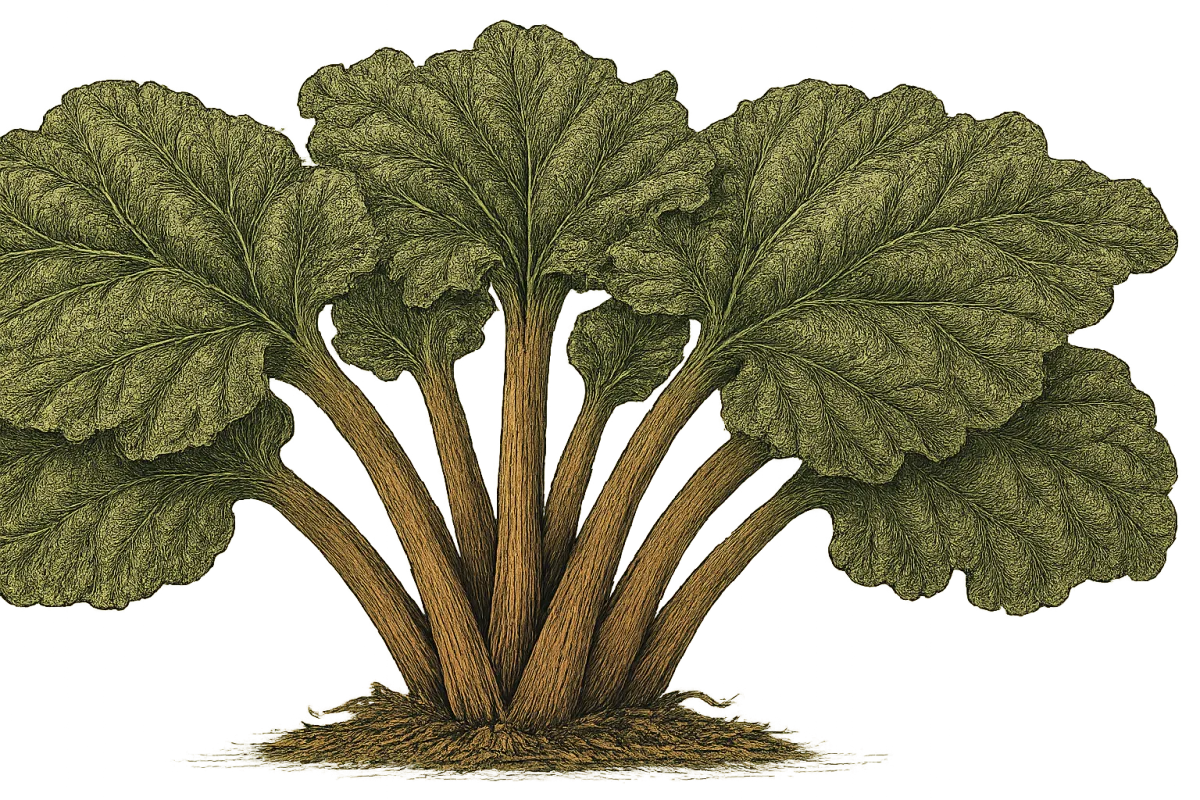
Rhubarb is a big plant at maturity — 2-4 feet tall with a spread of 3-4 feet. It will be in that spot for 20 years. Think about what surrounds it: it should not shade lower-growing vegetables, should not compete with aggressive perennials for root space, and should be positioned somewhere you can reach it comfortably for harvesting. Planting it in a corner where you have to trample other things to get to it is a small error that compounds over two decades.
Soil Preparation
Rhubarb benefits enormously from deep, thorough soil preparation before planting — more than almost any other vegetable, because the roots need to establish deeply and stay productive for decades without significant soil disruption.
Till or dig to a depth of at least 12-18 inches. Incorporate generous amounts of well-rotted compost or aged manure — several inches worked throughout the planting zone. Soil organic matter improves both drainage in heavy soils and moisture retention in sandy soils, which is exactly what you want. It also builds the nutrient base the plant will draw on for years.
Test your soil pH. Rhubarb prefers 6.0 to 6.8. If you are significantly below 6.0, incorporate agricultural lime to raise pH. If you are above 6.8, incorporate sulfur. These adjustments take time to register, so if you are planning a spring planting, amend the previous fall if possible. A soil test costs under $20 and takes the guesswork out of it entirely.
The Planting Process
Step 1: Dig the hole. Large enough to accommodate the full root system without cramping — typically 12 inches wide and deep for divisions or bare-root crowns. Loose soil around the roots matters more than hole size.
Step 2: Set the crown at the right depth. This is the single most important detail of planting. The crown bud — the growing point at the top of the root mass — should be no more than 1-2 inches below the soil surface. Plant too shallow and crowns are vulnerable to frost heave and drying out. Plant too deep and you delay emergence, risk crown rot, and potentially reduce vigor for years. One to two inches of soil over the crown bud. Not more.
Step 3: Backfill and firm. Fill the hole, firm the soil gently to eliminate air pockets, and water thoroughly to settle the soil around the roots.
Step 4: Space plants 3-4 feet apart. Crowns spread over time and need room. Crowding leads to competition, reduced airflow, and disease pressure. Rows should be spaced 4-6 feet apart if you are planting multiple rows.
Step 5: Mulch. Apply 2-3 inches of organic mulch — straw, wood chips, or aged compost — around the plant but not directly over the crown bud. Mulch conserves moisture, moderates soil temperature, and suppresses weeds in the root zone. In cold zones, heavier mulch (4-6 inches) applied after the ground freezes protects crowns through winter.
Step 6: Water in, then leave it alone. Rhubarb does not need coddling after planting. Keep soil consistently moist but not saturated for the first few weeks. After that, let the plant establish.
Watering Rhubarb: Deep and Infrequent Beats Frequent and Shallow
Established rhubarb is more drought-tolerant than most gardeners expect. The root system goes deep — significantly deeper than shallow-rooted annuals — and once it is established, it can draw on moisture reserves that surface-level plants cannot reach. This does not mean you ignore watering. It means you water differently than you would for annual vegetables.
The rule is simple: water deeply and infrequently. One inch per week during the growing season, applied in one or two deep waterings rather than daily light sprinkles. Deep watering encourages roots to develop downward, which improves drought resistance over time. Frequent shallow watering keeps roots in the top few inches of soil, where they are vulnerable to heat and dry spells.
During establishment — the first full growing season — water more consistently. New crowns do not yet have the deep root system that makes established plants resilient. Keep soil evenly moist but never waterlogged. After the first season, you can back off and let the plant work harder for its water.
The season where water management matters most is spring through early summer, when stalks are actively growing. Dry conditions during this window reduce stalk size and thickness directly — water stress shows up immediately in thinner, less productive stalks. The second critical period is late summer and early fall, when the plant is building crown and root reserves for the following year. Allowing the plant to go severely dry in August or September reduces the following spring's production even if everything else goes right.
Overwatering is a more serious problem than underwatering for established plants. Consistently saturated soil leads to crown rot, which can kill a plant that would otherwise have lived for 20 more years. If you are in a high-rainfall area, make sure your site drains well and do not supplement with irrigation unless the soil is actually dry.
In hot zones (7-8), water stress during summer is common and expected — the plant is semi-dormant anyway during peak heat. Do not try to force continued production by heavy watering during this period. Water enough to keep the crown alive and let the plant rest. It will come back in fall if you are in zone 7 or 8.
Drip irrigation is preferable to overhead watering for established plants. It delivers moisture directly to the root zone, keeps foliage dry (which reduces disease pressure), and uses less water overall. A simple drip line or soaker hose laid around the drip line of each plant is sufficient.
Feeding Schedule: Nitrogen in Spring, Restraint the Rest of the Year
Rhubarb is a heavy feeder by vegetable garden standards, but it is easy to overfeed it and the consequences are real. Too much fertilizer — especially nitrogen applied late in the season — produces excessive leaf growth at the expense of stalk thickness and crown development, and it makes the plant more vulnerable to disease and winter injury. The feeding program is simple and front-loaded.
Spring: The Critical Window
The most important fertilizer application of the year happens in early spring, just as new growth emerges from the crown. Apply a nitrogen-rich fertilizer at this point — a complete balanced fertilizer (10-10-10 or similar) works well here, applied at the rate of about 1/2 pound per plant. Some extension services recommend working well-rotted compost into the soil around the plant in early spring as an alternative or addition. The goal is fueling the rapid stalk growth of the spring harvest window.
Incorporate the fertilizer into the top few inches of soil around the plant — keep it away from the crown itself, which can be burned by direct contact with concentrated fertilizer. Water in after application.
After Harvest: A Second Application
After the main spring harvest is complete — roughly June in most zones — a second application of a balanced fertilizer supports the plant's continued leaf development and crown reserve building through summer and early fall. This is a lighter application than the spring feeding. Think of it as maintenance rather than forcing. The plant is building the energy reserves it will draw on for next spring's growth, and it needs adequate nutrition to do that effectively.
What to Avoid
Stop all fertilizer applications by midsummer — mid-July at the absolute latest. Late-season nitrogen stimulates soft new growth that will not harden before winter, and that soft growth is precisely what gets damaged by early frost or severe cold. This is a consistent recommendation across every extension service that covers rhubarb production.
Do not apply fresh manure directly to the crown area. It can burn crowns, introduces potential pathogens, and in high quantities disrupts soil pH. Well-rotted or aged manure is fine and genuinely beneficial as a soil amendment; fresh manure is not.
Rhubarb grown in rich, well-amended soil with annual compost additions often needs less supplemental fertilizer than plants in leaner conditions. Pay attention to your plant. Strong, upright stalks with good width and healthy leaf size are signs of adequate fertility. Thin, pale stalks and yellowing older leaves suggest the plant needs feeding.
Managing the Crown: Division, Removal, and Long-Term Productivity
Rhubarb does not need the same kind of annual pruning that fruit bushes and trees require, but it does need periodic management to stay productive. Two practices matter more than anything else: removing seed stalks and dividing crowns on schedule.
Seed Stalk Removal
This was mentioned in the cold-requirement section and bears repeating because growers consistently underestimate its importance. Remove seed stalks immediately when they appear. Do not wait. Do not let them partially develop out of curiosity or aesthetic interest. Cut them at the base with a sharp knife the moment you identify them.
Seed stalks typically emerge in early to midsummer, triggered by heat, drought, overcrowding, or simply the natural maturation cycle of an older plant. They draw significant energy from the crown — energy that would otherwise go into root development and the following year's stalk production. A plant that is allowed to flower and set seed consistently will decline in vigor noticeably over two or three seasons.
Crown Division
Rhubarb crowns spread over time, and after 5-8 years most established plants benefit from division. Division serves two purposes: it rejuvenates the parent plant, which can lose vigor as the crown gets very large and dense, and it produces new divisions you can replant or share.
Divide in early spring just as growth is beginning to emerge, or in early fall before the ground freezes. Dig the entire crown — it will be larger and deeper than you expect. Using a sharp spade, divide it into sections with each section containing at least one healthy bud and a substantial root mass. Replant immediately at the correct depth (1-2 inches of soil over the crown bud) in well-prepared soil.
Divisions establish faster than newly purchased crowns in most cases because they already have mature root structure. Expect good production by the second year after dividing an established crown.
End-of-Season Care
In fall, after the first hard frost kills back the leaves, remove the dead foliage and add it to the compost pile. Do not leave large masses of dead leaves around the crown through winter — they create habitat for slugs and disease organisms. In zones 3-5, apply a 4-6 inch layer of straw or shredded leaves over the crown area after the ground freezes to provide winter insulation without trapping excessive moisture.
In zones 6-8, winter mulch is lighter or unnecessary. The crowns are dormant but not at serious risk from cold in those zones.
The Mistakes That Actually Kill Rhubarb Yields
These are ranked by frequency and severity. The first two are responsible for more failed rhubarb plants than everything else combined.
Mistake #1: Harvesting Too Hard in Years One and Two
This is the rhubarb equivalent of the blueberry problem of letting new plants fruit. A rhubarb crown needs to establish a strong root and crown reserve before it can sustain heavy harvest. When you take too many stalks too early, you pull energy directly out of the crown before it has built up sufficient reserves. The result is a weakened plant that either fails to return vigorously the following spring or produces thin, undersized stalks for years afterward.
Year one: harvest nothing. Let every stalk grow to maturity. Every leaf the plant produces in year one is contributing to root development through photosynthesis. Stripping them out for early gratification is a trade of long-term yield for a few stalks today.
Year two: take a few stalks late in the spring harvest window. No more than one or two per plant, and only from vigorous growth. Stop before the plant shows any signs of stress.
Year three onward: Harvest normally — a good rule of thumb is never removing more than one-third to one-half of the stalks at any one time, and stopping harvest by early summer so the plant can build reserves for the following year.
Mistake #2: Planting in Poorly Drained Soil
Crown rot from waterlogged conditions kills rhubarb that would otherwise live for 20 years. The maddening part is that it does not always kill quickly — the plant declines over one or two seasons, losing vigor gradually, until you dig it up and find the crown has largely rotted away. By that point, the site problem has been present for years.
Test drainage before planting. If the site does not pass the drainage test — water clears within 2-4 hours of heavy rain — either amend aggressively with organic matter to improve structure or build raised beds. Do not plant in low spots or anywhere with a high water table.
Mistake #3: Ignoring Seed Stalks
A well-grown, established rhubarb plant can be measurably reduced in productivity within two or three seasons of consistent seed stalk development. This is a slow-moving mistake that sneaks up on growers who either do not notice the seed stalks forming in midsummer or mistake them for interesting growth worth leaving.
Check your plants weekly during June and July. Cut any seed stalk the moment it is identifiable. This takes less than a minute per plant and has an outsized impact on the following year's production.
Mistake #4: Choosing the Wrong Zone (or Ignoring Microclimates)
Zone 8 gardeners who plant rhubarb and expect zone-5 performance will be disappointed every time. More commonly, zone 6 and 7 gardeners choose the wrong site within their zone — a south-facing, heat-collecting spot near a masonry wall, for example — and create effectively zone-8 growing conditions for their rhubarb. The plant sulks in summer heat, produces poorly, and the gardener concludes rhubarb does not work in their area. The problem was site selection, not zone.
Think about microclimates when choosing your site. North or east-facing slopes stay cooler in summer. Spots sheltered from the prevailing afternoon sun extend the spring harvest window. In zone 7, this is not optional advice — it is the difference between a productive plant and a struggling one.
Mistake #5: Harvesting Too Late in the Season
Most gardeners err toward harvesting too much too early (mistake #1). But a significant number make the opposite error: they continue harvesting deep into summer because the plant still looks productive. Harvesting after midsummer depletes the crown reserves the plant is building for next spring. It also typically produces lower-quality stalks — by late June or early July in most zones, stalks are getting thicker and more fibrous, with increased oxalic acid content that makes them unpleasant to eat.
Stop harvesting by early June in zones 5-6 (earlier in zones 7-8). Let the plant close out the season on its own terms. Next spring's harvest will be better for it.
Mistake #6: Applying Fertilizer Too Late
Late-season nitrogen is a genuine problem for rhubarb in cold zones. Applied after midsummer, it pushes soft, leafy growth that will not harden before frost — and in zones 3-5, that means frost damage to growth that should have been hardened off and dormant. Repeated late-season fertilization weakens crowns over time by disrupting the normal dormancy cycle.
Stop all fertilizer applications by mid-July at the absolute latest. In zones 3 and 4, earlier is better.
Pests and Diseases
The good news about rhubarb: it has relatively few serious pest and disease problems compared to most vegetable crops. The leaves contain high concentrations of oxalic acid, which deters many feeding insects. That said, a few problems are worth knowing, and one disease — crown rot — is serious enough to kill plants that would otherwise have lived for decades.
Pests
Rhubarb curculio (Lixus concavus) is the most damaging insect pest specific to rhubarb. This rust-colored weevil — about 3/4 inch long — bores into stalks, crowns, and roots to lay eggs, and the tunneling damage weakens the plant and creates entry points for fungal disease. You will notice sap exuding from puncture holes in stalks, often with rust-colored frass (insect excrement). Adults are present from late May through June in most zones. Management is primarily cultural: remove and destroy infested stalks immediately, clean up plant debris around the crown where adults overwinter, and eliminate nearby dock weeds (Rumex species), which are an alternate host and a key part of the pest's life cycle. Michigan State Extension and others note that curculio populations are closely tied to dock populations in the surrounding area — controlling dock reduces pressure significantly.
Aphids colonize the undersides of rhubarb leaves and the growing points in spring, causing leaf curl and distortion. Heavy infestations reduce the photosynthetic capacity of leaves, which indirectly impacts crown development. Check young growth regularly from April onward. Most aphid infestations on established rhubarb are tolerable without intervention — natural predators including lady beetles, lacewings, and parasitic wasps typically bring populations under control within two to three weeks. If you need to intervene, a strong water spray dislodges aphids effectively. Insecticidal soap is the appropriate chemical option if populations are high and predator pressure is absent.
Slugs are a perennial problem in cool, moist climates — exactly the conditions where rhubarb performs best. They feed on young emerging stalks in early spring and on leaves throughout the season, leaving irregular holes and characteristic slime trails. Damage is rarely severe enough to threaten plant health but can be significant on young plants in year one or two. Keep mulch pulled back from the crown area in early spring to reduce slug habitat. Iron phosphate-based slug baits (Sluggo and similar products) are effective and safe around food plants. Avoid methaldehyde-based baits, which are toxic to pets and wildlife.
Flea beetles cause small, rounded holes in rhubarb leaves — the characteristic "shothole" feeding pattern. They are rarely serious enough on established plants to warrant intervention, but on young transplants in year one they can set back development. Row cover during the vulnerable establishment period is the most practical management tool.
Diseases
Crown rot is the most serious disease of rhubarb and the one most worth preventing, because by the time it is obvious the damage is usually done. It is caused by a complex of soilborne pathogens — primarily Phytophthora and Erwinia species — that thrive in waterlogged, poorly drained conditions. The above-ground symptoms are progressive: stalks become thin and weak, the plant declines in vigor over one or two seasons, and eventually new growth fails to emerge in spring. Dig a declining plant and you will find the crown has turned brown and mushy, often with a foul odor. There is no chemical cure once crown rot is established. Prevention is everything: well-drained soil, correct planting depth, and avoiding overwatering. If crown rot strikes, remove and destroy the plant, improve drainage before replanting, and wait at least two years before putting rhubarb back in that location.
Leaf spots — caused by several fungal pathogens — appear as angular brown or tan spots on rhubarb leaves, sometimes with yellow halos. They are aesthetically unpleasant but rarely serious on established plants. Good air circulation (adequate spacing, removal of dead leaves) prevents most leaf spot problems. Wet, cool spring weather increases incidence. Remove and compost affected leaves; do not leave them to overwinter around the crown. Fungicide applications are rarely warranted on home plantings.
Powdery mildew appears as a white, powdery coating on leaf surfaces in mid to late summer. It is a sign of stress — typically heat, drought, or poor air circulation — rather than a primary disease problem. Improving soil moisture consistency and ensuring plants are not overcrowded addresses the underlying cause. Affected leaves can be removed; the plant typically outgrows the problem once conditions improve.
Ramularia leaf spot (Ramularia rhei) produces specific circular, white-centered spots on upper leaf surfaces with a pinkish-tan hue. It is more common in cool, wet seasons and in crowded plantings. Management is cultural: remove heavily affected leaves, improve air circulation, and avoid overhead watering. As with other rhubarb leaf diseases, fungicide applications are typically not warranted on home garden plantings.
Botrytis crown rot (Botrytis cinerea) can affect rhubarb crowns during cool, wet conditions, particularly where excessive mulch is piled against the crown. The gray mold is distinctive. Prevent it by keeping mulch 2-3 inches away from the crown itself — mulch around the root zone, not over it. If botrytis develops on crown tissue, remove affected material and improve airflow.
When deciding whether to intervene on any pest or disease, apply this rule: if the problem is on leaves and the plant's vigor and stalk production are unaffected, monitor for two weeks before doing anything. If you are seeing crown-level damage, stalk production declining, or disease spreading actively despite dry conditions, act immediately with the appropriate cultural fix first. Chemical interventions on rhubarb are rarely necessary and should be the last resort rather than the first response.
Harvesting: The Rules That Keep the Plant Productive
Rhubarb harvest management is where most of the yield-damaging mistakes happen. The rules are simple, but they require some restraint — especially in years one through three when the plant looks productive and you are eager to actually eat something from it.
When to Start Harvesting
Do not harvest in year one. At all. The plant needs every leaf it produces to build crown and root reserves. This is non-negotiable.
In year two, take only a few stalks in late spring — two or three per plant maximum, and only if growth is strong and vigorous. If the plant looks small or weak, leave it alone for another full year.
From year three onward, harvest normally. A productive established plant can yield 3-8 pounds of stalks per season. The harvest window runs from when stalks reach usable size in spring through early summer — roughly March through June in zones 5-6, with earlier starts and earlier ends as you move toward zone 8.
How to Harvest
Twist and pull, or cut — either works. The traditional method is to grasp the stalk near the base and pull with a slight twisting motion until it detaches cleanly. This minimizes crown disturbance and is how most experienced growers prefer to do it. Cutting with a sharp knife just above the crown is equally acceptable. The key is a clean removal — do not yank or tear in ways that damage the crown.
Remove the leaf immediately. Rhubarb leaves are toxic — they contain high concentrations of oxalic acid and should not be eaten by people or animals. Twist or cut the leaf off and compost it (the oxalic acid breaks down in composting and is not a soil contamination concern). Never bring leaves into the kitchen with the stalks.
Harvest stalks that are at least 10-15 inches long and reasonably thick. Thin stalks are not worth taking and represent a net loss to the plant if removed. Let thin stalks continue developing.
The One-Third Rule
Never harvest more than one-third to one-half of the plant's total stalks in a single harvest or over the course of a season. Each stalk is supporting leaf tissue that contributes to photosynthesis and crown development. Strip too many stalks and you pull the plant's energy supply out from under it. Leave at least half the stalks to grow to full size and complete their contribution to root reserves.
When to Stop Harvesting
Stop by early June in zones 5-6. Stop by late May in zone 7. Stop by early May in zone 8. The plant needs the rest of the growing season to build reserves for next year. Late harvesting is one of the cleanest ways to reduce the following year's production, and unlike other mistakes it is entirely invisible — the plant looks fine after a late harvest, and the consequences do not show up until the following spring.
Storage
Fresh rhubarb stalks keep for 1-2 weeks in the refrigerator wrapped loosely in plastic. Freezing is easy and effective: chop stalks into 1-inch pieces, spread on a baking sheet to freeze individually, then transfer to freezer bags. Frozen rhubarb maintains good quality for 9-12 months and goes directly into pies and compotes without thawing.
 Where to Plant