 Where to Plant
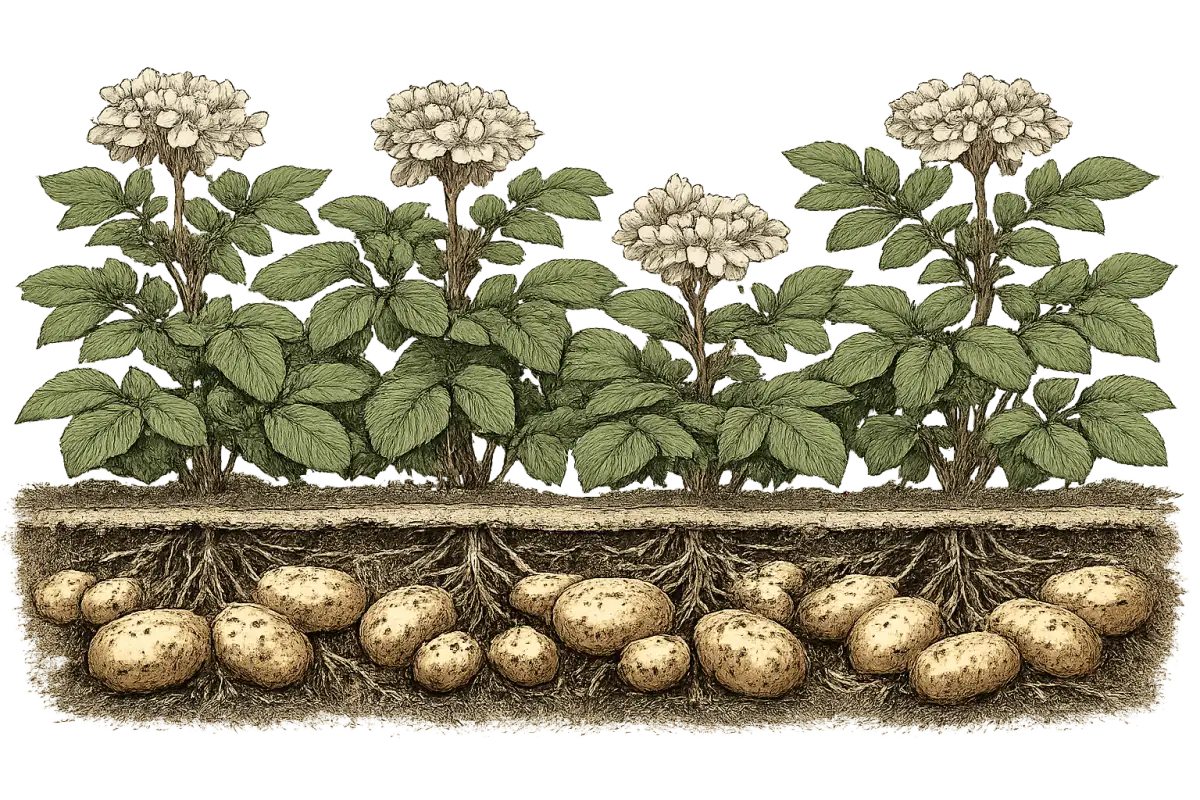
Potatoes are supposed to be simple. Drop them in the ground, hill them up, dig them out. That is the whole story, right?
Except most first-time growers end up with a patch of magnificent green foliage and a bucket of marble-sized disappointments. Or they bite into a potato that tastes vaguely wrong and wonder if the crop is cursed. Or they spend the whole season watering faithfully and dig up tubers that are knobby, cracked, and hollow in the middle.
None of this is bad luck. It is the same handful of mistakes, made over and over, by people who were never told the actual rules. And the rules are not complicated. They are just different from what you would guess.
Potatoes are a cool-season crop that wants nothing more than loose soil, consistent moisture, and enough buried stem to hang tubers from. A single 10-foot row, done right, can yield 50-100 pounds of food. A 20-gallon grow bag on a patio yields up to 12 pounds with zero digging and almost no space. A well-planned succession of early, mid, and late varieties gives you fresh potatoes from midsummer through fall, with storage potatoes that last into the following spring.
This guide covers every decision that actually matters — variety selection by zone, planting methods, hilling, watering, fertilization, harvest timing, and the mistakes that ruin the most crops. We will tell you what the extension services actually recommend, not the vague "keep moist and fertilize as needed" advice that fills most of what is written about potatoes.
Let's dig in.
Quick Answer: Potato Growing at a Glance
USDA Zones: 3 through 11 (cool-season crop; timing varies dramatically by zone)
Sun: Minimum 6 hours direct sunlight; 8+ hours ideal
Soil pH: 5.0-6.0 (non-negotiable for scab prevention)
Planting depth: 4-6 inches deep, eyes facing up
Spacing: 10-12 inches between seed pieces, 30-36 inches between rows
Water: ~1 inch per week early; 2-3 inches per week during tuber bulking
Fertilizer: Moderate nitrogen, higher phosphorus, highest potassium (5-10-10 or 4-8-10)
Hilling: Start at 6-8 inches of plant height; repeat every 2-3 weeks
Days to harvest: 55-160 days depending on variety
New potatoes: Any variety, 7-8 weeks after planting
Yield (trench/hill): 5-10 lbs per row foot in good conditions
First rule: Never plant grocery store potatoes. Use certified seed potatoes only.
The Soil pH Rule Nobody Tells You About
Before we talk about varieties or planting dates or any of the interesting stuff, you need to understand one soil fact that dictates everything else.
Potatoes need soil pH between 5.0 and 6.0. That is slightly acidic. Not as extreme as blueberries, but still well below what most garden soil naturally sits at. And the reason is specific: the common scab pathogen, Streptomyces scabiei, thrives in neutral to alkaline soil. Keep your pH in the 5.2-5.8 range and you create actively hostile conditions for scab. Let it drift above 6.5 and you are essentially sending an invitation.
This matters more than people realize because the two most common "helpfulness" impulses in gardening — liming the soil and adding wood ash for potassium — both raise pH directly into scab territory. Do not lime potato beds. Do not add wood ash. If you want extra potassium without touching pH, use sulfate of potash (0-0-50). If you need to bring pH down, use elemental sulfur or ammonium sulfate fertilizer.
Test before you plant. Extension services offer inexpensive soil testing and you cannot manage what you have not measured. Sandy loam is the ideal native texture — tubers expand freely, drain well, and come out clean at harvest. Heavy clay drains poorly, restricts tuber growth, and produces misshapen potatoes. If clay is what you have, build raised beds and fill them with something better.
Amend with well-rotted compost, aged manure, or leaf mold. Avoid fresh manure — it promotes scab and dumps excessive nitrogen into the bed. Avoid fresh wood chips, which rob nitrogen as they decompose. Keep fresh anything away from potato beds.
One more requirement that matters: rotation. Do not plant potatoes — or any member of the nightshade family, including tomatoes, peppers, and eggplant — in the same spot more than once every 3-4 years. Soil-borne diseases and pests accumulate fast in nightshade ground. Colorado potato beetles actually overwinter in the soil near last year's crop and walk to find new plants. Moving your potato patch even a short distance genuinely helps.
Certified Seed Potatoes: This Is Not Optional
Here is the most important sentence in this entire guide: do not plant grocery store potatoes.
I know you have a potato in the back of the pantry that is already sprouting. I know it seems wasteful to throw it out and buy seed potatoes instead. Plant it anyway and here is what might happen: supermarket potatoes are routinely treated with chlorpropham (CIPC), a sprout inhibitor that prevents germination. Your potato may simply refuse to grow. And if it does grow, you have just introduced an uninspected tuber — one that has never been tested for late blight, viruses, or bacterial pathogens — directly into your garden soil where those diseases can persist for years.
USDA-certified seed potatoes are inspected, lab-tested, and guaranteed disease-free. That is the entire point of the certification. The cost difference between certified seed and store-bought is real but small. The disease risk is not small.
If you genuinely want to experiment with a store-bought potato, use an organic one (less likely to be inhibitor-treated) and grow it exclusively in an isolated container. Never in soil that will grow food again.
Once you have certified seed potatoes in hand, here is how to prepare them: cut larger tubers into egg-sized chunks with at least one eye each — two or three eyes per piece is better. Let the cut pieces dry at room temperature (60-70F) for 2-3 days. This forms a protective callus layer that resists rot when the pieces hit cold, wet soil. Golf-ball-sized or smaller seed potatoes can go in whole.
Chitting: Worth the Bother in Short Seasons
Chitting means pre-sprouting seed potatoes indoors before planting. Place them eyes-up in egg cartons or shallow trays, in a bright room held at 50-60F, four to six weeks before your planned planting date. Wait for sprouts that are 0.5-1 inch long, stubby, green, or purple-tinged.
If your sprouts come up long, pale, and spindly, they grew in darkness and are weak. Rub them off and start over in better light. Good chitted sprouts are stout and compact.
Chitting gives you a 2-4 week head start, which is genuinely valuable in zones 3-5 where the growing window is short. It also lets you verify seed viability before committing pieces to the ground. Handle chitted potatoes carefully at planting — broken sprouts set you back.
Best Potato Varieties by Zone
Potato variety selection comes down to two things: how long is your growing season, and what do you want to do with the potatoes afterward. Season length is the hard constraint. Everything else is preference.
Early-season varieties mature in 55-85 days. Mid-season takes 90-110 days. Late-season runs 110-160 days — Russet Burbank, the most widely grown baking potato in the country, takes around 150. If your zone does not give you 150 frost-free days with soil warm enough for potato growth, Russet Burbank is not your variety. This is basic math that a lot of gardeners skip.