Onion watering has the same two-phase logic as fertilization — consistent moisture during growth, then a decisive stop at the right moment.
During Active Growth
Provide 1 inch of water per week from irrigation and rainfall combined, delivered in 1-2 deep waterings rather than daily shallow ones. The goal is to moisten the top 6-8 inches of soil consistently. Erratic watering — drought periods followed by heavy irrigation — causes split bulbs, where the outer rings crack as inner tissue expands rapidly. It also causes secondary growth, where the plant essentially restarts and produces a deformed double bulb. Those days of drought are simply lost; the bulb cannot compensate later.
Drip irrigation or soaker hoses are the clear best choice for onions. They deliver water directly to the root zone, keep foliage dry (which prevents downy mildew and other foliar diseases), and make the pre-harvest stop-watering transition easy to execute. If you have to choose between overhead watering (which knocks thrips off leaves) and drip irrigation (which prevents fungal disease), choose drip and manage thrips separately with spinosad.
Mulch extends the benefit of every watering. Apply 1-2 inches of straw between rows after plants are established — about two to three weeks after planting. Keep mulch away from the onion neck itself. Straw mulch reduces the need for irrigation by roughly 25-30% and buffers the moisture fluctuations that cause splitting. In hot, dry zones (8-10, arid West), mulch is essential rather than optional; unmulched soil in those climates loses moisture two to three times faster.
The Stop Signal
When approximately 50% of onion tops have fallen over naturally, stop all watering. This is not a suggestion — it is the trigger point. The plant is entering dormancy and the bulb is complete. Continued irrigation at this stage keeps the neck tissue wet, which is precisely the condition that causes storage rot. If it rains during this window, harvest promptly rather than leaving bulbs in saturated soil.
Do not bend tops over manually to speed the process. This is a commonly repeated piece of garden advice, and it is wrong. Manually lodging tops damages the neck tissue and creates direct entry points for Botrytis. The tops fall when the plant is ready. Wait for it.
Pests and Diseases Worth Knowing About
Onions have fewer problems than most garden crops. But the problems they do have can wipe out an entire planting if you are not paying attention.
Onion Maggot
The most damaging onion pest in northern gardens — zones 3-7. The adult looks like a small housefly. It lays eggs at the base of onion plants in spring. Larvae tunnel into the bulb and destroy it from the base up. You will know you have them when plants suddenly wilt and yellow; pull the plant and you find the bulb is tunneled and rotting.
Floating row covers applied immediately after planting are the single most effective defense. They physically block the egg-laying flies while allowing light, air, and water through. Crop rotation — no alliums in the same bed for three or more years — limits population buildup in the soil. Remove all onion debris after harvest; pupae overwinter near old plantings.
If you have an active infestation, remove affected plants immediately to slow spread. Beneficial nematodes (Steinernema feltiae) applied to soil can parasitize larvae. Spinosad is the preferred organic treatment for heavy pressure.
Thrips
The most widespread onion pest, present in every growing zone. Onion thrips are tiny — 1/25 inch — and often invisible until you look closely between leaf bases. The diagnostic sign is silvery-white streaking on the leaves, which is where they have rasped the surface and fed on plant juices. Light infestations are cosmetic. Heavy infestations reduce bulb size by up to 50% because damaged leaves cannot photosynthesize efficiently. Each damaged leaf means a thinner ring in the bulb.
Spinosad is the preferred organic treatment and is effective against thrips when applied directly to leaf surfaces. Remove weeds around onion beds — thrips harbor in grassy weeds and migrate to onions. Monitor weekly from late spring through harvest by pulling apart leaf bases.
Downy Mildew
The most common onion disease in humid climates, particularly zones 5-7 in the Southeast and Mid-Atlantic during wet springs. Look for pale yellow patches on leaves with gray-purple fuzzy growth visible in morning humidity. It spreads rapidly in cool (50-75F), rainy conditions.
Prevention is the only effective strategy. Proper spacing — 4-6 inches between plants, 12-18 inches between rows — allows leaves to dry quickly. Drip irrigation eliminates leaf wetness entirely. Copper-based fungicides applied preventatively before symptoms appear provide organic protection.
Neck Rot (Botrytis)
The primary storage disease, and unlike most of the problems above, you often do not know you have it until you are pulling onions out of storage three weeks after harvest and finding gray mold at the neck. Botrytis enters through neck tissue that is not fully dry after curing. Thick necks from late-season nitrogen fertilization are the most susceptible. Proper curing — 2-3 weeks in a warm (75-85F), dry, ventilated space — is the only effective prevention.
White Rot
Worth a specific mention not because it is common, but because of its consequences. White rot produces white fluffy mycelium with tiny black dots at the base of the bulb, and it renders soil unusable for alliums for 15-20 years. Buy from reputable suppliers, do not move soil from suspect areas, and if you confirm white rot in a bed, stop planting alliums there. There is no recovery path other than time.
Harvesting and Storage: The Part Most Gardeners Get Wrong
You can grow a textbook onion crop and still end up with nothing three weeks after harvest. Storage failure is overwhelmingly a curing problem.
When to Harvest
Harvest when approximately 50% of the onion tops have fallen over naturally. The neck softens, the tops bend at a distinct kink point, and they lay flat on the soil. This is the universal signal that bulbing is complete and the plant is entering dormancy.
Do not wait until every top is brown and dead. By that point, the outer scales may have begun to deteriorate. And do not force tops down manually — you already know why.
Choose a dry period for harvest. Use a garden fork inserted 3-4 inches from the bulb to lever the soil upward; do not pull straight up by the tops. The neck needs to stay attached and intact for curing. Leave the tops on.
The Curing Process
Cure in a warm (75-85F), dry, well-ventilated area for a minimum of 2-3 weeks. A covered porch, carport, or garage with a fan are all good options. Spread onions in a single layer so bulbs do not touch. Drape on wire mesh or old window screens so air circulates underneath.
Do not cure in direct sun — you get sunscald, not proper drying. Do not cure in a closed, humid space — you get mold, not drying.
Curing is complete when all three of these are true: the neck is completely dry and collapses easily when squeezed an inch above the bulb; the outer skins are papery and rustle when handled; and the roots snap off cleanly. Anything less and the onion is not ready for long-term storage. Once curing is complete, trim dried tops to 1 inch above the bulb and trim roots close to the basal plate.
Storage Conditions
The ideal storage environment is 32-40F with 65-70% humidity and moderate airflow. Temperature is the most critical factor. Above 40F, onions break dormancy and begin sprouting. Below 32F, cell damage occurs.
Mesh bags are the best storage container — maximum airflow, easy inspection, and they hang from hooks to save space. Pantyhose (the old-timer technique: drop in a bulb, tie a knot, repeat, hang vertically) works on the same principle. Never use sealed plastic bags or closed containers. Trapped moisture guarantees rot.
Storage Life by Variety
Storage duration is genetic. Sweet varieties store poorly because the properties that make them sweet — high water, high sugar content — are exactly what rot organisms prefer.
Long-storage varieties (6-9 months): Copra is the benchmark. Dense flesh, thick skin, and it actually improves in flavor as it sits. Patterson follows close behind at 6-8 months. Red Wing holds 4-6 months and is the best option in the red category. Norstar is comparable for those in zones 3-4.
Short-storage varieties (1-2 months): Vidalia/Yellow Granex, Texas 1015, Walla Walla, and Ailsa Craig all fall here. These are fresh-eating onions. Plan accordingly — eat them, give them away, pickle them, or make large batches of French onion soup. Do not count on them sitting in a mesh bag through December.
The practical approach for most gardens: grow both. Plant a sweet variety for immediate gratification in the weeks after harvest, and a long-day storage variety like Copra for everything after that.
Inspect stored onions every 2-3 weeks. A single soft, rotting bulb spreads to adjacent bulbs within days. Catch it early, remove it, and save the rest.
The Top Mistakes That Kill Onion Harvests
If you read nothing else in this guide, read this section. These are ranked by how often they cause complete harvest failure.
Mistake #1: Wrong Day-Length Type for Your Latitude
We opened the guide with this and it stays at number one because nothing else comes close in terms of frequency and severity. Lush tops and no bulb is almost always this. Tiny premature marble-sized bulbs in the North is always this.
The fix: match your variety to your latitude. Use transplants from a specialty supplier rather than unlabeled sets from a garden center. If you are in an overlap zone, go intermediate. This one decision matters more than everything else combined.
Mistake #2: Planting Too Late
Every leaf equals one bulb ring. An onion planted four weeks late might produce 40% less bulb volume regardless of how well you manage everything else. Onions are cold-hardy — they tolerate frost. Plant them when the soil is workable, not when the weather is warm.
Mistake #3: Fertilizing During Bulbing
Nitrogen after bulbing begins produces soft tissue that cannot cure properly. The resulting thick necks invite Botrytis and the whole batch rots in storage. The fix: watch for the base of the plant to swell, and stop all nitrogen the moment you see it. No exceptions.
Mistake #4: Using Large Sets
Sets are more bolt-prone than transplants to begin with. Large sets — over 3/4 inch diameter — are the most bolt-prone of all. A bolted onion has a hard, woody flower stalk through the center and will not store. Use transplants for bulb onions. If you insist on sets, choose the smallest ones in the bag.
Mistake #5: Compacting Soil Around Bulbs
Onion bulbs swell outward, not downward. Compacted soil physically restricts this expansion and produces undersized or misshapen bulbs. Never walk on the growing bed. Never hill up soil against onion bulbs (this is correct for potatoes — it is wrong for onions). As bulbs swell, they will naturally push partially above the soil surface. Leave them alone.
Mistake #6: Inconsistent Watering
The drought-flood cycle that splits bulbs and causes secondary double-bulb formation is entirely preventable. One inch per week, delivered consistently with drip or soaker irrigation, and mulch between rows to buffer fluctuations. The consistent growers get smooth, full bulbs. The inconsistent ones get cracked and deformed ones.
Mistake #7: Skipping or Rushing the Cure
Two to three weeks. That is what curing takes. Not five days. Not a week in the sun. The neck must be completely dry and papery, the outer skins must rustle, and the roots must snap. Shortcut this and you lose your harvest to neck rot in storage.
Mistake #8: Poor Weed Management
Onions are among the worst weed competitors in the vegetable garden. Their narrow, upright leaves cast almost no shade. Their roots are shallow. Research shows weed competition during the first 6-8 weeks can reduce bulb yield by 50% or more. Weed weekly for the first two months. Mulch between rows. Hand-pull near plants rather than hoeing, which damages shallow onion roots.
Companion Planting
Onions are strong chemical communicators—their sulfur compounds deter a range of pests, making placement decisions mostly about who benefits from that protection and who gets stunted by it.
Best Companions
For pest suppression: Carrots and onions are a classic pairing with a clear mechanism: carrot flies are repelled by onion scent, and onion flies are confused by carrot scent. Interplanting them in alternating rows reduces pressure from both pests without any chemical inputs.
For brassicas: Broccoli benefits from growing near onions because the sulfur compounds deter aphids and cabbage loopers that commonly attack brassica foliage. The two crops also have compatible root depths, so competition for moisture and nutrients stays low.
For compatible allium groupings: Beets and celery are well-documented companions. Beets share similar soil and watering needs, while celery gains some pest deterrence from onion proximity. Dill is a spatial companion—it neither benefits from nor harms onions, but the two fill bed space efficiently without conflict.
For structural companions: Garlic and leeks share the same allium family and have similar soil, spacing, and rotation requirements, making bed management straightforward. Grouping them also concentrates the sulfur-rich root zone, which may suppress soilborne fungal activity around all three.
What to Keep Away
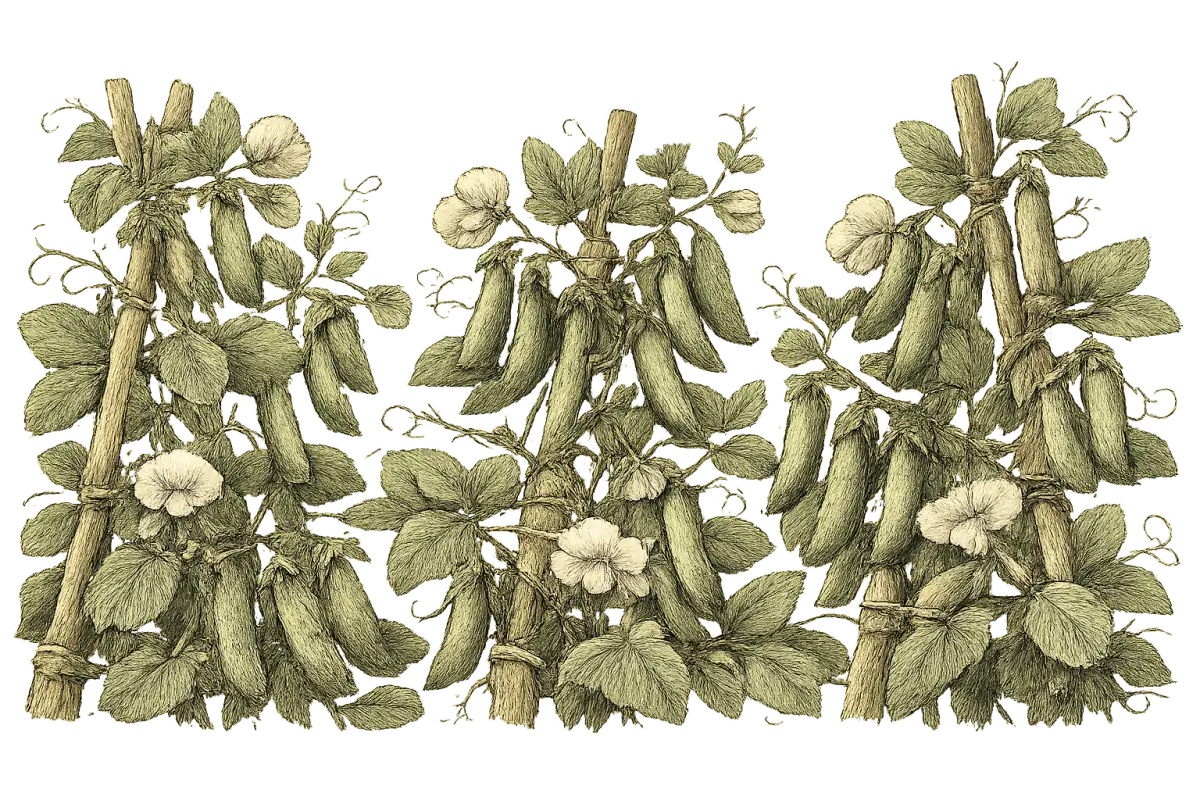
Beans and legumes: Beans are the clearest incompatibility. Onion root exudates suppress the nitrogen-fixing bacteria (Rhizobium) that legumes depend on, reducing bean yields noticeably when planted in direct proximity. Keep at least a full bed between them.
Other legumes: The same inhibition mechanism applies broadly to peas and other nitrogen-fixing crops. Onions planted near legumes undermine the primary benefit those crops provide to the soil.
Sage and asparagus: Asparagus and onions compete aggressively for soil space and nutrients, and asparagus beds are long-term plantings that make rotation difficult. Sage can inhibit onion growth when planted too close—keep aromatic woody herbs separate.
Rotation note: Onions share diseases—particularly white rot (Sclerotium cepivorum)—with all other alliums. Avoid following onions with garlic, leeks, or shallots in the same bed, and maintain a three-to-four year gap before replanting any allium family crop in that spot.
Frequently Asked Questions
What is the difference between short-day, intermediate-day, and long-day onions?
The difference is the number of daylight hours required to trigger bulbing. Short-day onions bulb at 10-12 hours, intermediate at 12-14 hours, and long-day at 14-16 hours. These correspond to latitude: southern latitudes never provide 14-16 hours, so long-day varieties fail there. Northern latitudes exceed 12 hours very early in spring, so short-day varieties bulb prematurely. Match your variety to your latitude and you are most of the way to a successful harvest.
Can I grow sweet onions in the North?
Yes, but not all sweet varieties. Walla Walla is the go-to sweet long-day onion for northern zones — it produces large, mild, sweet bulbs and is the Pacific Northwest's answer to Vidalia. Ailsa Craig is another northern sweet variety with exceptional size. Just plan to eat them within 1-2 months of harvest. The sweetness that makes them appealing is the same property that shortens their storage life.
Should I use sets or transplants?
Transplants for bulb onions. Sets for green onions. Sets are more bolt-prone, have poor variety selection, and the day-length type is often unknown. Transplants from a specialty supplier — Dixondale Farms is the major US source — arrive zone-matched, variety-labeled, and significantly less bolt-prone. The cost difference is modest. The outcome difference is substantial.
Why are my onion tops falling over before the bulbs seem big enough?
Check your variety selection first. If you planted the wrong day-length type, the plant triggered bulbing early when it was still small. The tops fall because bulbing is complete, but the bulb is undersized because the plant did not have enough leaf mass before bulbing began. The fix is correct variety selection for your latitude next season. If your variety was correct, look at your planting date — late planting reduces leaf mass and therefore bulb size.
How do I know when curing is done?
Squeeze the neck one inch above the bulb. It should collapse easily and feel completely dry — like paper. If it gives any resistance or feels thick and moist, keep curing. The outer skins should rustle like paper when handled, and the roots should snap off cleanly. All three conditions, not just one. Rushing this step causes neck rot in storage. Two to three weeks minimum in a warm, dry, ventilated location.
Can I grow onions in containers?
Yes, with limitations. Onion bulbs need room to expand laterally, so containers need to be at least 12 inches deep and wide. Bunching onions and green onions work better in containers than bulb onions because they do not need the lateral expansion room. For bulb onions in pots, use a well-draining mix, maintain consistent moisture (containers dry out faster than ground beds), and fertilize more frequently since nutrients leach with each watering. Day-length rules still apply in containers — the plant does not know it is in a pot.
The Bottom Line
Onions are not difficult. They are specific.
Get the day-length type right for your latitude and you have solved the problem that defeats most home growers. Plant early, use transplants from a zone-matched supplier, give them full sun in loose soil, fertilize hard during leaf growth and stop completely at bulbing, water consistently at 1 inch per week and cut off completely when tops fall, and cure for a full 2-3 weeks before storage.
Do those things and you will have onions through the following spring — storage varieties like Copra and Patterson routinely deliver 6-9 months under proper conditions. Fresh-eating sweet varieties like Walla Walla and Vidalia/Yellow Granex will be the best onions you have ever eaten, because you harvested them at peak ripeness instead of three weeks early for shipping durability.
Start with the day-length question. Everything else follows.
 Where to Plant