Vegetables

Growing Watermelon: Everything You Need to Know to Actually Get a Good One

James Calloway

James Calloway

Vegetable & Edibles Specialist · Updated April 2026

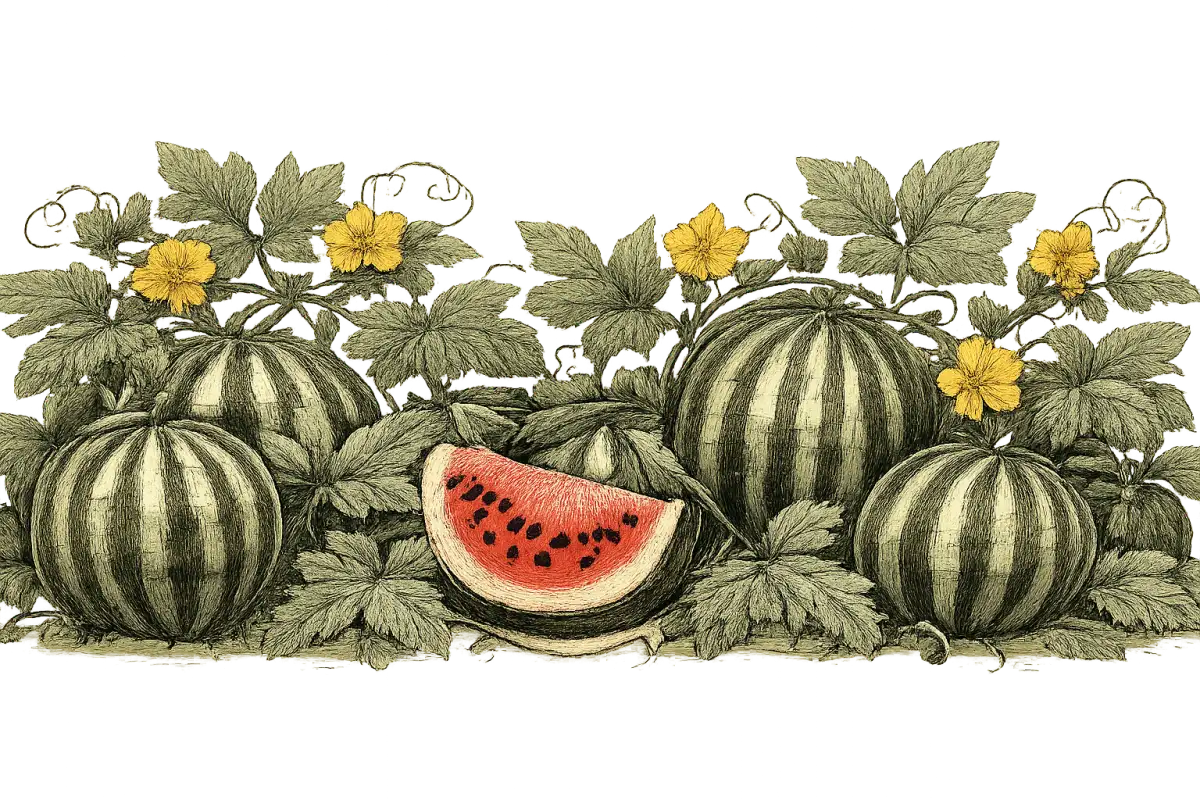
How to grow watermelon — vintage botanical illustration showing the plant in detail

Watermelon at a Glance

Sun

Sun

Minimum 6 hours full sun daily

Soil pH

Soil pH

5.5-7.0

Water

Water

1-2 inches per week during vine growth and fruit development

Spacing

Spacing

24 sq ft per plant"

Days to harvest

Days to Harvest

65-100+ days

Height

Height

Trailing vine

Soil type

Soil

Sandy loam

Lifespan

Lifespan

annual

Get your personalized growing data

Enter your zip code for frost dates, growing season, and soil type.

Watermelon is an honest crop. It gives you exactly what you put into it -- which is why so many home gardeners end up with a gorgeous vine loaded with foliage and exactly nothing worth eating.

I've seen it too many times. Big healthy plants, thick stems, sprawling vines all over the garden. Then harvest day comes. The melon looks right. You cut it open. Pale pink, watery, tasteless. Or worse, you get no fruit at all. The vine flowered and flowered and set nothing. You blame the weather. You blame your soil. You write watermelon off as too difficult.

It isn't too difficult. But it is unforgiving of specific mistakes -- and most gardeners make at least two of them. The good news is they are all fixable once you know what you are dealing with.

Here is what watermelon actually needs: soil that is warm enough before you plant, enough space to do what it wants to do, consistent water during fruit development, dramatically less water in the final two weeks, and bees. If you are growing seedless varieties, you also need a seeded pollinizer planted nearby or you will get zero fruit. Full stop.

That last point alone probably explains half the failed seedless crops in this country.

This guide covers all of it -- variety selection by zone, the full planting process, watering and feeding through every growth stage, how pollination actually works, how to know when a melon is actually ripe (harder than you think), and the mistakes that produce waterless watermelons. Do these things right and you will be the person giving melons away to neighbors who didn't ask for them.

Let's get into it.


Quick Answer: Watermelon Growing at a Glance

USDA Zones: 3 through 10 (with the right variety and season extension in cold zones)

Sun: Full sun, minimum 6 hours direct daily

Soil: Sandy loam, well-drained, pH 5.5-7.0 (optimal 6.0-6.5)

Soil Temperature: 65F minimum to plant; 70-90F for best germination

Air Temperature: 70-85F optimal; growth stalls below 50F at night

Spacing: 24 square feet per plant (standard varieties); 2-3 feet for bush types

Water: 1-2 inches per week during growth; reduce significantly in final 1-2 weeks before harvest

Fertilizer: Nitrogen-forward early; switch to phosphorus/potassium (5-10-10) at fruit set -- stop nitrogen after fruit sets

Pollination: Bees required; seedless varieties MUST have a seeded pollinizer (1 per 3 seedless plants)

Days to maturity: 65-100+ days depending on variety

Yield: 2-3 melons per plant on average

Harvest cue: Ground spot turns buttery yellow; tendril nearest fruit dries and browns


The Space and Heat Problem (Why Impatient Gardeners Fail)

Two things kill more watermelon crops than any disease or pest. The first is planting into cold soil. The second is not giving the plants enough room.

Let's deal with heat first.

Watermelon is a subtropical crop. It evolved in warm conditions and has no interest in cooperating with yours if the soil temperature is below 65F. Plant into cold soil and you are looking at poor germination, damping-off (the seedling-killing fungal collapse at the soil line), and stunted, sulking plants that never quite recover. The optimal soil temperature range for germination is 70-90F. Most northern gardeners plant too early. They see the calendar, they see "last frost date," they plant. But last frost date and warm soil are not the same thing. Stick a soil thermometer in the ground at 4 inches. If it reads below 65F, wait.

The space requirement is just as non-negotiable. Standard watermelon vines need 24 square feet per plant. That is a six-by-four foot patch, minimum. The vines will run 6 to 10 feet in all directions. Crowded plants compete for water, nutrients, and light -- and the result is small, poorly developed fruit or no fruit at all. This is not a guideline. It is a math problem. If you have a small garden, the answer is bush and icebox varieties, not cramming standard vines closer together.

Both problems have the same root cause: impatience. Watermelon rewards growers who wait for the right conditions and give the plant room to work.


Best Watermelon Varieties by Zone

Watermelon selection is not about finding your favorite flavor in a catalog. It is about matching days-to-maturity to your growing season. Pick a 90-day variety for a 90-day frost-free window and you are gambling on perfect weather from start to finish. No gardener wins that bet consistently.

The other factor is size. A 30-pound picnic melon is spectacular. It is also impractical for a small household or a short-season zone where every day of growing time is precious. Know your season length, know your space, pick accordingly.

What zone are you in?

Enter your zip code for frost dates, growing season, and soil type.

Cold Zones (3-6): Beat the Clock or Go Home

If you are gardening in zones 3 through 6, the growing season is your enemy. You may have 90 to 120 frost-free days, and standard watermelons need 80 to 100 of them under ideal conditions. That margin is basically zero once you factor in a late spring cold snap or an early September frost.

The answer is short-season varieties and every season-extension trick in the book (more on those in the planting section).

Yellow Doll is the first variety to reach for in zones 3-5. It matures in 65-70 days and has been tested successfully in Montana and Vermont growing conditions. It produces 4-8 pound melons with sweet yellow flesh. Golden Midget also hits 65-70 days and has a built-in harvest indicator -- the rind turns from striped green to golden when the fruit is ripe, which removes most of the guesswork. A 3-5 pound melon that tells you when it's ready is hard to argue with.

Blacktail Mountain has demonstrated success in zones 3-4, matures in 70 days, and produces 6-12 pound red-flesh melons. If you want something ultra-reliable and compact, Sugar Baby is the most widely grown icebox variety in the country -- 8-10 pounds, compact vines, and it produces a guaranteed crop in zone 3 when conditions are right. Early Midget is built explicitly for northern climates at 65 days.

If you want to push into mid-size melons in zone 5-6, Cole's Early at 80 days has a long track record as a northern-state favorite, producing melons in the 15-20 pound range. Combine it with black plastic mulch and transplanting and you have a realistic shot.

One option worth knowing for zones 4-5 with adequate shelter: Orangeglo is an heirloom orange-flesh variety at 85-95 days that has reportedly succeeded in zone 4 with protection. It produces a super-fruity, distinctive flavor completely unlike standard red-flesh watermelons. Not a first-year gamble for beginners, but an interesting choice once you have the basics dialed in.

Warm Zones (7-9): The Full Menu is Open

Zone 7 and above is where watermelon growing becomes genuinely comfortable. You have 150-plus frost-free days, soil warms reliably, and you can plant the full range of variety sizes without holding your breath.

Crimson Sweet is the standard against which most picnic-size varieties are judged -- 80-96 days, 20-30 pounds, reliable flavor. Iowa State recommends it for the Midwest specifically. Sangria (85 days, 20-26 pounds) produces deep red flesh and strong, productive vines. If you want an old-fashioned long-season variety, Charleston Gray (90 days, 25-35 pounds) is nearly indestructible and naturally resistant to sunscald -- the striped gray-green rind deflects intense sun better than dark-rinded varieties.

Black Diamond takes more patience at 75-95 days but rewards it -- 30-50 pounds of fruit with rich red flesh and a thick rind that travels well. Moon and Stars is the heirloom showpiece of the watermelon world: dark green rind dotted with yellow spots, 100 days, 20-40 pounds. Grow it for the conversation as much as the flavor.

For seedless varieties in zones 7-9, Liberty, Fascination, and Majestic are among the most widely grown. All require a seeded pollinizer -- we will cover that in detail shortly.

Hot Zones (10): Plant Early, Harvest Before the Worst Heat

Zone 10 -- south Florida and similar climates -- does not have the "short season" problem. It has the opposite one: summers are too hot and humid for watermelons to thrive. UF/IFAS recommends planting in December through March in south Florida and March through April in north Florida. This gets the crop established and producing before the brutal summer heat sets in.

In Florida specifically, standard picnic and icebox varieties all work during the right planting window. Crimson Sweet, Sugar Baby, Mini Love, and the full seedless lineup are all viable. The key is timing -- plant on the early side of the window, not the late side.


When and How to Plant

Timing Is Not Negotiable

The single most common mistake across all zones: planting too early. Check two things before you put a seed in the ground. First, soil temperature at 4-inch depth must be at least 65F -- 70F preferred. Second, your night temperatures should be consistently above 50F. Below that, growth stalls and the plant wastes energy just surviving instead of producing.

For zone-specific timing: south Florida growers are planting December through March. North Florida and zone 9 growers plant March through April. The Carolinas' Piedmont region: April 15 through June 15 (coastal South Carolina: April 1-30). Central Iowa: mid-May. Southern Minnesota: after May 20. Northern Minnesota: mid-June. Last practical planting date for early-season varieties in Iowa is June 20.

The Case for Transplanting (Especially in Zones 3-6)

Direct sowing is simpler. Transplanting adds 2-4 weeks of effective growing season and moves your harvest approximately 2 weeks earlier. In zones 3-6, that is not a convenience -- it is the difference between a ripe melon and a vine you are staring at when the frost comes.

Start seeds indoors 2-4 weeks before your last frost date. Temperature during germination should be 80-90F -- a heat mat is not optional if your house runs cool. Once they sprout, drop to 75F. Transplant at 2-3 true leaves after hardening off for 5-7 days.

Here is the critical detail most guides gloss over: watermelons are extremely sensitive to root disturbance. More sensitive than almost any other vegetable you will grow. Start seeds in 4-inch peat pots, soil blocks, or paper pots that go directly into the ground. Never disturb the root ball during transplanting. This is the single biggest cause of transplant failure. A watermelon with disrupted roots will sulk for weeks or fail entirely.

Black Plastic: Worth Every Dollar

Black plastic mulch is one of the most underused tools in the home vegetable garden. For watermelons specifically, it earns its keep:

It warms soil 5-10F above ambient, which is often the difference between plantable and not plantable. It allows planting 2-3 weeks earlier in cold zones. It suppresses weeds aggressively through the entire season. It conserves soil moisture. It keeps developing fruit off bare soil, reducing ground rot.

Lay the plastic over prepared beds 1-2 weeks before planting to pre-warm the soil. Cut 3-inch diameter holes at your planned plant spacing and transplant through them. This is especially valuable on clay soils -- Clemson Extension notes that yields on clay soils increase significantly with black plastic over raised beds.

One important timing note: do not apply organic mulches (straw, grass clippings) until soil temperature exceeds 75F. Organic mulch insulates cold soil and keeps it cold. It helps in summer; it hurts in spring.

Hill Planting and Spacing

The traditional method is hill planting -- slightly raised mounds with 2-6 seeds planted 1 inch deep, then thinned to the 1-2 strongest seedlings after emergence. Clemson Extension recommends 2-3 seeds per hill with hills spaced 6 feet apart in rows 7-10 feet apart. Iowa State goes slightly denser: 4-5 seeds per hill, hills 2-3 feet apart, rows 6-8 feet apart.

The rule of thumb that applies regardless of source: 24 square feet per plant for standard varieties. Bush varieties need 2-3 feet of spacing. Vertical trellising (for varieties under 10-12 pounds) allows you to get down to 1-2 feet between plants if you build a 5-6 foot trellis and use fabric slings to support the developing fruit.

Season Extension Strategy for Cold Zones

Combining multiple techniques can add 3-4 weeks of effective growing time -- enough to make borderline zones viable:

Start seeds indoors 4 weeks before last frost with a heat mat. Two weeks before last frost, lay black plastic over prepared beds to begin warming soil. Harden off seedlings one week before transplanting. Transplant through the plastic at last frost date and install low tunnels with wire hoops. Remove the tunnels when flowering begins (pollinators need access) or when daytime temperatures exceed 90F (heat kills blossoms). This combined approach -- transplanting plus black plastic plus low tunnels -- is what makes watermelon possible in places like northern Minnesota and Vermont.


Watering: Heavy Until the End, Then Stop

Watermelons are 92% water. Most of their root system occupies the top 12 inches of soil. That combination creates two competing demands: they need a lot of water during fruit development, and they need you to significantly cut back before harvest. Get the timing of that reduction wrong in either direction and you pay for it in flavor or fruit splitting.

The Growth-Stage Approach

During germination and early seedling establishment, keep the soil consistently moist but not waterlogged. Light, frequent watering is right here -- wet soil plus cool temperatures is a recipe for damping-off.

During vine growth and flowering, move to 1-2 inches per week with consistent, deep watering. Deep and infrequent is better than shallow and frequent -- you want to encourage roots to go down into the soil profile, not stay near the surface where they are vulnerable to dry spells.

During fruit development, maintain 1-2 inches per week without fail. This is the most water-demanding stage. Inconsistent watering during this window causes two problems: small, poorly developed fruit, and blossom end rot. Blossom end rot -- the dark, sunken, leathery patch on the bottom of the fruit -- is technically a calcium deficiency, but it is almost never caused by a lack of calcium in the soil. It is caused by inconsistent moisture, which disrupts calcium transport through the plant. Fix the watering and you fix the blossom end rot.

The Pre-Harvest Reduction (Do Not Skip This)

This is where most home growers blow a perfectly grown crop. In the final 1-2 weeks before expected harvest, you need to gradually reduce watering to near nothing. As one source puts it directly: "Ample water supply during the ripening period reduces the sugar content and adversely affects the flavour."

You grew a 92%-water fruit and now you are withholding water. It feels wrong. Do it anyway. The melon's sugars concentrate when moisture uptake slows. This is the single biggest lever a home grower has over flavor quality -- and it is free.

The other reason to cut back: excessive water in the final two weeks causes fruit splitting. Heavy rain after a dry period can crack open a nearly ripe melon overnight as rapid water uptake expands the flesh faster than the rind can stretch. Consistent watering throughout the season, with a deliberate reduction at the end, prevents this.

Drip Irrigation Makes This Easier

Drip irrigation is the recommended method for watermelons, and the reasons are practical: it delivers water directly to the root zone, keeps foliage dry (wet leaves promote fungal disease), and saves 36-44% of water compared to overhead irrigation, according to UF/IFAS research. Overhead sprinklers are the least preferred option -- if you use them, irrigate in the early morning only so foliage can dry before evening.


Feeding Schedule: Three Phases, Hard Stop After Fruit Set

Watermelon fertilization follows a clear three-phase logic, and the most important rule is about what you stop doing, not what you start.

Phase 1: Pre-Plant

Before planting, work in 1-2 pounds of 10-10-10 (Iowa State) or 30 pounds of 5-10-10 per 1,000 square feet (Clemson) into the top 6-10 inches of soil along with 1 inch of composted organic matter per 100 square feet. If you are transplanting, mix 2 tablespoons of 10-10-10 into 1 gallon of water and apply 1 pint per plant as a starter solution at transplanting time. This gives seedlings an immediate, accessible nutrient boost.

Phase 2: Vine Running

At 30-60 days from planting, just as vines begin to run and before bloom, side-dress with a nitrogen source. Clemson recommends 34-0-0 at 1 pound per 100 feet of row or calcium nitrate (15.5-0-0) at 2 pounds per 100 feet. Utah State University recommends 3-4 tablespoons of 21-0-0 per plant, watered in well. This supports vigorous vine growth heading into the flowering window.

This is the last significant nitrogen application. Write that down somewhere.

Phase 3: Fruit Set Onward

Once fruit sets, switch entirely to phosphorus and potassium emphasis -- a 5-10-10 or 0-10-10 formula. Potassium is critical for fruit quality and sweetness. Nitrogen at this stage drives vine growth at the direct expense of fruit flavor. If you keep feeding nitrogen after fruit set, you will have the most spectacular vines in the neighborhood and watermelons that taste like nothing.

UF/IFAS research adds a specific warning about potassium application method: do not band potassium fertilizer. Banding increases soil salt concentration by 25-60% and reduces yields by 7-10%. Always broadcast instead.

One more note from UF/IFAS: copper deficiency can cause complete fruit-set failure. If you have had consistent soil test results showing low copper -- not a common problem but worth knowing -- that is a potential culprit that gets overlooked when growers assume poor pollination is the cause.


Pollination: The Make-or-Break Factor Nobody Talks About

Watermelon is monoecious -- male and female flowers grow separately on the same plant. Male flowers appear first and outnumber female flowers throughout the season. Female flowers have a small, melon-shaped bump at the base; that bump is the developing fruit. Every female flower is receptive for exactly one day. It opens in the morning, is most receptive before 10 AM, and closes by afternoon. After that, the window is closed.

Getting pollen from a male flower to a female flower requires bees. You cannot skip this step.

The Seedless Variety Problem

If you are growing seedless watermelons, here is the fact that most catalog descriptions bury in fine print: seedless (triploid) watermelons produce non-viable pollen. They cannot pollinate themselves or each other. You must plant a seeded (diploid) variety nearby to supply viable pollen. Without it, you will get zero fruit from your seedless plants. Not reduced fruit. Zero.

The minimum ratio is one seeded pollinizer plant for every three seedless plants. In-row, alternate every third transplant with a pollinizer. The pollinizer must flower at the same time as the seedless variety and should be planted within 10 feet of the seedless plants, per Clemson Extension. Any standard seeded variety works as a pollinizer -- Crimson Sweet, Royal Sweet, and Sangria are reliable choices.

How Many Bee Visits Does This Actually Take?

More than you would think. A seeded watermelon needs about 8 honey bee visits to receive the 500-1,000 pollen grains required for full fruit set. A seedless variety needs 16-24 visits per flower -- two to three times as many -- because bees carrying a mix of viable and non-viable pollen fertilize less efficiently. This is why ensuring adequate bee populations matters more for seedless varieties than any other type.

Bumble bees are far more efficient than honey bees for watermelon pollination -- approximately 10 times more efficient per visit. Their larger body transfers more pollen, they use vibration to release pollen from flowers, they forage in lower temperatures and for longer daily periods, and they tolerate adverse weather better. A healthy bumble bee population near your watermelon patch is worth more than almost any other pollination management strategy.

For home gardeners: plant pollinator-friendly flowers near your watermelons. Do not spray insecticides between 8 AM and 4 PM during the foraging window. If you must spray, apply in the early morning or evening. When row covers come off at flowering, they come off completely -- pollinators need unrestricted access.

If you see flowers opening but no fruit setting, hand-pollination is your backup. Use a small paintbrush or cotton swab to transfer pollen from a male flower directly to the three stigma lobes of a female flower before 10 AM. Cover all three lobes -- incomplete coverage produces misshapen, lopsided fruit.
What zone are you in?

Enter your zip code for frost dates, growing season, and soil type.


Quick Reference: Top Picks by Zone Group

Zone GroupTop 3 VarietiesTypeWhy
3-5Yellow Doll, Blacktail Mountain, Sugar BabyIcebox/Short-season65-70 day maturity; cold-climate tested
5-6Cole's Early, Sugar Baby, Mini LoveIcebox/Early70-80 days; pairs with season extension
7-8Crimson Sweet, Sangria, Charleston GrayPicnicFull range viable; proven Midwest/South performers
9-10Crimson Sweet, Sugar Baby, Liberty (seedless)Picnic/Icebox/SeedlessPlant early window; full variety menu available

Knowing When It's Actually Ripe (This Is Harder Than It Looks)

Here is the core problem with harvesting watermelons: they do not ripen after picking. Cut one too early and it is pale, watery, and bland -- and it will stay that way. There is no bowl-on-the-counter rescue like there is for tomatoes or peaches. Get it right in the garden or eat disappointment.

Most gardeners rely on the thump test. This is a mistake, particularly if you are growing seedless varieties. A Texas A&M watermelon expert warns explicitly that newer seedless hybrids have little to no internal airspace -- the hollow sound that indicates ripeness in seeded varieties can actually indicate overripeness in seedless ones. Clemson Extension also advises against relying on the thump test. If you have grown exclusively seeded varieties your whole life and just switched to seedless, your "ripe" thump calibration is probably wrong.

Use these indicators instead, in combination:

Ground spot color is the single most reliable indicator for all varieties. The spot where the melon rests on the soil turns from white or cream to bright buttery yellow when the fruit is ripe. Iowa State describes the change as "greenish-white to buttery yellow or cream." This is happening on the side you cannot see without lifting the fruit, so check it deliberately and regularly as harvest approaches.

Tendril drying is the method most home growers know -- the curly tendril closest to the fruit turns brown and dries at ripeness. This is reliable but with an important nuance: in many varieties, the tendril dries 7-10 days after the fruit is actually ready. Treat it as an early-warning signal, not a same-day indicator. When you see the tendril browning, start checking your ground spots.

Days from pollination is the most precise method if you tracked your flowering dates. From pollination to ripe fruit is 35-45 days, depending on variety and growing conditions. This is more reliable than counting days from planting, since weather affects growth rates significantly.

Surface dullness is a useful secondary check: a ripe watermelon has a smooth, dull surface. Shiny means not yet ripe. The thumbnail-resistant rind -- where the skin resists a fingernail scratch -- also indicates maturity.

Harvest Technique

Cut the fruit from the vine with a sharp knife or pruners. Never pull -- pulling can damage the vine and stress plants that may still be producing. Leave 2 inches of stem attached to the fruit. Handle carefully; bruising near harvest reduces storage life significantly.

Expect 2-3 melons per plant on average.

Storage

Uncut watermelons store best at 45-50F -- cool but not refrigerator cold. At that temperature they keep 2-3 weeks. Room temperature (70-75F) keeps them about 1 week. Once cut, refrigerate immediately at 35-40F and use within 2-3 days.


The Mistakes That Produce Terrible Watermelons

These are ranked by how frequently they ruin crops. Fix the first one first.

Mistake #1: Too Much Water at the End

You grew the vine correctly. You watered consistently. The melon sized up beautifully. Then you kept watering right up until you picked it. The result: a melon with enough water content to fill a kiddie pool and not enough sugar to sweeten a glass of iced tea.

Reduce watering in the final 1-2 weeks before harvest. Gradually, not abruptly. The stress concentrates sugars. This single change -- and it costs nothing -- is the biggest improvement most home growers can make to flavor quality.

Mistake #2: Growing Seedless Varieties Without a Pollinizer

A seedless watermelon without a seeded pollinizer nearby produces no fruit. Not a few fruit. None. The plants will flower, vines will look healthy, and you will get nothing. Plant one seeded variety (any standard seeded variety works) for every three seedless plants. The pollinizer needs to flower at the same time and sit within 10 feet of the seedless plants.

If you lost pollinizer plants partway through the season and fruit set stopped, that is your answer.

Mistake #3: Planting into Cold Soil

Cold soil (below 65F) causes poor germination, damping-off, and plants that start behind and never quite catch up. Use a soil thermometer. If the soil is cold, wait or warm it with black plastic before planting. There is no recovering those early weeks -- a stressed, cold-shocked watermelon plant never quite delivers what a properly established one does.

Mistake #4: Too Much Nitrogen After Fruit Set

Nitrogen before and during vine growth: important. Nitrogen after fruit sets: actively harmful to fruit quality. Excess nitrogen at that stage pushes the plant into producing more vine and more foliage instead of concentrating energy into the developing fruit. Switch to a high-phosphorus, high-potassium formula (5-10-10) at fruit set and do not look back. This is not a subtle difference -- the flavor gap between a properly fed fruit and an over-nitrogenized one is significant.

Mistake #5: Overcrowding

Standard vines need 24 square feet per plant. Ignoring this leads to competition for water and nutrients, reduced airflow (which promotes disease), shaded fruit, and small melons. If you have limited space, choose bush varieties or icebox types explicitly bred for compact growth -- they exist for exactly this reason.

Mistake #6: Leaving Row Covers on During Flowering

Row covers are excellent for season extension and frost protection. They are also a complete barrier to the bees your watermelons need to set fruit. Remove them the moment flowering begins. Not "soon." Immediately. Every day with row covers on during flowering is a day of missed pollination opportunities you cannot get back.

Mistake #7: Relying on the Thump Test for Seedless Varieties

We covered this in the harvesting section, but it belongs on the mistakes list too. The thump test was calibrated on seeded varieties with internal air pockets. Seedless varieties lack that airspace. If you are thumping a seedless watermelon and hearing hollow sounds and calling it ripe, you may be picking overripe fruit. Switch to ground spot color and tendril drying for seedless varieties. Leave the thump test for seeded cultivars.

What zone are you in?

Enter your zip code for frost dates, growing season, and soil type.


Frequently Asked Questions

What Is the Best Watermelon Variety for a Small Garden?

For small spaces, you want small vines and small fruit. Mini Love (70 days, 3-7 pounds) is a semi-bush dwarf that grows well in containers with a minimum 10-gallon container. Golden Midget (65-70 days, 3-5 pounds) is a compact dwarf with a built-in ripeness indicator -- the rind turns golden when ripe. Garden Baby and Bush Sugar Baby are both true compact bush types that need only 2-3 feet of spacing instead of the 6-10 feet required by standard vines. If you want to go vertical, any variety under 10-12 pounds can be trained up a 5-6 foot trellis with fabric slings supporting the fruit. This brings spacing down to 1-2 feet between plants.

Can I Grow Watermelon in Zone 3?

Yes, with the right combination of strategy and variety. Blacktail Mountain has documented success in zones 3-4. Sugar Baby, Yellow Doll, and Early Midget are all 65-70 day varieties that can work with season-extension techniques. The full strategy: start seeds indoors 4 weeks before last frost in peat pots with a heat mat, lay black plastic 2 weeks before transplanting to pre-warm soil, transplant at last frost date, cover with low tunnels. Combined, these techniques add 3-4 weeks of effective growing time -- often enough to get a ripe melon before the first fall frost arrives.

Do Watermelons Need Full Sun?

Yes, and this is non-negotiable. Six hours is the stated minimum; more is better. Watermelons are heat-loving, sun-hungry plants. Part-shade planting results in poor fruit development and bland flavor even when everything else is done correctly. Site selection matters -- choose the sunniest spot in your garden. South-facing, sheltered locations are ideal in northern zones because they maximize heat accumulation.

Why Are My Watermelons Bland?

There are two likely causes. The first and most common: you watered too much in the final 1-2 weeks before harvest. Excess moisture dilutes sugars. The second: too much nitrogen after fruit set. Nitrogen at that stage drives vine growth at the expense of fruit quality. Review your watering and fertilization timing. If you reduced water appropriately and stopped nitrogen at fruit set, the issue may be variety selection -- some varieties simply have lower sugar potential than others. Early-season cold snaps that slow fruit development can also reduce final sweetness.

How Do I Know if My Watermelon Is Ready to Pick?

Use multiple indicators together. The ground spot -- the patch where the melon rests on the soil -- should turn from white or cream to bright buttery yellow. The tendril closest to the fruit should be drying and browning (though this may happen 7-10 days before or at peak ripeness depending on variety). The surface should be dull, not shiny. If you tracked your pollination date, you are looking at 35-45 days from fruit set to ripe. The thump test works on seeded varieties but is unreliable for seedless -- do not depend on it if you're growing seedless.

Why Is My Watermelon Hollow Inside?

Hollow heart -- internal voids or cracked flesh -- is primarily caused by poor pollination. When some but not all of the stigma lobes receive adequate pollen, seed and flesh development becomes uneven, creating voids. It is also associated with rapid growth after stress (drought followed by heavy rain) and temperature fluctuations during development. Make sure your pollinizer is nearby and flowering if you grow seedless varieties, maximize bee access, and maintain consistent watering to avoid stress-induced growth surges. Some varieties are more susceptible than others.


The Bottom Line

Watermelon is not a forgiving crop, but it is a logical one. Every failure has a specific cause and a specific fix. Cold soil, wrong variety for your season length, insufficient pollinizer for seedless types, nitrogen overload during fruiting, excess water at harvest -- these are the five things that produce most of the disappointing crops we see.

Get the soil warm before you plant. Match your variety's days-to-maturity to your season. If you are growing seedless, plant a seeded pollinizer. Stop nitrogen after fruit sets. Cut back water in the final two weeks.

Do those five things and you will grow better watermelons than most people buy at the store -- because you will pick them at actual ripeness instead of for shipping convenience. The ground spot turns yellow. The tendril dries. The surface goes dull. You cut it open. That is what a watermelon is supposed to taste like.

It is worth the effort. A lot of things in the garden are worth the effort. Watermelon is one of the more obvious ones.

Research for this guide was synthesized from extension service publications by Clemson University, Iowa State University Extension, University of Minnesota Extension, Utah State University Extension, UF/IFAS (University of Florida Institute of Food and Agricultural Sciences), and Texas A&M University watermelon research. Variety performance data and days-to-maturity figures are sourced from university cultivar trial records and extension service recommendations.

Where Watermelon Grows Best

Watermelon thrives in USDA Zones 6, 7, 8, 9. Explore each zone's complete guide for growing tips, companion plants, and seasonal advice.

Also possible in: Zone 4, Zone 5, Zone 10 (challenging but possible with the right conditions).

Not sure of your zone? Look it up by zip code →