Vegetables

Zucchini & Summer Squash: Stop Drowning in Baseball Bats and Start Growing Them Right

James Calloway

James Calloway

Vegetable & Edibles Specialist · Updated April 2026

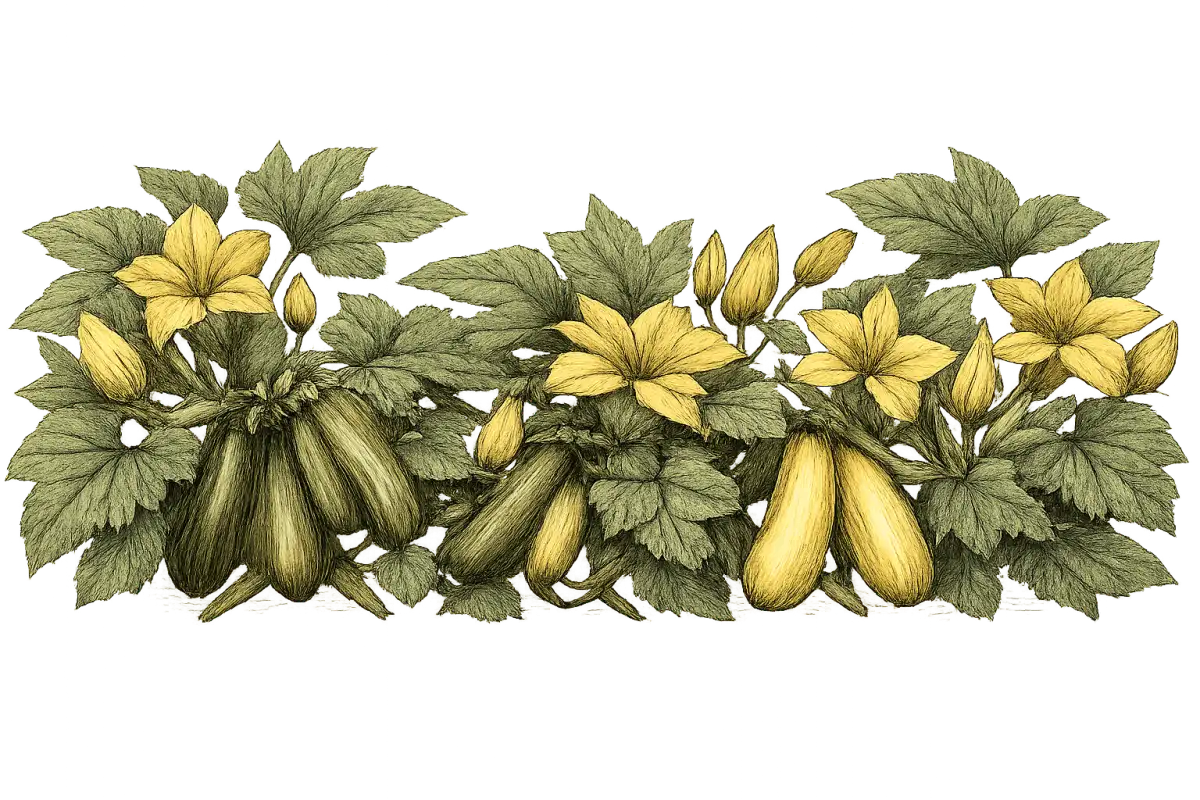
How to grow zucchini & squash — vintage botanical illustration showing the plant in detail

Zucchini & Squash at a Glance

Sun

Sun

6-10 hours

Soil pH

Soil pH

6.0-6.5

Water

Water

1 inch per week

Spacing

Spacing

4-6 ft

Days to harvest

Days to Harvest

45-65 days from seed, 35-50 from transplant

Height

Height

24-36 inches tall

Soil type

Soil

Well-drained

Lifespan

Lifespan

annual

Get your personalized growing data

Enter your zip code for frost dates, growing season, and soil type.

At some point every summer, someone hands you a zucchini the size of a small baseball bat and says "I just found it under a leaf." You take it home, slice into it, and find a fibrous, watery, seed-packed mess. You cook it anyway because you feel bad throwing it out. It tastes like nothing good.

This is the universal zucchini experience, and it does not have to be yours.

Here is the reality: summer squash is one of the fastest, most productive crops you can put in the ground. A single plant yields 6-10 pounds over the season. Two or three plants can reliably feed a family of four. When you get the fundamentals right -- correct variety for your zone, consistent water, disciplined harvesting -- squash produces with a generosity that borders on embarrassing.

The problems most people have are not complicated. They plant one variety and wonder why fruit set fails. They overhead-water every evening and then wonder where the powdery mildew came from. They miss a zucchini under a leaf for four days and then wonder why production stopped. They fertilize with high-nitrogen formulas and get enormous beautiful plants with no fruit. Every one of these outcomes is predictable, and every one of them is preventable.

There is also the vine borer problem, which is real and genuinely destructive if you garden east of the Rockies. We will cover that in detail. But for the majority of growers, the issues are simpler: wrong timing, wrong watering, wrong harvest size.

This guide covers all of it -- variety selection by zone, soil and feeding, water management, pest strategy, harvesting, and preservation. Read the sections that apply to you. Then go grow something.


Quick Answer: Zucchini & Summer Squash Growing at a Glance

USDA Zones: 3 through 10 (warm-season annual; timing varies significantly by zone)

Sun: 8-10 hours direct sunlight; 6 hours is the minimum and will cost you yield

Soil pH: 6.0-6.5; tolerates up to 7.5

Planting trigger: Soil temperature at 2-inch depth must reach 70F -- not just air temperature

Spacing: 2-3 feet between plants; hills 4-6 feet apart

Water: 1 inch per week; drip or soaker hose; never overhead if you can help it

Fertilizer: Balanced 10-10-10 at planting; side-dress at flowering; watch for nitrogen excess

Harvest size: Zucchini at 6-8 inches; yellow squash at 4-6 inches; pattypan at 2-4 inches diameter

Days to first harvest: 38-65 days from seed depending on variety

Yield per plant: 6-10 pounds over the season

Peak production duration: 6-8 weeks per planting before decline

Key technique: Succession plant every 3 weeks; check plants daily during production


The Soil Temperature Rule Nobody Follows (But Should)

Let's talk about why squash plantings fail before they start.

Every spring, gardeners who have been cooped up all winter rush to put seeds in the ground the week after last frost. The air is warm. They are optimistic. The seeds rot in the soil and germinate weeks later -- or not at all -- and the gardener blames the seed company.

The problem is soil temperature. Summer squash requires soil at 70F at a 2-inch depth for reliable germination. Air temperature gets there weeks before soil does. You can have daytime highs in the mid-60s with soil still sitting at 58F. At 58F, squash seeds sit and struggle. At 70F, they germinate in 5-10 days.

Buy a cheap soil thermometer. Use it. Your planting date is not your last frost date -- it is the date your soil actually reaches 70F.

Preparing the Bed

Squash are heavy feeders. They go from seed to harvestable fruit in 45-65 days, produce continuously, and support massive leaf canopies the entire time. Soil preparation is not optional.

The basics:

  • Work 2-4 inches of compost or well-rotted manure into the top 6-8 inches of soil before planting. Never use fresh manure -- the pathogen risk is real.
  • Target pH 6.0-6.5. Test before the season. Your local extension service runs tests for $15-30. Know your baseline; do not guess.
  • To raise pH, apply dolomite lime (which also adds calcium and magnesium). To lower it, apply elemental sulfur.
  • Drainage is non-negotiable. Squash roots sitting in waterlogged soil develop rot fast. If you have heavy clay, build raised beds or hill plant. Hill planting -- small mounds of amended soil 4-6 feet apart -- improves drainage at the root level and warms soil faster.

Black plastic mulch is worth considering in cool-climate zones. It warms soil 5-10F faster, which can move your planting date 1-2 weeks earlier. In zones 3-5, that is not a trivial advantage.

Apply organic mulch -- straw, compost, or shredded leaves at 3-4 inches deep -- but only after soil reaches 75F. Mulching cold soil insulates it and keeps it cold. Patience here pays off.

Feeding the Beast

Squash need a lot, but they need it balanced. This is where most gardeners go wrong.

At planting, mix a balanced granular fertilizer (10-10-10) into the planting area. During the first three to four weeks of vegetative growth, feed every two weeks at half strength with a balanced liquid fertilizer. Fish emulsion works well at this stage.

The most important fertilization event of the season is the side-dress at first female flower appearance. Apply 1/2 cup of 10-10-10 per plant in a ring 6-8 inches from the stem, scratch it lightly into the surface, and water it in. Do not pile fertilizer against the stem. During fruit production, continue feeding every 2-3 weeks at half strength.

The mistake that kills fruit production: too much nitrogen. High-nitrogen fertilizers -- lawn fertilizer, fresh manure, heavy fish emulsion -- produce exactly the wrong result. You get enormous, lush, dark-green plants with beautiful canopies and almost no fruit. The plant is essentially on a vegetative feeding frenzy and has no interest in making seeds. If this happens, stop all nitrogen immediately and switch to a phosphorus/potassium-focused feed like bone meal or kelp extract. Production should resume within 1-2 weeks.


Best Zucchini & Summer Squash Varieties by Zone

Variety selection is the highest-leverage decision you make for squash. The right variety for your zone and your specific pest pressure means less disease, fewer losses, and more productive plants from the same amount of work.

A note on squash types: all summer squash except Tromboncino belong to Cucurbita pepo. They are harvested immature with tender, edible rinds. Green zucchini, yellow straightneck, yellow crookneck, pattypan, and cousa are all summer squash. Tromboncino is Cucurbita moschata -- a different species that matters enormously if squash vine borers are your problem, which we'll get to.

What zone are you in?

Enter your zip code for frost dates, growing season, and soil type.

What zone are you in?

Enter your zip code for frost dates, growing season, and soil type.

Cold Zones (3-4): Race Against the Calendar

The growing window in zones 3 and 4 is tight -- 90 to 110 days between last and first frost. Soil reaches 70F in late May to early June. First frost arrives by mid-September. You get 2-3 succession plantings if you move quickly, and every day of maturity time matters.

Fast-maturing, disease-resistant varieties are the only logical choice here.

Green Machine (F1, 45 days) is your first-choice green zucchini. Fast to harvest, disease-resistant, open habit that makes finding fruit easy. From a late-May or early-June planting, you are eating by July. Sunglo (F1, 38-42 days) is the fastest disease-resistant variety on the market -- ideal for your last succession planting in late June to early July. If you need squash on the table quickly before frost closes the window, Sunglo gets there first.

Spineless Perfection (F1, 45 days) is worth growing for a practical reason: standard squash stems and leaf petioles are prickly. In zones 3-4 where you are checking plants every single day to maximize your short window, spineless plants are a quality-of-life improvement.

Dunja (F1, 47 days) brings genuine disease resistance -- powdery mildew, watermelon mosaic virus, zucchini yellow mosaic virus, and papaya ringspot virus -- which keeps plants productive for the entire short season instead of collapsing early.

For something different, Black Beauty (open-pollinated, 50 days) is the classic heirloom. Reliable producer. You can save seeds from year to year, which matters to some growers.

Zone 3-4 strategy: use black plastic mulch at every planting to gain that 5-10F soil warming advantage. Choose varieties 50 days or under for all plantings. Your last succession goes in late June to early July -- count back 55 days from your first frost date to confirm you have enough time.

Standard Zones (5-6): Great Conditions, One Serious Threat

Zones 5 and 6 offer 130-160 growing days and plenty of sun. Conditions are excellent for squash. The catch, if you garden east of the Rocky Mountains, is squash vine borer. In zones 5 and 6, adults emerge in late June to early July. A single larva can kill an otherwise healthy plant in days.

Variety selection here is partly about disease resistance and partly about timing your way around vine borers.

Dunja (F1, 47 days) is the gold standard for zones 5-6. Its disease resistance -- powdery mildew, watermelon mosaic virus, zucchini yellow mosaic virus, papaya ringspot virus -- extends productive plant life well into late summer when less-resistant varieties are already succumbing. Desert (F1, 48 days) adds cucumber mosaic virus resistance on top of everything Dunja covers, making it the broadest disease package available in a green zucchini.

For yellow squash growers: Success PM (F1, 50 days) is the right call. Its powdery mildew resistance is exceptional -- it stays green and productive in humid Midwest and Mid-Atlantic summers when other yellow squash are dead or dying.

Costata Romanesco (open-pollinated, 52 days) is worth growing for flavor alone. This Italian heirloom produces ribbed, gray-green fruit with dense, nutty flesh unlike anything you get from a hybrid. Less disease-resistant than Dunja, but worth the trade-off for at least one planting.

For vine borer defense: Tromboncino (C. moschata, 60 days) is the weapon of choice. This long-necked Italian squash is the most vine-borer-resistant summer squash available because its hard stem tissue is nearly impenetrable to larvae. It needs trellis space or room to sprawl, but if vine borers have destroyed your squash three years running, this is the solution. Plant it alongside a standard variety for reliability.

Zone 5-6 strategy: plant your first succession mid-May, then every three weeks through mid-July. Your July plantings naturally dodge the vine borer egg-laying window -- adults in most northern areas finish by mid-July. This is the most underused strategy in zone 5-6 gardening. Later plantings also face less squash bug pressure and carry into fall.

Long-Season Zones (7-8): Managing Heavy Pressure

Zones 7 and 8 give you 180-240 growing days. That sounds great, and it is -- if you can manage the pests. Two generations of squash vine borer. Persistent squash bugs all season. High summer humidity that drives powdery mildew and fungal disease. And extreme heat above 95F that causes blossom drop in midsummer.

Disease resistance is not optional here. It is the price of admission for a productive summer.

Dunja and Desert both belong in zone 7-8 gardens for the same reasons they work in zones 5-6, but the stakes are higher because disease pressure is heavier and the season is longer. Sunglo (F1, 38-42 days) earns its place at the other end of the spectrum: its speed lets you squeeze in extra successions before and after peak heat and pest windows.

Tatume (open-pollinated, 55 days) is a Mexican heirloom that deserves wider recognition. It is unusually heat-tolerant, handles temperatures that cause standard zucchini to stall, and has good vine borer tolerance. Round, light green fruit with a vining habit. If you have experienced midsummer production crashes from heat or vine borers, Tatume is worth growing.

Tromboncino (C. moschata, 60 days) is even more valuable in zones 7-8 than in zones 5-6, because two generations of vine borer rather than one dramatically raises the risk. Plant it on a trellis and let it climb -- it is a vigorous viner.

University of Maryland recommends planting the fall crop on July 1-15 in zone 7. This is the move that most zone 7-8 gardeners do not make, and it changes the game. Fall squash misses peak SVB pressure, faces reduced squash bug populations, and produces into November. Do it.

When temperatures exceed 95F, consider 30-40% shade cloth to prevent blossom drop. Extreme heat shuts down pollination -- pollen becomes nonviable, female flowers drop before setting fruit. Shade cloth and consistent watering are your tools against this.

Hot Zones (9-10): Two Windows, One Heat Gap

Zone 9-10 gardeners have nearly year-round potential -- and a brutal summer gap. Spring planting runs February through March. Spring harvest runs through May and June. Then temperatures hit 100F+ and production stalls. Fall planting begins again in August and September, with harvest running October through December (and longer in frost-free areas).

Work the two windows aggressively. Accept the gap.

Tatume is the standout variety for zones 9-10. It is genuinely heat-tolerant in ways that standard zucchini varieties simply are not. Where most zucchini stall and sulk above 95F, Tatume keeps going. Its vining habit is an advantage in this zone -- the long rambling stems can be trained away from paths and onto trellises. Desert (F1, 48 days) is the disease-resistance workhorse -- named appropriately, it performs in hot, dry conditions with broad disease protection.

Green Machine (F1, 45 days) and Sunglo (F1, 38-42 days) earn their spots through speed. Fast maturity means you produce more fruit before heat or cold closes each window. A 38-day variety planted in late February can have you harvesting before mid-April.

Tromboncino (C. moschata, 60 days) adds another C. moschata option for heat tolerance and pest resistance. Give it a trellis and room to run.

Zone 9-10 strategy: plant fast-maturing varieties (38-50 days) for both spring and fall windows. If attempting summer production, 30-40% shade cloth is nearly mandatory. Choose the sunniest spot in your yard for all plantings -- 8-10 hours of direct sun is your target even in hot zones.

Quick Reference: Top Picks by Zone

Zone GroupTop 3 VarietiesTypeWhy
3-4Green Machine, Sunglo, DunjaF1 HybridsFast maturity; disease resistance for short seasons
5-6Dunja, Desert, TromboncinoHybrid + C. moschataDisease resistance; vine borer insurance
7-8Dunja, Tatume, TromboncinoHybrid + OPHeat and pest pressure; two SVB generations
9-10Tatume, Desert, Green MachineOP + F1 HybridHeat tolerance; fast maturity for two short windows

Watering: The Method Matters More Than the Amount

The target water requirement for summer squash is simple: 1 inch per week from rainfall or irrigation. The University of Minnesota, University of Maryland, South Dakota State, and Oregon State extension programs all land on the same number. Adjust upward during hot spells above 90F, during peak fruit production when plants transpire heavily, and in sandy soils that drain quickly. Reduce when rain is abundant.

That part is easy. What trips people up is how they deliver that water.

Drip Irrigation Is the Answer

Every major extension program recommends drip irrigation or soaker hoses for squash. This is not a matter of debate or gardener preference. Overhead watering is genuinely harmful to squash in a way that is not true for every plant.

Here is the mechanism: wet foliage creates the warm, humid microclimate that powdery mildew, downy mildew, anthracnose, and bacterial leaf spot all require to establish and spread. The powdery mildew spores germinate on dry leaf surfaces in humid air -- and overhead watering creates exactly that combination, warm air thick with moisture and leaf surfaces that stay damp for hours. Soil splashing onto lower leaves carries soilborne pathogens directly to plant tissue.

Drip irrigation eliminates all of this. Water goes to the root zone. Foliage stays dry. Disease pressure drops dramatically. The setup is not expensive -- lay drip tape along the base of plants with emitters 6-12 inches from the stem, run 30-60 minutes per session, and add a $15-30 battery timer for automated consistency.

Soaker hoses work nearly as well and are cheaper to set up. They are less precise than drip emitters but keep leaves dry and deliver water slowly to the root zone.

If overhead watering is your only option, water before 7 AM so leaves dry quickly. Never water in the evening. Wet leaves overnight dramatically increases disease risk, full stop.

Water Deeply, Not Frequently

The goal is moisture at 6-8 inches deep. Shallow, frequent watering grows shallow roots. Shallow roots cannot sustain a large squash plant through heat stress. Water deeply and let the top inch of soil dry between waterings. Push a finger or a probe into the soil -- if it is moist at 6-8 inches, you have done your job.

Flowering and Fruit Set: The Critical Window

Inconsistent watering during flowering and early fruit set is the direct cause of blossom end rot. That dark, water-soaked rot on the bottom of developing fruit is not caused by low calcium in most cases -- most soils have plenty of calcium. It is a calcium transport failure. Calcium moves through the plant only via transpiration, and when water supply fluctuates, calcium transport stops. Developing fruit cells that do not get calcium at the right moment die and rot.

This is the period where drip irrigation with an automated timer most clearly pays for itself. Rock-steady moisture delivery during the four to six weeks of peak flowering and fruit set prevents blossom end rot more reliably than any other single action.

Normal Afternoon Wilt: Do Not Panic

Large-leaved plants like squash wilt on hot afternoons even with perfectly adequate soil moisture. This is normal transpiration stress -- the leaves are losing water faster than roots can replace it during peak heat. If the plant recovers fully by the next morning, your watering is fine. Check soil moisture at 6-inch depth before reaching for the hose.


Pests: The Ones That Actually Matter

Six pests account for nearly all insect damage to summer squash in home gardens. Three of them require active management. The others can be handled reactively.

Squash Vine Borer: Know Your Geography

If you garden east of the Rocky Mountains, squash vine borer is a real threat and you need a plan for it. If you garden west of the Rockies, vine borers are rare to absent. Pacific Northwest and California gardeners can largely ignore this section and focus elsewhere.

For everyone east of the Rockies: the adult is a day-flying moth that resembles a wasp -- metallic greenish-black front wings, orange-red abdomen. It lays flat, reddish-brown eggs singly at the base of squash stems. Eggs hatch in 7-10 days. Larvae bore directly into the stem and feed inside for 4-6 weeks, destroying the vascular tissue. By the time you notice the wilting, they have been at work for days.

The diagnostic sign is frass at the stem base -- moist, greenish or orange sawdust that looks like someone sprinkled wet wood shavings at the soil line. If you see frass, you have vine borers.

Timing varies by zone:

  • Zone 8-10 (Deep South): adults emerge late April to May
  • Zone 7 (Mid-Atlantic, Southeast): late May to early June
  • Zone 5-6 (Midwest, Northeast): late June to early July
  • Zone 3-4 (Upper Midwest, New England): early to mid-July

Zones 3-6 see one generation per year. Zones 7-10 see two -- which is why the problem is so much harder to manage in the South.

Prevention options, ranked:

1. Row covers from planting through flowering. Remove for pollination (unless using parthenocarpic varieties that set fruit without bees). Prevents moth access entirely.

2. Delayed planting. In zones 5-6, a July planting naturally misses the adult egg-laying window. Shorter season, zero vine borer damage. This works.

3. Stem wrapping. Wrap the bottom 2-4 inches of stems with aluminum foil. Prevents egg-laying and blocks young larvae. Rewrap every 10 days as stems thicken.

4. Trap crop with Blue Hubbard squash. Plant Blue Hubbard around the garden perimeter 2-3 weeks before your main crop. Vine borers preferentially attack Hubbard. Monitor the trap crop and destroy concentrated pests before they reach your main planting.

5. Grow resistant species. Tromboncino (C. moschata) is the most vine-borer-resistant summer squash you can grow. Its stem tissue is hard enough that larvae struggle to penetrate it. Butternut (C. moschata) is practically immune -- but that is a winter squash.

If you find frass: Perform vine surgery immediately. Slit the stem lengthwise at the entry point with a sharp knife. Find the cream-colored grub with the brown head -- it can be up to an inch long -- and kill it. Mound moist soil over the wound and keep the plant well-watered. Plants can recover if caught early enough.

Squash Bugs: Check the Undersides

Squash bugs -- dark brown, 5/8-inch shield-shaped insects that smell terrible when crushed -- overwinter as adults and emerge to lay neat rows of orange-yellow eggs on leaf undersides. Adults and nymphs suck plant juices and inject a toxin that causes leaves to wilt, blacken, and die. Heavy infestations kill plants outright.

The most effective single action is checking leaf undersides weekly and scraping off egg masses with a butter knife or tape. Do this consistently and you manage squash bugs without ever reaching for a spray bottle. Hand-pick adults and nymphs in the morning when they are sluggish. Place boards under plants at night -- bugs congregate underneath -- and destroy them in the morning. Remove all plant debris at season end to eliminate overwintering habitat.

Cucumber Beetles: The Disease Problem

Striped cucumber beetles (yellow-green with three black stripes) and spotted cucumber beetles (yellow-green with 11 black spots) are present through most of the eastern United States. The feeding damage is bad enough on its own. But the real danger is that cucumber beetles are the primary vector for bacterial wilt (Erwinia tracheiphila). Once a plant has bacterial wilt, there is no cure. Row covers at planting, kaolin clay (Surround) applied to leaves and stems, and neem oil repellent all reduce exposure. Yellow sticky traps monitor population levels.

Aphids, Spider Mites, and Pickleworms

Aphids (melon aphid, Aphis gossypii) cluster on leaf undersides, transmit cucumber mosaic virus, and spread rapidly. A strong spray of water knocks them off and, repeated every few days, keeps populations down. Encourage natural predators -- ladybugs, lacewings, parasitic wasps. Avoid broad-spectrum insecticides that wipe out the beneficial insects doing your pest management for free.

Spider mites explode in hot, dry conditions. The giveaway is fine webbing on leaf undersides and pale, stippled leaf surfaces. Strong water spray and two applications of insecticidal soap five days apart handle most outbreaks.

Pickleworms are primarily a problem in zones 8-10. They tunnel into flowers, buds, and fruit. Spinosad spray applied in the evenings when buds and flowers first appear -- repeat every seven days -- is the organic control of choice.

What zone are you in?

Enter your zip code for frost dates, growing season, and soil type.

> Not sure where to put your squash plants? Our tool maps the sun and shade patterns across your exact yard and tells you the best placement for maximum yield -- plus variety recommendations matched to your zone and pest pressure. $9.99 for your personalized guide. Find My Best Spot


The Mistakes That Waste an Entire Season

After everything above, here are the specific errors that most reliably destroy a squash planting. We have ranked them by frequency.

Mistake #1: Letting Fruit Grow Too Large

Zucchini grows from 4 inches to 12-plus inches in 2-3 days. Large leaves hide developing fruit. You miss one under a leaf. You find it four days later looking like a green torpedo. You laugh, take a photo, and lose two weeks of production.

Here is what happens biologically: an oversized squash tells the plant that its reproductive mission -- maturing seeds -- is nearly complete. The plant shifts resources away from producing new fruit. Even one baseball bat left on the plant long enough can dramatically slow production.

Check plants every day. Lift every leaf. Harvest at the right size: zucchini at 6-8 inches, yellow straightneck and crookneck at 4-6 inches, pattypan at 2-4 inches diameter. Use the thumbnail test -- if your thumbnail dents the skin easily, it is ready; if the rind resists your nail, it is overripe. If you find a hidden giant, remove it immediately even if it is too large to eat well. Removing it restarts production. Oversized zucchini can be shredded for bread, muffins, or cake -- no waste necessary.

Mistake #2: Panicking Over Male-Only Flowers

Male flowers appear 1-2 weeks before female flowers. This is normal squash biology. Males outnumber females 10:1 early in the season. If you are seeing flowers but no fruit, look at the base of each flower: a male has a long, thin stem and no swelling. A female has a tiny miniature fruit (the ovary) visible at the base.

Wait for female flowers. They arrive within 1-2 weeks of the first males. If after three or more weeks you still have no female flowers, check nitrogen levels -- excess nitrogen suppresses flowering -- and confirm the plant is getting at least 6 hours of direct sun.

Mistake #3: Overhead Watering (Already Covered -- Still Worth Repeating)

We covered this in the watering section, but it is the third most common season-wrecking mistake. Powdery mildew kills squash plants mid-summer faster than almost anything else, and overhead watering is the primary accelerant. Switch to drip or soaker hose. If overhead is your only option, morning only, before 7 AM.

Mistake #4: No Succession Planting

Every squash planting has a natural productive lifespan of 6-8 weeks. After that, powdery mildew accumulates, pest populations grow, and yields drop. If you plant once in May, you get a glut in July and nothing after that. Succession plant every three weeks from last frost through mid-summer. Each planting needs 50-60 frost-free days remaining.

In zone 6 with a May 15 last frost date, that means plantings on roughly May 15, June 5, June 25, and July 15. The July 15 planting should use a fast-maturing variety -- 38-45 days -- to finish before frost. When older plants decline, pull them and let the next succession carry production. No gap.

Mistake #5: Poor Pollination Management

Female flowers are receptive for one day -- the day they open, before about 9 AM. Each female flower needs 12-15 bee visits for complete pollination. If bee activity is low (due to pesticide use, cold or rainy weather, or an urban location with few pollinators), fruit will not set. You will see tiny fruit start forming, then yellow, shrivel, and drop.

Hand-pollinate in early morning when flowers are freshly open. Pick a male flower, peel back the petals, and roll the pollen-bearing stamen directly onto the stigma of an open female. One male pollinates 1-2 females. Successful pollination: the tiny fruit grows visibly within 24-48 hours.

Plant bee-friendly flowers nearby -- sunflowers, zinnias, borage, lavender. Avoid all pesticide applications during bloom, especially in the morning when bees are most active.

Mistake #6: Eating Bitter Squash Without Checking

If your harvested squash tastes noticeably bitter, stop eating it. The bitter compound is cucurbitacin, a naturally occurring toxin in cucurbits. High cucurbitacin levels cause serious gastrointestinal distress. Discard extremely bitter squash and do not eat it to be polite.

Triggers include drought stress, extreme temperature swings, nutrient deficiency, and cross-pollination with ornamental gourds. Maintain consistent watering and nutrition. Do not plant summer squash near ornamental gourds. Do not save seeds from plants that grew near ornamental gourds.


Harvesting: Pick Small, Pick Often, Pick Every Day

The single most important harvesting principle is not complicated: pick early and pick often. Young squash at the correct size is more tender, more flavorful, and more nutritious than anything you can buy at the store. Letting fruit grow too large degrades quality in every measurable way and signals the plant to slow production.

Ideal harvest sizes:

  • Zucchini: 6-8 inches long; maximum 10 inches before quality drops
  • Yellow straightneck and crookneck: 4-6 inches long
  • Pattypan/scallop: 2-4 inches diameter
  • Cousa: 3-5 inches long

Use the thumbnail test before every harvest. Dents easily -- harvest now. Won't dent -- already overripe.

How to Cut, Not Pull

Use a sharp knife, pruning shears, or scissors. Cut the fruit from the vine leaving 1-2 inches of stem attached. Never pull or twist -- this damages the plant and can break stems in ways that invite disease. Cut cleanly. Handle harvested squash gently; the skin bruises easily and bruises lead to faster spoilage. A shallow basket is better than a deep bucket.

Harvest in the morning. Fruit is firmest and coolest. Do not harvest when vines are wet -- handling wet plants spreads disease.

During peak production, a single zucchini plant can produce 2-4 squash per day. Check plants daily. Harvesting every 1-2 days stimulates continued flowering and fruit production. This is not optional maintenance -- it is the mechanism that keeps the plant producing.

When Production Outpaces Eating

This happens. Here is what to do with the overflow:

Freezing is the most versatile preservation method. For shredded zucchini (the most useful form): wash and grate, steam blanch 1-2 minutes until translucent, cool immediately, drain thoroughly by squeezing with cheesecloth or spinning in a salad spinner. Removing excess water is critical -- zucchini is 95% water and frozen-thawed releases even more. Pack in recipe-sized portions (1 cup, 2 cups per bag) and freeze flat. Quality holds for 10 months. Goes directly into zucchini bread, muffins, cake, pancakes, pasta sauce, or meatloaf.

For frozen sliced: cut into 1/2-inch slices, blanch 3 minutes, ice bath 3 minutes, drain, freeze flat on a sheet pan before bagging. Use within 10 months in soups, stews, and stir-fry.

Dehydrating produces zucchini chips that keep up to a year. Slice into uniform 1/4-inch rounds, season optionally, and dry at 125F in a dehydrator for 8-12 hours until brittle. Store in airtight containers in a cool, dark location.

Pickling works well for quick refrigerator pickles (ready in 24 hours, keeps 2-3 weeks) or shelf-stable bread-and-butter pickles processed in a water bath.

One critical safety note: the USDA withdrew its recommendations for pressure canning plain sliced or cubed summer squash. The density and texture make safe processing times uncertain and botulism risk is real. Only can zucchini using tested pickling or acid-added recipes. This is non-negotiable.

What zone are you in?

Enter your zip code for frost dates, growing season, and soil type.

> Your yard is unique. Your planting plan should be too. We map the exact sun exposure across your property and tell you precisely where to place squash for maximum production -- plus personalized variety picks and a succession planting calendar matched to your zone. $9.99. Get Started


Frequently Asked Questions

Why Are My Squash Plants Flowering But Producing No Fruit?

Three possible causes, in order of likelihood. First, and most common early in the season: you only have male flowers. Male flowers appear 1-2 weeks before females and outnumber them 10:1 early on. Look at the base of each flower. No swelling -- it is male. Tiny miniature fruit visible -- it is female. Wait for females to arrive.

Second: poor pollination. Female flowers are receptive for one day. If bees are absent or inactive due to pesticide use, cold weather, or rain, pollen does not get transferred and fruit fails to set. Hand-pollinate in early morning using a freshly opened male flower.

Third: too much nitrogen. If you have abundant female flowers and pollination is happening but fruit still fails to set or drops early, check your fertilizer. High-nitrogen feeding produces lush vegetative growth at the expense of fruiting. Stop nitrogen applications and shift to phosphorus/potassium.

How Many Squash Plants Do I Actually Need?

For fresh eating for a family of four, two to three plants per succession planting is sufficient. With succession planting every three weeks, six to twelve plants total over the season covers fresh eating well. If you want to preserve -- freeze, pickle, dehydrate -- plan four to six plants per succession. That is twelve to twenty-four plants over the season. This sounds like a lot until you remember that production peaks for 2-3 weeks and then declines. You need enough plantings to cover the gaps.

Can I Grow Squash in Containers?

Yes, with the right varieties. Standard squash plants are large and need substantial root space. Compact and container-bred varieties work well. Astia (F1, 48 days) was bred specifically for containers -- French variety, 5-gallon minimum. Bush Baby (50 days) is one of the smallest zucchini plants available. Eight Ball (open-pollinated, 55 days) produces round fruit and can be trellised. Use containers at least 5 gallons in size. Container plants need more frequent watering since the root zone dries out faster than in-ground beds. Feed regularly -- containers leach nutrients more quickly too. The payoff is that containers give you complete control over soil quality and drainage.

What Is the Best Single Variety for a First-Time Squash Grower?

Dunja (F1, 47 days) is the answer for zones 3-8. It produces reliably, resists the most common diseases that kill squash mid-season, sets fruit even with lower pollinator activity, and matures fast enough to fit any zone's window. It will not produce the most complex flavor you have ever tasted -- Costata Romanesco wins that contest -- but it will produce consistently and without drama while you learn the system. Once you have a handle on harvesting timing, succession planting, and watering, add an heirloom variety alongside Dunja for the flavor experience.

For zones 9-10, substitute Tatume as the primary variety. Its heat tolerance where Dunja stalls is the difference between a productive season and a disappointing one.

Why Did My Plant Suddenly Wilt Overnight?

Two likely causes. First, if you are east of the Rockies and it is late June through early August, suspect squash vine borer. Check the stem base for frass -- moist, sawdust-like material at the soil line. If frass is present, perform vine surgery immediately: slit the stem at the entry point, kill the larvae, mound moist soil over the wound, keep well-watered. Act fast.

Second, suspect squash bugs or bacterial wilt. Slit a wilting stem cross-sectionally and check for brown or black vascular discoloration, which indicates bacterial wilt. If the vascular tissue is discolored and you see strings of bacterial slime when you slowly pull the cut stem apart, bacterial wilt is the diagnosis. There is no cure. Remove the plant. Cucumber beetles transmitted it; reduce their population on remaining plants.


The Bottom Line

Squash is one of the most forgiving and productive crops you can grow, until it is not. The failures are nearly always the same: wrong planting timing, overhead watering that invites disease, letting fruit get too large, planting once and expecting continuous harvest all summer, and ignoring vine borers in zones where they matter.

Fix those five things and you fix most of what goes wrong.

Pick varieties with disease resistance built in -- Dunja and Desert for zones 3-8, Tatume for heat-stressed zones 7-10, Tromboncino wherever vine borers are your primary threat. Get your soil to pH 6.0-6.5 with abundant compost worked in. Use drip or soaker irrigation. Harvest at the right size every single day during production. Succession plant every three weeks.

Do those things and you will have more squash than you know what to do with. Which is, admittedly, its own problem -- one that the freezer section above is designed to solve.

Research for this guide was synthesized from university extension programs including the University of Minnesota, University of Maryland, Oregon State University, South Dakota State University, University of Maryland Extension, and additional regional extension sources. Variety performance data and pest management recommendations are based on published extension and university trial data.

Where Zucchini & Squash Grows Best

Zucchini & Squash thrives in USDA Zones 5, 6, 7, 8. Explore each zone's complete guide for growing tips, companion plants, and seasonal advice.

Also possible in: Zone 3, Zone 4, Zone 9, Zone 10 (challenging but possible with the right conditions).

Not sure of your zone? Look it up by zip code →