 Where to Plant
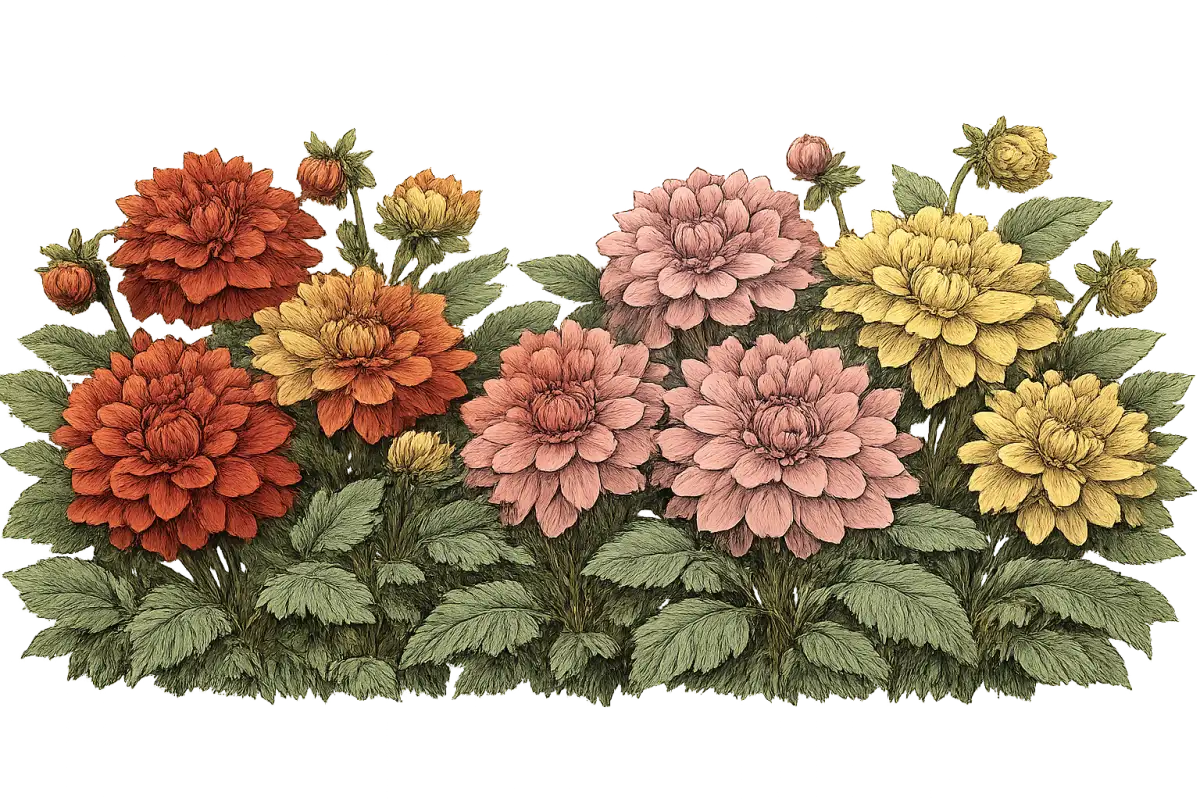
There is a moment in late August when a dahlia garden reaches its full expression — dinner plate blooms the size of a child's face, ball dahlias in lacquered coral and burgundy, cactus types with petals that spiral like fireworks — and it stops people mid-step. I have seen it happen in gardens I have visited across the country. The plants command attention in a way almost nothing else in the ornamental world can match.
What makes that moment remarkable is how unlikely it seems from the starting point. You begin with a tuber that looks like a small, shriveled hand. You place it in the ground in spring, and if you do not touch it — do not water it, do not fuss over it — it slowly becomes something extraordinary. Dahlias reward patience and restraint in their early weeks, then reward generosity and attention in their peak weeks, and then ask you to tuck them safely away for winter. They operate on their own clear terms.
Those terms are the subject of this guide. Dahlias are not temperamental plants, but they do have specific needs — and two or three of those needs are the kind where getting them wrong means nothing grows at all. Understanding drainage, knowing when not to water, choosing varieties suited to your zone, and keeping up with deadheading are what separate a garden that stops people in their tracks from one that produces a few straggling blooms before sulking into September.
Whether you are planning your first planting or trying to understand why last year's tubers never came up, this guide covers everything from soil preparation through overwintering, with specific variety recommendations for every zone from Minnesota to Southern California.
Quick Answer: Dahlias at a Glance
USDA Zones: 3-11 (dig tubers in zones 3-7; leave in ground in zones 8-11)
Sun: Minimum 6 hours direct sunlight daily; 8+ hours ideal
Soil: Well-drained, slightly acidic to neutral (pH 6.0-7.0); drainage is non-negotiable
Planting depth: 4-6 inches deep, eye facing up; cover with 2-3 inches initially
Spacing: 18-24 inches; dinner plate varieties up to 3 feet apart
Water: Do NOT water after planting until shoots emerge; then deep, infrequent watering
Fertilizer: Low nitrogen, higher phosphorus and potassium (5-10-10); stop by late August
Stakes: Install at planting time, before covering the tuber — never after
First blooms: Approximately 8 weeks after planting; peak bloom August through September
Bloom colors: Every color except true blue — white, cream, yellow, peach, orange, pink, red, dark red, purple, near-black, and countless bicolors
The One Thing That Kills Most Dahlias (And It Is Not What You Think)
Before we talk about beauty and variety selection and how to build a cutting garden that carries you through autumn, there is something you must understand. It is not glamorous, but getting it wrong ends your dahlia season before it starts.
Do not water your tubers after planting.
Not even a little. Not "just to settle the soil." Not "just a quick drink to get them going." Every source on dahlia growing agrees on this single rule more than any other: dormant tubers sitting in moist soil rot. They rot because a dormant tuber cannot absorb or use water. The moisture simply sits around it, providing the perfect environment for fungal and bacterial rot to take hold. You plant a firm, healthy tuber in May and dig up a soft, disintegrating mass in June — and wonder what went wrong.
The tuber contains enough moisture to initiate growth on its own. Your job is to leave it alone. Shoots typically emerge within 2-3 weeks but can take up to 5 weeks. The patience required during this waiting period is the hardest thing about growing dahlias. Resist it.
The only exception is genuinely bone-dry soil with no rain forecast for weeks — in that rare situation, a single light watering is acceptable. But in most spring gardens, the soil has more than enough residual moisture. Trust the tuber.
The second piece of this same problem: drainage. Dahlias require well-drained soil with an almost-unreasonable conviction. Even when you are not actively watering, a low-lying bed or heavy clay soil that holds water after rain creates the same conditions as overwatering. Before you plant a single tuber, test your drainage. Dig a hole 12 inches deep, fill it with water, let it drain, fill it again. If that second fill takes more than four hours to empty, your soil needs amendment or you need raised beds. A 12-inch raised bed filled with a mix of garden soil, compost, and perlite solves drainage problems permanently and warms up faster in spring — both significant advantages.
Get the drainage right. Do not water before shoots emerge. These two things prevent the vast majority of dahlia failures.
Choosing Your Dahlias: Form, Color, and Purpose
This is where dahlia growing becomes genuinely delightful, because the range of choice is staggering. The American Dahlia Society recognizes approximately 14 flower forms. Nine of them appear regularly in home gardens, and each creates a different effect.
Dinner plate dahlias — officially called decorative dahlias in the large and giant classes — are what most people picture when they imagine a dahlia at its most dramatic. Blooms reach 8-12 inches across on plants that stand 3-5 feet tall. Cafe au Lait is the most requested dahlia in the world right now, and with reason — its creamy, blush-peach tones photograph beautifully and work in everything from cottage gardens to modern arrangements. Thomas Edison offers a deep, saturated royal purple that makes a vivid statement at the back of a border. Kelvin Floodlight produces enormous clear yellow blooms with surprising stem strength. Penhill Dark Monarch brings a dark burgundy-plum so rich it reads almost black in certain light. All dinner plate varieties require heavy staking and are best grown with disbudding — removing the two side buds when three appear at a branch tip — to concentrate the plant's energy into one spectacular central bloom.
Ball dahlias are among the best-designed cut flowers in existence. Their globe-shaped blooms are densely packed with petals that spiral precisely to the center, and they last significantly longer in a vase than dinner plates. Wizard of Oz in salmon pink is both prolific and stunning in arrangements. Jomanda in dark orange-red has exceptional vase life. Cornel in dark red is a reliable, unfussy producer that blooms steadily from midsummer through frost.
Pompon dahlias are ball dahlias scaled down to under 2 inches — perfectly round, endlessly charming, and extraordinarily prolific. Franz Kafka in purple is one of the best-known pompons, producing masses of round blooms with geometric precision. Little William in red and white bicolor adds a playful note to borders and mixed arrangements. Pompons tend to bloom earlier than dinner plates and handle heat somewhat better, making them particularly good choices in zones 3-5 where the season is short.
Cactus and semi-cactus dahlias have pointed, reflexed petals that spiral outward like fireworks, giving them an architectural quality that suits modern and naturalistic gardens equally well. Nuit d'Ete in dark red and Alfred Grille in a pink-and-yellow blend are two cactus classics. Karma Choc in dark chocolate-maroon is a semi-cactus type that has become enormously popular for its unusual coloring.
For pollinator gardens and relaxed, naturalistic plantings, single dahlias — open-centered, daisy-like blooms — are the most ecologically generous choice. Bees access the pollen with ease, something they cannot do in the dense doubles. The Bishop series — Bishop of Llandaff with its scarlet blooms against near-black foliage, Bishop of Canterbury in purple — are among the most striking dahlias in any form, and their dark foliage extends their ornamental value well beyond bloom time.
Collarette and anemone types offer beautiful mid-sized flowers with interesting centers. Boogie Woogie in yellow and pink is one of the most distinctive anemone dahlias available, with a pincushion center that draws the eye in the garden. Waterlily types like Karma Sangria produce broad, cupped blooms with a refined elegance that reads as more restrained than dinner plates — beautiful in gardens where you want impact without drama.
The one color missing from this entire genus: true blue. Dahlias come in virtually everything else — white through cream through gold through every shade of orange, the full spectrum of pinks, cherry red through dark maroon, lavender through purple through near-black — but blue does not exist in dahlias. If your garden palette requires blue, pair dahlias with salvias, agapanthus, or Russian sage.
Best Dahlias by Zone: What to Grow and When to Plant
Dahlias are native to the highlands of Mexico, tender perennials that are only truly cold-hardy in USDA zones 8-11. In zones 3-7, which is where most American dahlia gardeners live, tubers must be dug and stored each winter. This is less inconvenient than it sounds — the digging process is simple, and the storage requirements are modest — but it does mean your zone shapes not just which varieties you grow but how you manage your entire season.