Cold Zones (3-4): Perennials Are Your Foundation
In zone 3 — where winter temperatures plunge to -40F — D. purpurea rosettes often winterkill before getting their chance to bloom, making it an unreliable choice. The true perennial species are your foundation here, and they are beautiful in their own right.
D. grandiflora (yellow foxglove) is the standout for cold climates. Hardy to zone 3, it returns reliably year after year without any biennial management, producing elegant pale yellow spikes on 2-3 foot plants. Pair it with D. lutea (straw foxglove), another zone-3-hardy perennial with refined, creamy-yellow bells of a smaller scale — it has a delicate, woodland-garden quality that pairs beautifully with ferns and hostas.
For immediate summer color in zones 3-4, treat Dalmatian series hybrids as annuals. They will not overwinter at these temperatures, but they bloom their first season and bring that foxglove presence to the garden while your perennial species establish.
In zone 4, D. purpurea becomes worth attempting with 3-4 inches of winter mulch (evergreen boughs or straw) laid over the rosettes after the ground freezes. Site these carefully — south-facing, wind-sheltered spots give them the best chance of reaching the second-year bloom. The Camelot series may also overwinter in mild zone 4 winters.
Standard Cold Zones (5-6): The Foxglove Sweet Spot Begins
Zone 5 is where D. purpurea becomes a reliable performer. This is the northern edge of consistent self-sowing, though late spring frosts can occasionally nick emerging flower stalks. Shelter matters — a south-facing wall or a position among established shrubs offers meaningful protection.
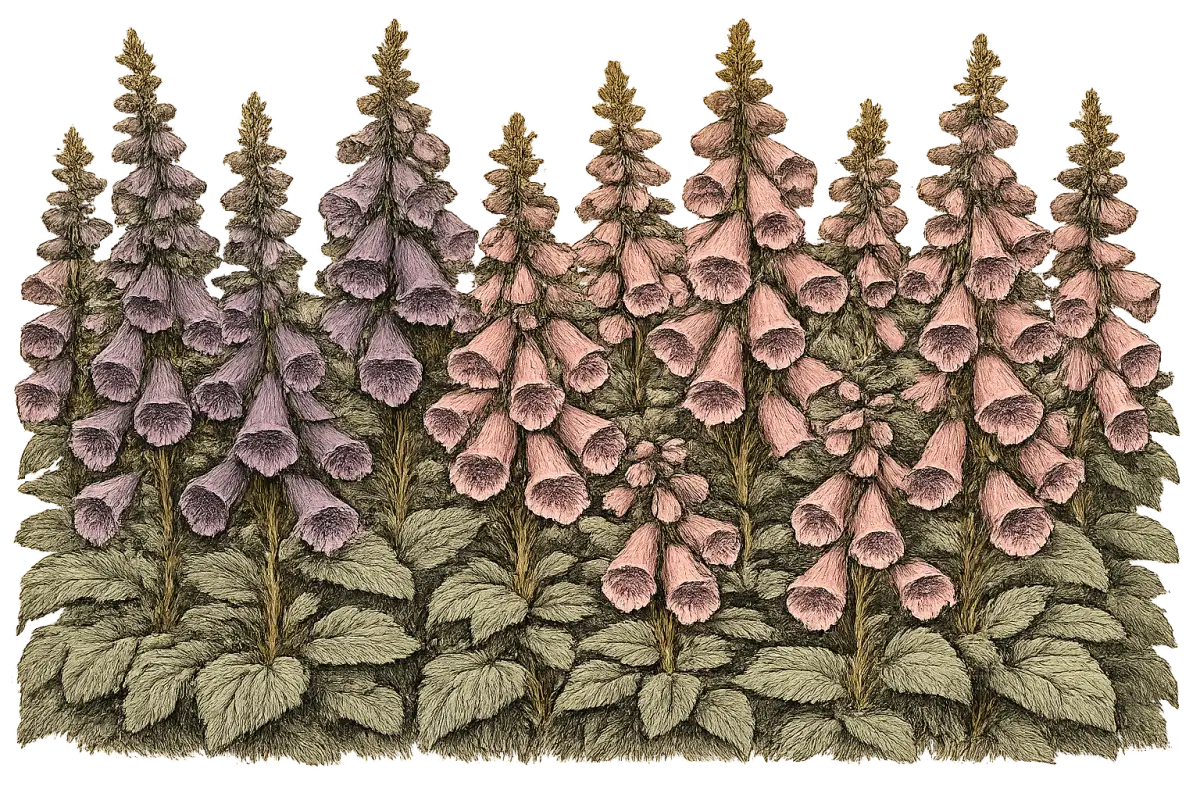
'Excelsior' is the variety to reach for first in zones 5-6. Standing 4-5 feet tall, it was bred so that flowers face outward from the spike rather than downward, dramatically improving the garden display. 'Pam's Choice' brings something more refined: pure white flowers with striking maroon-spotted throats, elegant in both cottage and more formal settings. 'Alba' is a crisp, pure white form — luminous in partial shade, particularly striking in evening gardens.
For a shorter alternative, 'Foxy' reaches only 2.5-3 feet and can even be coaxed to bloom in its first year if started early enough indoors. The perennial D. ferruginea (rusty foxglove) is worth seeking out in zone 5 — its unusual copper-toned flowers on 3-5 foot spikes create an architectural drama quite different from the spotted bells of D. purpurea.
The first-year hybrids — Camelot Lavender, Camelot Rose, Camelot White, and the full Dalmatian color range — perform reliably in zones 5-6. Camelot, at 4 feet, gives you that same towering effect as the biennial species with guaranteed first-year bloom. Dalmatian, at 16-20 inches, is the right choice for borders where tall spikes would be out of scale, and the only foxglove genuinely suited to container culture.
The Prime Zones (6-7): All Bets Are On
Zones 6-7 are prime foxglove territory. Every category thrives. D. purpurea self-sows prolifically and, once established, creates colonies that sustain themselves season after season with almost no effort beyond leaving a few seedheads standing in summer.
The full color palette of D. purpurea is available here: the classic mixed pinks, purples, and creams of the species; the outward-facing blooms of 'Excelsior'; the white-throated elegance of 'Pam's Choice'. Layer in D. grandiflora and D. lutea for perennial structure and a softer yellow note in the planting, and add D. ferruginea for its striking copper-toned spikes — all three return reliably in zones 6-7 without any biennial management.
In zone 7, light becomes the critical variable. Morning sun with afternoon shade is the ideal exposure — this produces the strongest stems and the longest-lasting blooms. Full sun in zone 7 is manageable but begins to shorten the bloom period noticeably. Site foxgloves on the east side of structures, under the dappled canopy of deciduous trees, or at the back of borders where taller shrubs provide afternoon protection.
Warm Zones (8-9): Hybrids and the Heat-Tough Species
Zones 8-9 change the calculus. D. purpurea requires cold vernalization to trigger its second-year bloom, and that winter cold becomes insufficient in zone 9 and parts of zone 8b. Heat stress in summer compounds the challenge — foxgloves planted in full sun in warm climates wilt, scorch, and produce poor blooms.
In zone 8, D. purpurea still performs with careful siting — afternoon shade is mandatory, not optional. Shaded microclimates with consistent moisture (under deciduous trees with northern or eastern exposure) allow it to thrive and even self-sow in favorable spots.
In zone 9, the first-year hybrids are the practical solution. Plant Camelot or Dalmatian as cool-season plants: set out in fall, enjoy spring bloom, remove before summer heat arrives. They bypass the vernalization problem entirely by blooming in their first season. Treat them as you would a larkspur or sweet pea — a cool-season performer with a defined window.
D. ferruginea is the most heat-tolerant of the perennial foxgloves — its Mediterranean origin gives it a genuine resilience to warm climates that other Digitalis species lack. In zones 8-9, it is the perennial species most worth building around. D. lutea also performs respectably in warm climates when given afternoon shade.
For all warm-zone foxgloves: afternoon shade is essential. Morning sun with afternoon protection is the winning exposure. Position plants on east-facing walls, beneath deciduous trees, or north-facing fences where summer heat is filtered.
Quick Reference Table: Top Picks by Zone Group
| Zone Group | Top 3 Picks | Type | Why |
|---|
| 3-4 | D. grandiflora, D. lutea, Dalmatian | Perennial / Annual hybrid | Cold-hardiest options; perennials return reliably |
| 5-6 | 'Excelsior', 'Pam's Choice', Camelot | Biennial / F1 hybrid | Full D. purpurea performance; first-year option available |
| 6-7 | D. purpurea (mixed), D. ferruginea, Camelot | Biennial / Perennial / F1 | All types thrive; self-sowing colonies easily established |
| 8 | D. purpurea (shaded), D. ferruginea, Camelot | Biennial / Perennial / F1 | Afternoon shade essential; ferruginea most heat-tolerant |
| 9 | Camelot, Dalmatian, D. ferruginea | F1 hybrid / Perennial | Hybrids bypass vernalization; ferruginea handles heat |
Soil and Light: Getting the Foundation Right
Foxgloves evolved in the woodland edges and clearings of Western Europe, where the soil is deep with decomposed leaf litter, reliably moist but never soggy, and naturally acidic. Understanding that origin tells you almost everything about what they need.
Soil pH: Acidic Is Right
The ideal soil pH for foxgloves is 5.5-6.5. This is genuinely important — at pH 7.0 and above, iron and manganese become less available, and you will see yellowing between leaf veins and reduced growth. At pH above 7.5, foxgloves struggle significantly.
Test your soil before planting. Home testing kits are available at most garden centers, or send a sample to your cooperative extension service for a more thorough analysis. If your pH is above 6.5, work elemental sulfur into the bed — roughly 1-2 pounds per 100 square feet to drop the pH by one point. Sulfur works slowly (3-6 months in active soil), so apply it the fall before a spring planting if possible. Monitor pH every 2-3 years, especially if your irrigation water is alkaline — hard water gradually raises soil pH with every watering.
In the Pacific Northwest, many gardeners grow foxgloves with minimal soil amendment because regional soils are naturally acidic and rich in organic matter — conditions closely matching foxglove's native habitat. In the Midwest, prairie soils tend toward neutral to slightly alkaline (pH 6.5-7.5) and often need sulfur correction before planting. In the Southwest, where native soils can reach pH 7.5-8.5, raised beds with custom soil mixes are the practical solution.
Drainage: The Non-Negotiable
If there is one absolute requirement for foxgloves, it is this: the soil must drain well. Crown rot — caused by fungal pathogens that thrive in waterlogged soil — is the leading killer of foxgloves, and once it sets in, the plant cannot be saved. Prevention is everything.
Before planting, dig a 12-inch hole, fill it with water, let it drain completely, then fill it again and time the drainage. If it empties in under 4 hours, your drainage is good. Between 4-8 hours is marginal — amend with compost and perlite. Over 8 hours means you need raised beds. Building a bed 8-12 inches above grade and filling it with a mix of 60% topsoil, 30% compost, and 10% perlite solves virtually every drainage problem and gives foxgloves exactly the conditions they love.
For heavy clay soils, work 4-6 inches of compost and 2 inches of perlite into the top 10-12 inches before planting. For sandy soils that drain too fast, incorporate 4-6 inches of compost to improve moisture retention and mulch heavily (3-4 inches) to slow surface evaporation.
Light by Zone
In cool zones (3-5), foxgloves handle full sun to part shade without stress. As you move south, afternoon shade becomes progressively more important.
In zones 6-7, morning sun with afternoon shade is the ideal arrangement — it produces the strongest stems and longest-lasting blooms. Full sun is manageable but begins to show its limits in zone 7 summers.
In zones 8-9, afternoon shade is not optional. Full sun causes wilting, scorched foliage, and dramatically shortened bloom time. The best placement is east-facing: morning light, afternoon shelter. Under the dappled canopy of deciduous trees is ideal — it mimics foxglove's natural woodland habitat and keeps roots cool during summer heat.
Planting and Germination: The Seed Rule That Changes Everything
Whether you are starting foxgloves from seed or transplanting seedlings, a handful of specific practices make the difference between success and disappointment.
The Seed Rule Nobody Enforces Enough
Foxglove seeds require light to germinate. This is not a minor preference. Cover them with even a thin layer of soil and germination rates plummet — potentially to zero.
Foxglove seeds are tiny, almost dust-like. Every instinct says to cover them. Do not. Surface sow only: press seeds gently into moist seed-starting mix so they make firm contact with the surface, but leave them exposed. If starting indoors, cover the tray with a clear plastic dome to retain humidity while still allowing light through. If direct sowing outdoors, scatter seeds on the soil surface and press them in with the back of a board or your palm. Do not rake.
Maintain germination temperature at 60-65F — cooler than most seeds prefer. Temperatures above 75F can inhibit germination. Seedlings appear in 14-21 days.
Indoor Starting for Hybrids
For first-year-blooming Camelot and Dalmatian series, start indoors 10-12 weeks before your last frost date. Sow on the surface of fine seed-starting mix, mist to settle seeds without burying them, dome the tray, and place under grow lights or in a bright window. Once seedlings emerge and develop their first set of true leaves, thin or transplant to individual cells. Harden off over 7-10 days before planting outside after your last frost date.
For Biennial D. purpurea
Direct sowing works beautifully for biennials. In late spring, once soil temperatures reach 60F, scatter seeds over a prepared bed in part shade. Press in and keep consistently moist until germination. Thin seedlings to 18-24 inches apart when they reach 2-3 inches tall.
Transplanting
Set transplants at the same depth they were growing in their pot. Never bury the crown — this is the juncture where stem meets root, and burying it invites the crown rot that kills more foxgloves than anything else. In clay soil, consider setting transplants 1/2 inch above the surrounding soil level so water naturally drains away from the base.
Space plants 18-24 inches apart. This looks sparse when plants are young, but foxglove rosettes expand considerably, and the air circulation that comes with proper spacing is crucial for disease prevention. Group plants in clusters of 3-5 for the best visual impact — a single foxglove is pleasant; five foxgloves together create that sweeping, cottage-garden drift.
Watering: The Narrow Space Between Moist and Wet
The phrase "moist but well-drained" is the most misunderstood instruction in gardening. For foxgloves, it means the soil stays slightly damp like a wrung-out sponge — never bone dry, and absolutely never soggy. Getting this right matters more than almost any other care decision.
How Much and How Often
Established foxgloves need 1-1.5 inches of water per week, including rainfall. In zones 3-6 during active growth, this typically means watering every 4-7 days depending on conditions. In zones 7-9 during summer, you may need to water every 2-4 days. Newly planted seedlings need more frequent attention — keep the soil consistently moist for the first 4-6 weeks while roots establish.
Rather than watering on a rigid schedule, use the finger test: push one finger about an inch into the soil near the plant base. If it is dry at that depth, water deeply. If it is still moist, wait and check the next day.
When you water, water deeply — the goal is 8-10 inches of penetration. Shallow, frequent watering creates shallow root systems vulnerable to drought and heat. After watering, push a long screwdriver into the soil; it should slide easily through the moistened zone. A 4x4-foot foxglove bed needs roughly 3-4 gallons per session to achieve that depth.
Overwatering Is the Greater Danger
Overwatering kills more foxgloves than underwatering, and the insidious part is that the symptoms look nearly identical. Both produce wilting. The diagnostic key is the soil: underwatered soil is dry and crumbly; overwatered soil is wet and soggy. Check the crown (the base where stems meet roots) — if it is soft, mushy, or brown, crown rot has set in. At that point, the plant cannot be saved. Remove it immediately, improve drainage, and do not replant foxgloves in the same spot for at least two years.
Never water on a fixed schedule without checking soil conditions first. "When in doubt, don't water" is genuinely safer advice for foxgloves than its opposite.
Drip or Soaker: Keep Foliage Dry
Drip irrigation and soaker hoses are the best watering methods for foxgloves, for one specific reason: they keep foliage dry. Wet leaves promote powdery mildew and leaf spot — two of the more common foxglove ailments in humid climates. If you hand-water, use a wand directed at the base of the plant. If overhead watering is unavoidable, water only in the early morning so foliage has time to dry before evening.
Mulch as Your Moisture Partner
A 2-3 inch layer of organic mulch reduces watering frequency by 30-50% by slowing surface evaporation. It also moderates soil temperature, suppresses weeds, and — when you use leaf mold or shredded bark — mimics the woodland floor that foxgloves call home. Apply mulch after planting and replenish each spring. Critically: keep mulch 2 inches away from the crown. A ring of bare soil around the plant base is not aesthetic laziness — it is essential insurance against crown rot.
 Where to Plant