 Where to Plant
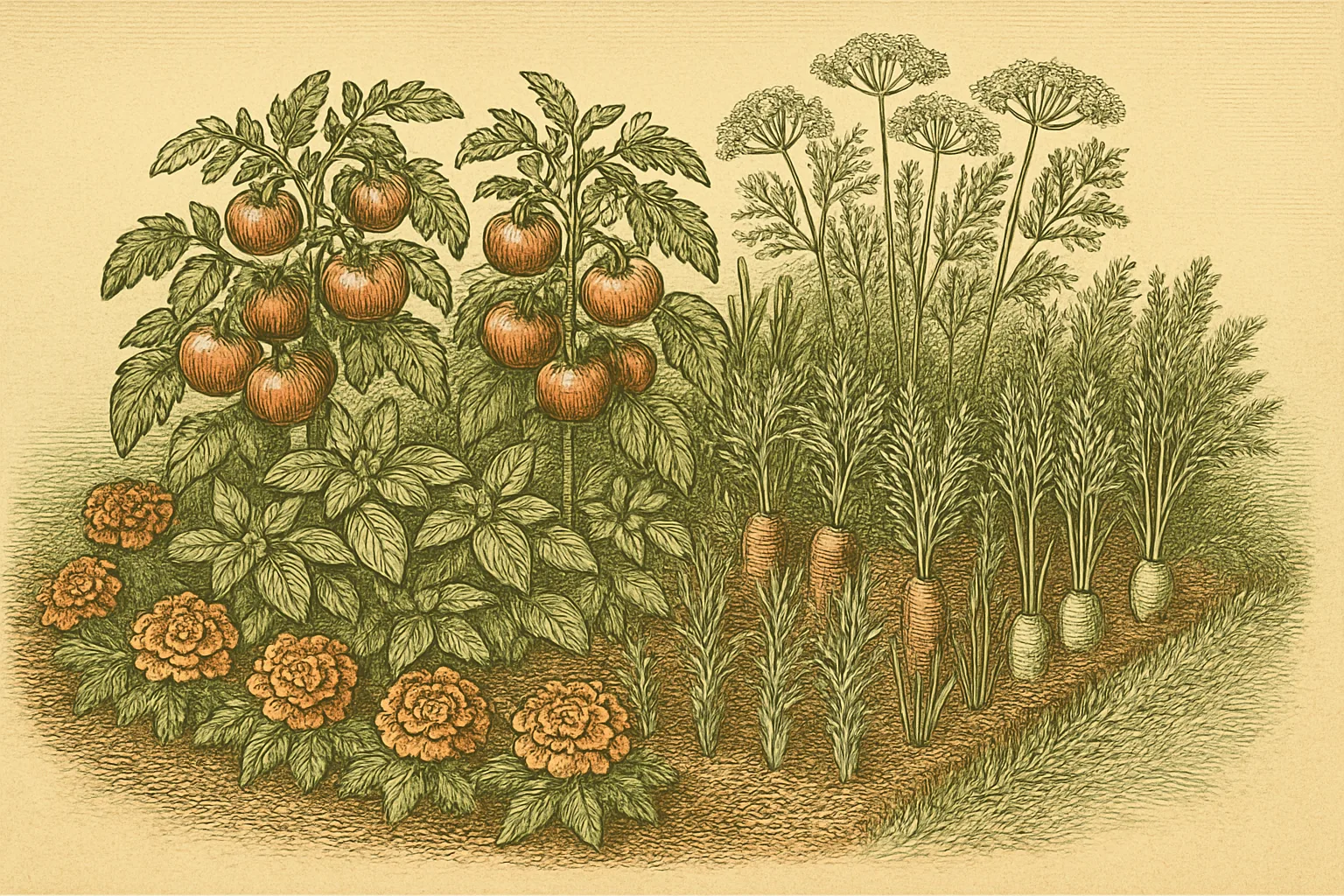
Companion planting is two ideas stapled together. One is real and well-documented. The other is folklore that Google still ranks. This guide keeps them separate.
The real part: plants interact with each other — through their roots, their flowers, their chemistry, and the soil microbes they host. Some pairings measurably improve yields, reduce pest pressure, or suppress disease. The Iroquois Three Sisters. Legumes ahead of heavy feeders. Aromatic herbs that draw parasitic wasps to prey on caterpillars. These are grounded in mechanisms you can read about in peer-reviewed literature.
The folklore part: most of the pairwise claims in popular companion-planting charts — “basil makes tomatoes sweeter,” “marigolds repel all insects,” “nasturtiums improve cucumber flavor” — have never been rigorously tested, and when they have been tested, the effects are usually small or nonexistent. That doesn't mean these pairings are bad. It means the reason they work (when they work) is almost never what the chart says.
The one-sentence version: plant things that share conditions, don't plant things that share pests, and don't bury nightshades next to strawberries.
The 5 Principles That Actually Work
1. Nitrogen fixation: legumes before or alongside heavy feeders
Beans and peas host Rhizobiumbacteria in their root nodules. These bacteria pull atmospheric nitrogen and convert it into forms other plants can use. When a legume crop decomposes (or simply shares soil space), that nitrogen becomes available to neighbors. Heavy nitrogen feeders — corn, brassicas, leafy greens, celery— benefit directly.
This is the mechanism behind the Three Sisters: corn as a trellis, beans fixing nitrogen that corn consumes heavily, squash as living mulch. It is also why crop rotation works. Modern gardeners can get the same benefit by under-sowing clover between rows, or planting a legume cover crop the season before a demanding crop.
2. Pest deterrence through aromatic compounds
Some plants release volatile compounds that mask the scent cues insect pests use to find their hosts. Onions and carrots is the clearest example: onion volatiles disrupt carrot fly navigation. Similarly, garlic near roses has a documented effect on aphid and black spot pressure. Basil shows modest deterrent effects on thrips and whiteflies around tomatoes.
What does notwork reliably: using marigolds to repel every pest in the garden. The effective marigold mechanism is different — see the myths section.
3. Pollinator support: flowering companions within 10–15 feet
Many vegetable crops are pollinator-dependent — notably squash, melons, and cucumbers. Planting flowering companions within 10 to 15 feet dramatically improves fruit set. Good choices include marigolds, cosmos, sunflowers, borage, and any flowering herb you let bolt (cilantro, dill, basil, mint in containers).
The secondary benefit: flowering umbels (dill, cilantro, fennel-family in flower) attract parasitic wasps and hoverflies that prey on aphids, caterpillars, and thrips. This biological control is the single most underrated feature of letting your herbs bolt at the end of the season.
4. Shared soil and moisture needs — the quiet principle
Most successful pairings are not magic. They're plants that simply thrive in the same conditions. Blueberries pair well with rhododendron and azaleas because all three require acidic soil (pH 4.5–5.5). Lavender grows alongside rosemary and sage because they all tolerate drought and sharp drainage.
Inversely, the most common “bad pairing” reason is mismatched needs. Lavender and cilantro both grow well — but not together, because lavender wants it dry and cilantro wants it wet.
5. Avoiding shared families and shared diseases
This is the negative principle, and it is the most important one most home gardeners ignore. Plants in the same botanical family share pests, share pathogens, and deplete the same nutrients. Grouping them together — or rotating into the same bed in successive years — guarantees compounding pest and disease pressure.
The families to know:
- Solanaceae (nightshades): tomatoes, peppers, eggplant, potatoes. Share verticillium wilt, late blight, and Colorado potato beetles.
- Brassicaceae (cabbage family): broccoli, cabbage, kale, Brussels sprouts, cauliflower. Share cabbage worms, aphids, and clubroot.
- Apiaceae (carrot family): carrots, celery, parsnips, dill, cilantro. Share carrot rust flies and fusarium yellows.
- Cucurbitaceae (squash family): cucumbers, zucchini, pumpkins, melons. Share squash bugs, vine borers, and powdery mildew.
- Rosaceae (rose family): strawberries, raspberries, roses, apples. Share verticillium and various fungal rots.
Rotate families as a unit on a 3- to 5-year cycle. Never plant strawberries where nightshades grew in the last 5 years — verticillium persists in soil that long.
Compatibility Chart: Pairings With a Real Mechanism
These are pairings with clear biological or horticultural mechanisms — most traceable to university extension trials or long-standing crop-rotation practice. They are worth implementing.
| Plant | Works With | Why It Works |
|---|---|---|
| Tomatoes | Basil | Similar water and sun needs; basil's flowering phase supports pollinators; field trials show modest thrips and whitefly deterrence. |
| Tomatoes | Marigolds | French marigolds (Tagetes patula) suppress root-knot nematodes when grown the prior season. Use as a rotation crop, not just interplanted. |
| Corn | Beans | Beans fix atmospheric nitrogen via Rhizobium root nodules. Corn is a heavy nitrogen feeder. This pairing is the backbone of the Three Sisters. |
| Broccoli | Dill | Dill's umbel flowers attract parasitic wasps that prey on cabbage worms — one of broccoli's worst pests. |
| Carrots | Onions | Onion scent masks carrot fly olfactory cues. The pairing reduces carrot fly damage in field observations. |
| Blueberries | Strawberries | Both thrive in acidic soil (pH 4.5–5.5). Strawberries act as living ground cover that shades blueberry root zones. |
| Blueberries | Rhododendron | Shared acidic-soil preference (pH 4.5–5.5) and similar mulching needs. |
| Celery | Beans | Celery is a heavy nitrogen consumer. Legumes before or alongside offset feeding demands. |
| Cucumbers | Dill | Dill hosts predatory insects that control cucumber beetles and aphids; both crops share similar watering schedules. |
| Brassicas | Cilantro | Cilantro in flower attracts hoverflies and parasitic wasps that prey on aphids and caterpillars. |
| Roses | Garlic | Garlic's sulfur compounds deter black spot and aphids. Traditional gardens have paired them for centuries; the mechanism has modern support. |
| Squash family | Nasturtium | Acts as a trap crop for squash bugs and aphids, drawing pests away from your actual harvest. |
What NOT to Plant Together
Conflicts matter more than compatibilities. A bad pairing can cost you a crop; a neutral pairing just doesn't help. These are the conflicts with real, documented consequences.
| Don't Pair | With | Reason |
|---|---|---|
| Tomatoes | Potatoes | Both Solanaceae. Share early blight, late blight, and verticillium wilt. Also compete for the same nutrient profile. |
| Carrots | Celery | Both Apiaceae. Share carrot rust flies, carrot weevils, and fusarium yellows. Rotate the entire family together. |
| Strawberries | Nightshades | Nightshades carry verticillium wilt, which persists in soil for up to a decade and kills strawberries. Never plant strawberries where nightshades grew in the last 5 years. |
| Blueberries | Raspberries | Raspberries prefer alkaline soil; blueberries require acidic (pH 4.5–5.5). They also spread aggressively via underground runners. |
| Dill (mature) | Tomatoes | Young dill is fine. Mature dill releases compounds that inhibit tomato growth. Harvest dill before it bolts, or plant far apart. |
| Brassicas | Strawberries | Shared verticillium vulnerability and competing nutrient demands. |
| Fennel | Almost everything | Fennel releases allelopathic compounds that actively suppress nearby plant growth. Grow it in a separate bed. |
| Walnut trees | Blueberries, tomatoes, potatoes | Walnuts emit juglone, toxic to many plants. Maintain a 50-foot buffer from black walnut and English walnut. |
What to Plant With…
Quick reference for the most common “what goes with” questions. Each plant link jumps you to the full companion section on that plant's growing guide.
Tomatoes
Plant with: basil, marigolds, carrots, onions, garlic, borage. Avoid: potatoes, fennel, corn, brassicas, and mature dill. Tomatoes share verticillium with most Rosaceae — keep them away from strawberries and raspberries in rotation.
Blueberries
Plant with: strawberries, rhododendron, azaleas, lavender. Avoid: raspberries, asparagus, tomatoes, peppers. Acidic soil is the dealbreaker — pair only with plants that share pH 4.5–5.5 needs.
Broccoli & Brassicas
Plant with: dill, cilantro, carrots, lettuce, beets. Avoid: tomatoes, peppers, strawberries. Umbel herbs host the predators that control cabbage worms — broccoli's #1 pest.
Strawberries
Plant with: lettuce, spinach, garlic. Avoid: broccoli, eggplant, potatoes, tomatoes, peppers. Never plant where nightshades grew in the last 5 years — verticillium wilt risk.
Celery
Plant with: broccoli, tomatoes, lettuce, spinach, onions, beans, peas. Avoid: carrots. Heavy feeder — legumes offset the nitrogen demand. Keep celery out of the Apiaceae family bed.
Cucumbers
Plant with: dill, beans, corn, lettuce, radishes. Avoid: potatoes, sage. Sage's aromatic oils suppress cucumber growth; keep them well apart.
Cilantro
Plant with: tomatoes, lettuce, peppers, spinach, basil. Avoid: lavender, carrots. Water-loving — keep cilantro away from drought-adapted herbs.
Dill
Plant with: cucumbers, broccoli, lettuce, onions. Avoid (when mature): tomatoes, carrots, peppers. Flowering dill attracts beneficial predators; mature dill suppresses tomatoes.
Mint
Plant with: cucumbers, broccoli, tomatoes, beans, peas. Always plant in containers — mint spreads aggressively via underground runners and will overtake neighbors if given open ground.
Lavender
Plant with: blueberries, hostas, roses. Drought-adapted — pair with plants that tolerate dry conditions and sharp drainage.
Marigolds
Plant with (as cover crop the prior season): cucumbers, broccoli, tomatoes, zucchini, peppers, beans, roses. French marigolds suppress root-knot nematodes — but only when grown to maturity a full season before your target crop.
Carrots
Plant with: onions, lettuce, radishes, garlic, chives, beans, beets, basil. Avoid: celery, cilantro, dill. The carrot-onion pair is the signature of pest-deterrent companion planting — onion volatiles disrupt carrot fly navigation. Keep carrots out of the Apiaceae bed.
Peppers
Plant with: marigolds, carrots, cilantro, radishes, basil. Avoid: strawberries, cucumbers, broccoli, eggplant(shared pests), mature dill. Peppers share verticillium wilt with the rest of the Solanaceae — rotate them as a unit.
Lettuce & Greens
Plant with: strawberries, carrots, radishes, cilantro, celery, beets, garlic, basil, dill. Avoid: broccolifamily. Lettuce is one of the easiest-to-pair crops — its short roots and partial-shade tolerance make it a good understory between taller crops like pole beans or staked tomatoes.
Onions
Plant with: broccoli, carrots, celery, beets, dill. Avoid: asparagus, beans, peas. Onion sulfur compounds inhibit legume root-nodule bacteria — never plant onions in the same bed as nitrogen-fixing crops.
Peas
Plant with: radishes, carrots, spinach, celery, beets, mint. Avoid: garlic, onions, other alliums. Peas fix nitrogen that heavy feeders benefit from next season — pair with leafy greens or brassicas that follow.
Roses
Plant with: garlic, lavender, marigolds, coneflower, hollyhocks, clematis. Avoid: mint, hostas, ferns, impatiens. Garlic deters aphids and black spot; lavender and coneflower feed the pollinators that improve hip set on repeat bloomers.
Potatoes
Plant with: marigolds, cilantro, beans, basil, garlic. Avoid: strawberries, sunflowers, cucumbers, eggplant, tomatoes, peppers. All Solanaceae share late blight and verticillium — never rotate potatoes into ground where other nightshades grew within the last 3 years.
Squash & Zucchini
Plant with: marigolds, cosmos, beans, corn, basil, garlic, nasturtium. Avoid: potatoes, pumpkin, beets. Squash is pollinator-dependent — make sure something in flower is within 15 feet at blossom time.
Asparagus
Plant with: tomatoes, carrots, ferns, rhubarb, basil, dill, parsley. Avoid: blueberries, potatoes, garlic, onions. Tomatoes repel asparagus beetle via solanine release; asparagus ferns deter certain nematodes that attack tomato roots — a rare mutual-benefit pairing.
The Myths: What Companion Planting Can't Do
Myth: Marigolds repel all garden pests.
Reality: French marigolds (Tagetes patula) release alpha-terthienyl from their roots that is genuinely effective against root-knot nematodes — when planted as a full-season cover crop the season before your main crop. Living marigolds interplanted with vegetables during the same season do not meaningfully repel above-ground insects, despite what nearly every companion-planting chart claims. The useful mechanism is belowground and requires seasonal commitment.
Myth: Basil makes tomatoes taste sweeter.
Reality: The flavor claim has never been demonstrated in controlled trials. Planting them together is still a good idea — they share water and light preferences, basil in bloom supports pollinators, and some studies show modest deterrence of thrips and whiteflies. But the tomatoes themselves taste the same.
Myth: The Three Sisters is a general template for any polyculture.
Reality: The Three Sisters works because of the specific complementary needs of corn, beans, and squash — vertical support, nitrogen fixation, and ground cover. Swapping in different plants doesn't automatically produce the same synergy. A genuine polyculture requires matching specific plant roles, not just planting three things together.
Myth: Fennel is a good companion for most vegetables.
Reality: Fennel is allelopathic— it releases compounds that actively suppress nearby plant growth. Grow it in its own bed or in a container. Do not put it in a shared vegetable bed.
Myth: Companion planting replaces crop rotation.
Reality: It doesn't. Even perfectly paired companions will build up soil-borne pathogens and pest populations if you plant the same family in the same ground year after year. Companion planting is a complement to rotation, not a substitute for it.
References
This guide synthesizes research from university cooperative extension services and peer-reviewed horticultural literature. Primary sources:
- University of Minnesota Extension — Companion Planting
- Oregon State Extension — Companion Planting
- Clemson Cooperative Extension — Companion Planting
- Penn State Extension — Companion Planting
- NC State Extension — Companion Planting
- Iowa State Extension — Companion Planting in the Vegetable Garden
- Michigan State Extension — The Three Sisters
Frequently Asked Questions
Does companion planting actually work?
Some pairings are backed by research — nitrogen fixation by legumes, pollinator attraction by flowering herbs, pest deterrence by aromatic plants, and avoiding shared pest and disease families. Most of the specific pair-wise folklore (e.g., basil makes tomatoes taste sweeter) has never been rigorously tested, and most claims don't hold up in controlled trials. Focus on the mechanism, not the folklore.
What is the single most effective companion pairing?
Planting legumes (beans, peas) before or alongside heavy nitrogen feeders (corn, squash, brassicas, leafy greens). Legume roots host Rhizobium bacteria that fix atmospheric nitrogen into the soil. The effect is measurable and well-documented. This is the foundation of the Iroquois Three Sisters planting and of crop rotation science generally.
What plants should never be grown together?
Avoid planting members of the same botanical family together or in succession — they share pests and soil-borne diseases. Examples: carrots and celery (both Apiaceae), tomatoes and potatoes (both Solanaceae), broccoli and cabbage (both Brassicaceae). Also avoid mismatched soil pH needs, like acid-loving blueberries next to alkaline-preferring raspberries.
Are marigolds effective against all pests?
No. Marigold folklore oversells their effect. Research shows French marigolds (Tagetes patula) release alpha-terthienyl from their roots that suppresses root-knot nematodes when grown as a cover crop the season before planting. Living marigolds interplanted with vegetables do not repel most above-ground insects despite widespread claims.
Is the Three Sisters planting a real companion planting method?
Yes, and it is one of the few pre-scientific companion systems with solid mechanistic support. Corn provides a trellis for pole beans, beans fix nitrogen that corn and squash consume heavily, and squash vines cover soil to suppress weeds and retain moisture. It is a genuine polyculture with complementary resource use.
Do tomatoes and basil really grow better together?
The flavor-enhancement claim is folklore with no controlled evidence. However, there are real reasons to interplant: basil is a pollinator attractor when it flowers, takes up similar water and sun conditions, and some research shows it may deter thrips and whiteflies. Plant them together because they grow well in the same conditions, not because basil sweetens tomatoes.
How far apart should companion plants be spaced?
Close enough that they interact — usually 12 to 24 inches apart for vegetables — but not so close that they compete for light, water, or nutrients. Pollinator attractors should be within 10 to 15 feet of the crops they support. Avoid planting tall companions on the south side of sun-loving vegetables where they'll cast shade.